Secret Service agents stand guard as Former President Donald Trump sits for a deposition at the office of the NYS Attorney General on August 10, 2022 in New York City. A top Secret Service official who previously served in a political position in the Trump White House left the agency Monday for a job in the private sector.
Michael M. Santiago | Getty Images News | Getty Images
A top Secret Service official who served in a political position in the Trump White House left the agency Monday for a job in the private sector.
Tony Ornato, who was an assistant director at the Secret Service, said his departure was planned more than a year ago, before explosive congressional testimony this summer about former President Donald Trump's actions on Jan. 6.
"I did retire today to pursue a career in the private sector," Ornato told NBC News. "I retired from the U.S. Secret Service after more than 25 years of faithful service to my country, including serving the past five presidents. I long-planned to retire and have been planning this transition for more than a year."
Secret Service Special Agent Kevin Helgert said Ornato retired "in good standing."
Ornato led Trump's protective detail and made the unusual move to a political position as the White House deputy chief of staff for operations in 2019 before he returned to the Secret Service to help oversee its office of training.
Ornato became a key figure in the House Jan. 6 committee's investigation into the insurrection when former White House aide Cassidy Hutchinson testified at a public hearing that Ornato had described to her an incident inside the armored SUV carrying Trump on Jan. 6, 2021. Hutchinson said Ornato described Trump's lunging at the driver and insisting they go to the Capitol, where his supporters were gathering. Hutchinson's account has been disputed by some people familiar with the matter.
His departure from the Secret Services comes amid other high-level changes at the agency. James Murray announced his retirement as director last month, before the congressional uproar over missing Secret Service text messages from Jan. 6 became public. President Joe Biden last week appointed Kim Cheatle as Murray's successor.
CNBC Politics
Read more of CNBC's politics coverage:
Rep. Adam Kinzinger, R-Ill., a member of the Jan. 6 committee, said in an interview Sunday on NBC News' "Meet the Press" that the panel was looking into the missing text messages and would likely be able "to get answers to that" by the time it restarts public hearings next month.
Ornato has already testified to the House panel behind closed doors, according to an aide.
Text messages for former President Donald Trump’s acting Homeland Security Secretary Chad Wolf and acting deputy secretary Ken Cuccinelli are missing for a key period leading up to the Jan. 6 attack on the Capitol, according to four people briefed on the matter and internal emails.
This discovery of missing records for the senior-most homeland security officials, which has not been previously reported, increases the volume of potential evidence that has vanished regardingthe time around the Capitol attack.
It comes as both congressional and criminal investigators at the Department of Justice seek to piece together an effort by the president and his allies to overturn the results of the election, which culminated in a pro-Trump rally that became a violent riot in the halls of Congress.
The Department of Homeland Security notified the agency’s inspector general in late February that Wolf’'s and Cuccinelli’s texts were lost in a “reset” of their government phones when they left their jobs in January 2021 in preparation for the new Biden administration, according to an internal record obtained by the Project on Government Oversight and shared with The Washington Post.
The office of the department’s undersecretary of management also told the government watchdog that the text messages for its boss, undersecretary Randolph “Tex” Alles, the former Secret Service director, were also no longer available due to a previously planned phone reset.
The office of Inspector General Joseph V. Cuffari did not press the department leadership at that time to explain why they did not preserve these records, nor seek ways to recover the lost data, according to the four people briefed on the watchdog’s actions. Cuffari also failed to alert Congress to the potential destruction of government records.
The revelation comes on the heels of the discovery that text messages of Secret Service agents — critical firsthand witnesses to the events leading up to Jan. 6 — were deleted more than a year ago and may never be recovered.
The news of their missing records set off a firestorm because the texts could have corroborated the account of a former White House aide describing the president’s state of mind on January 6. In one case, the aide, Cassidy Hutchinson said a top official told her that Trump had tried to attack a senior Secret Service agent who refused to take the president to the Capitol with his supporters marching there.
In a nearly identical scenario to that of the DHS leaders’ texts, the Secret Service alerted Cuffari’s office seven months ago, in December 2021, that the agency had deleted thousands of agents’ and employees’ text messages in an agency-wide reset of government phones. Cuffari’s office did not notify Congress until mid-July, despite multiple congressional committees’ pending requests for these records.
The telephone and text communications of Wolf and Cuccinelli in the days leading up to Jan. 6 could have shed considerable light on Trump’s actions and plans. In the weeks before the attack on the Capitol, Trump had been pressuring both men to help him claim the 2020 election results were rigged and even to seize voting machines in key swing states to try to “re-run” the election.
“It is extremely troubling that the issue of deleted text messages related to the January 6 attack on the Capitol is not limited to the Secret Service, but also includes Chad Wolf and Ken Cuccinelli, who were running DHS at the time,” House Homeland Security Committee Chairman Bennie G. Thompson said in a statement.
“It appears the DHS Inspector General has known about these deleted texts for months but failed to notify Congress,” Thompson said. “If the Inspector General had informed Congress, we may have been able to get better records from Senior administration officials regarding one of the most tragic days in our democracy’s history.”
Neither Cuccinelli nor Wolf responded to requests for comment. DHS’s Office of Inspector General did not immediately respond to requests for comment.
The discovery of missing records for the top officials running the Department of Homeland Security during the final days of the Trump administration raises new questions about what could have been learned, and also about what other text messages and evidence the department and other agencies may have erased, in apparent violation of the Federal Records Act.
Wolf and Cuccinelli had remained at DHS as Trump openly challenged the 2020 election results, even though the agency led efforts to help state and local governments safeguard the integrity of the election results.
Starting in late December, numerous DHS intelligence units across the country were warning of extremely worrisome chatter in white nationalist and pro-Trump social media platforms that were promoting coming armed to Trump’s Jan. 6 rally and using violence to block Biden from becoming president.
In late December, Trump railed in a Cabinet meeting that his secretaries were failing to properly help him investigate fraud that had corruptly “given” the election to Joe Biden, but cited unsubstantiated claims. Trump firedChristopher Krebs, the former director of the Cybersecurity and Infrastructure Security Agency, in a tweetafter Krebs countered Trump’s claims of widespread election fraud, and complained that Wolf should have moved faster to force Krebs out.
On New Year’s Eve of 2020, Trump also called Cuccinelli to pressure him to seize voting machines in swing states and help him block the peaceful transfer of power. Trump falsely told him that the acting attorney general had just said that it was Cuccinelli’s job to seize voting machines “and you’re not doing your job.”
Cuccinelli was in Washington on the day of the attack and toured the Capitol that night to survey the damage. Wolf was on an official trip to the Middle East.
After the Capitol attack, several lawmakers called for hearings into why DHS had failed to anticipate the threat Trump supporters posed to Congress on the day lawmakers and Vice President Mike Pence planned to certify the election results.
Wolf had resigned five days after the attack on the Capitol, and cited “recent events” as well as legal rulings questioning his legitimacy to continue leading the department as an acting secretary for 14 months.
“Effective 11:59 p.m. today, I am stepping down as your Acting Secretary,” Wolf wrote in a message to the department. “I am saddened to take this step, as it was my intention to serve the Department until the end of this Administration.”
In an interview days later with CNN’s Wolf Blitzer, the departing acting secretary said Trump bore some responsibility for the events of Jan. 6.
“I was disappointed that the President didn’t speak out sooner on that. I think he had a role to do that. I think, unfortunately, the administration lost a little bit of the moral high ground on this issue by not coming out sooner on it,” he said of Trump not swiftly condemning the violence.
A Government Accountability Office report in 2020 found that Wolf and Cuccinelli were ineligible to serve in their positions because their appointments had not followed the proper order of succession, an issue the GAO referred to the DHS Office of Inspector General.
Unlike Trump, Wolf did not dispute the election results and said DHS was preparing for the “orderly and smooth transition to President-elect Biden’s DHS team.”
“Welcome them, educate them, and learn from them,” Wolf said then. “They are your leaders for the next four years — a time which undoubtedly will be full of challenges and opportunities to show the American public the value of DHS and why it is worth the investment.”
Wolf had emerged as Trump’s favorite DHS Secretary, the president’s fourth pick for the job in just four years in office. Trump had promoted his first secretary John Kelly to be his White House chief of staff, then pushed Kelly out of that job for not complying with his orders. He had fired Kelly’s successor Kirstjen Nielsen for balking at some of Trump’s demands for how to handle migrants crossing the border which Nielsen knew were illegal.
The third secretary, Nielsen’s successor Kevin McAleenan, grew frustrated by the way Trump tried to politicize the department during his reelection effort departed after just seven months. Then Trump named Wolf as his acting secretary, and found the fourth time was a charm. Wolf repeatedly touted Trump’s immigration record as stellar and also deployed department personnel to tamp down Black Lives Matter protesters in Portland, to help promote Trump’s law-and-order message to voters.
Trump had appointed Cuccinelli to key DHS roles after seeing him defend his immigration agenda on television.
Trump allies still believe Wolf served him well. Wolf is among those mentioned this month in an Axios article as someone whom Trump could ask to return to government service if Trump successfully runs for president in 2024.
A West Virginia man charged in the Jan. 6 assault of Capitol Police officer Brian Sicknick pleaded guilty Wednesday to two misdemeanor charges.
George Tanios was arrested two months after the Jan. 6 attack, along with Julian Khater, who investigators identified in videos as having deployed bear spray against three officers outside of the Capitol, including Sicknick.
Sicknick died the day after the riot of natural causes after suffering at least two strokes, according to the Washington, D.C., medical examiner's office.
Tanios pleaded guilty Wednesday to entering and remaining on restricted grounds, and disorderly and disruptive conduct on restricted grounds.
Khater has pleaded not guilty to multiple felony charges stemming from the alleged assault, and is set to go on trial in October.
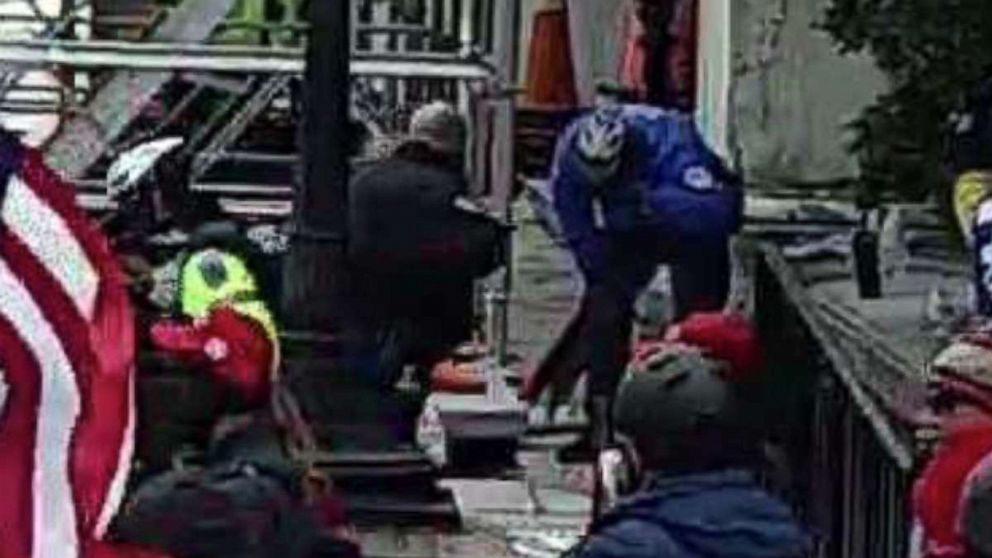
In an image included in an affidavit, the man in the blue coat and bike helmet has been identified by a source as Capitol Police officer Brian Sicknick, as he reacts to an irritant being sprayed in his face at the Capitol, Jan. 6. 2021.
FBI
Prosecutors said in Wednesday's hearing they have also extended a plea offer to Khater and they continue to negotiate with his counsel, but they warned that the offer will expire by Aug. 17.
Khater could face between 78 and 97 months behind bars as part of his sentence if he were to accept the plea deal of two counts of felony assaults on officers, prosecutors said.
That amount would be more than a year longer than the two harshest sentences given to any Capitol rioters thus far.
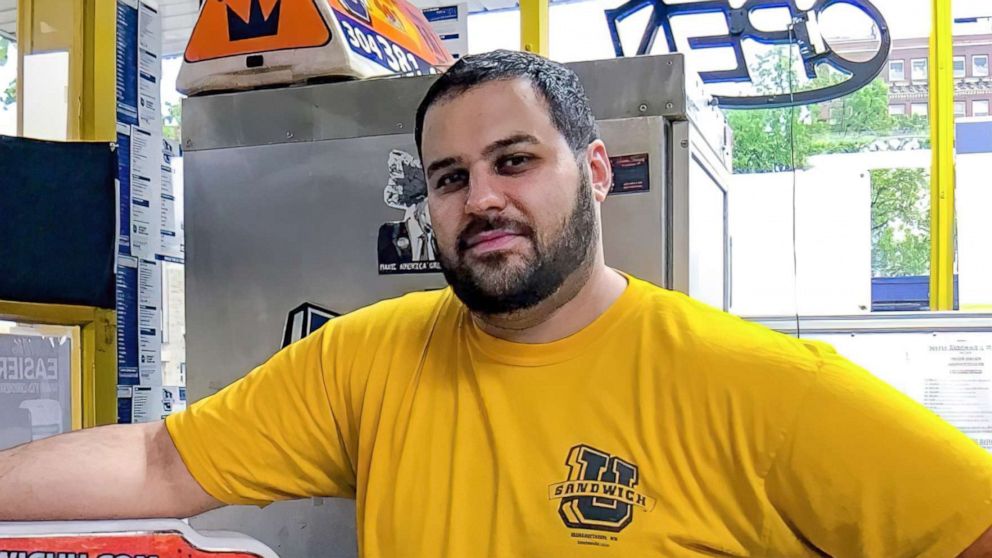
George Tanios at his sandwich shop in Morgantown, W.Va.
Andrew Spellman/The Daily Athenaeum via AP
As part of his plea deal with prosecutors, Tanios faces a potential range of 0-6 months behind bars, though he has already served five months in pre-trial detention following his arrest, for which he would receive credit.
In their original affidavit against Khater and Tanios, investigators cited open source videos that they said showed Khater at one point telling Tanios "Give me that bear s---" before reaching into a backpack Tanios was wearing.
Tanios then responded, "Hold on, hold on, not yet, not yet ... it's still early."
"This verbal exchange between Khater and Tanios, together with Khater's retrieval of the spray can from Tanios, reveals that the two were working in concert and had a plan to use the toxic spray against law enforcement," the charging documents said.