Republican Liz Cheney says she will "be very focused on working to ensure that we do everything we can not to elect election deniers," after earlier promising to keep Donald Trump out of office.
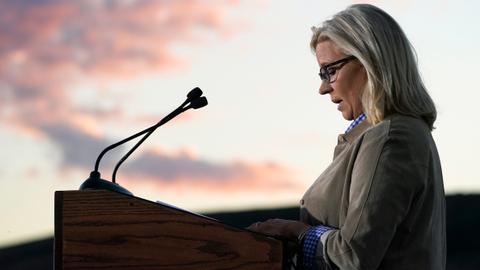
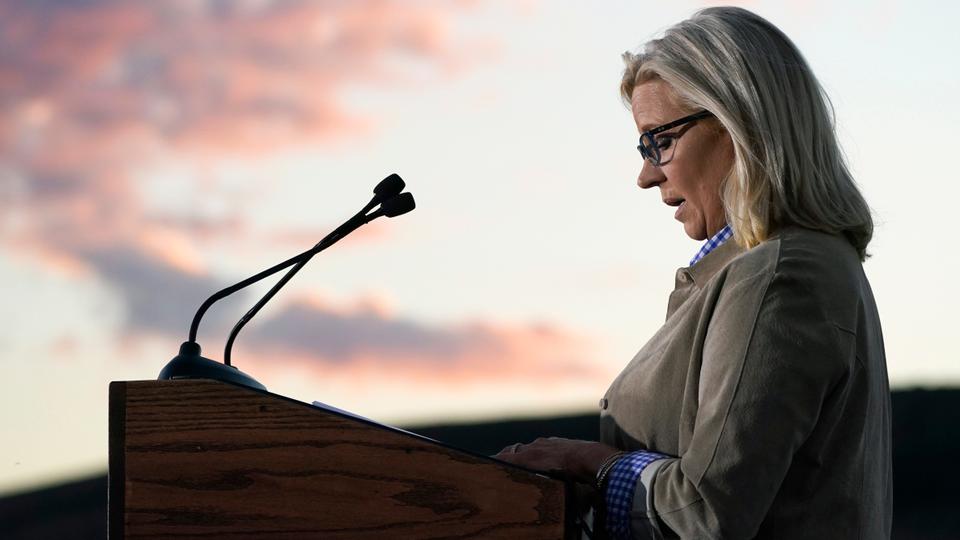
Republican Liz Cheney, US Representative from Wyoming, speaks at a primary Election Day gathering on August 16, 2022, after losing to Republican opponent Harriet Hageman in the primary.
(Jae C. Hong / AP)
US Representative Liz Cheney has vowed to oppose Republican candidates who back former President Donald Trump's falsehood about a stolen 2020 election.
Cheney told ABC's "This Week" on Sunday that Senators Ted Cruz and Josh Hawley were "unfit" for office after they voted to overturn the presidential results.
Cheney, who is Trump's leading critic and vice chair of the congressional committee investigating the January 6, 2021, attack on the US Capitol by his supporters, said that a broad movement of election denial could undermine the US constitutional order if left unchecked.
The daughter of former vice president Dick Cheney has already said she will spend the next two years trying to stop Trump from returning to the White House in 2024, possibly with her own presidential bid. She declined to tell ABC whether she would run inside or outside the Republican Party, should she decide to make a presidential bid.
"I'm going to be very focused on working to ensure that we do everything we can not to elect election deniers," Cheney said in an interview recorded last week, days after she lost her Republican primary race to a Trump-backed candidate.
READ MORE:Cheney vows to do 'whatever it takes' to deny Trump second term
[embed]https://www.youtube.com/watch?v=2aSJccrT7dg[/embed]
Risk of election deniers in power
"We've got election deniers that have been nominated for really important positions all across the country. And I'm going to work against those people. I'm going to work to support their opponents."
Cheney did not say which Republican candidates she would oppose but acknowledged that they would include some of her fellow Republicans in the House of Representatives.
Republicans are favoured to take control of the House but could face a bigger challenge capturing a Senate majority in the November 8 midterm elections, which will determine the balance of power in Congress for the next two years.
As one of two Republicans on the House January 6 committee, Cheney has been able to draw a direct connection between the deadly melee and Trump's repeated false claims that he won the 2020 election against President Joe Biden.
"Donald Trump is certainly the centre of the threat," Cheney said. "What he's created is a movement on some level that is post-truth."
The January 6 assault forced Congress to temporarily suspend its certification of Trump's loss to Biden, during which Hawley, Cruz and other Republican members of Congress voted against certification of election results.
[embed]https://www.youtube.com/watch?v=XwIdKH3ijaU[/embed]
Cheney said the actions of Hawley, Cruz and other Republican lawmakers "fundamentally threatened the constitutional order and structure" and concluded that "they both have made themselves unfit for future office."
A Cruz spokesperson responded with a statement saying the senator does not want or need Cheney's endorsement.
Hawley's office was not immediately available for comment. Neither Cruz nor Hawley is up for re-election in November.
She also criticised Florida Governor Ron DeSantis for campaigning on behalf of election deniers, including Republican gubernatorial candidates Kari Lake of Arizona and Doug Mastriano of Pennsylvania.
"That is something that I think people have got to have real pause about. You know, either you fundamentally believe in and will support our constitutional structure, or you don't," Cheney said.
The DeSantis campaign was not immediately available for comment.
Cheney's re-election loss in Wyoming last week was widely seen as a victory for Trump's revenge campaign against Republicans who voted to impeach him. She told ABC she heard from Biden afterwards: "We had a very good talk, a talk about the importance of putting the country ahead of partisanship."
READ MORE:Why Trump could run as an independent in 2024
Source: Reuters
Liz Truss and Rishi Sunak who want to replace PM Boris Johnson says they want more focus on the Scottish government's record on health and education.
Scotland
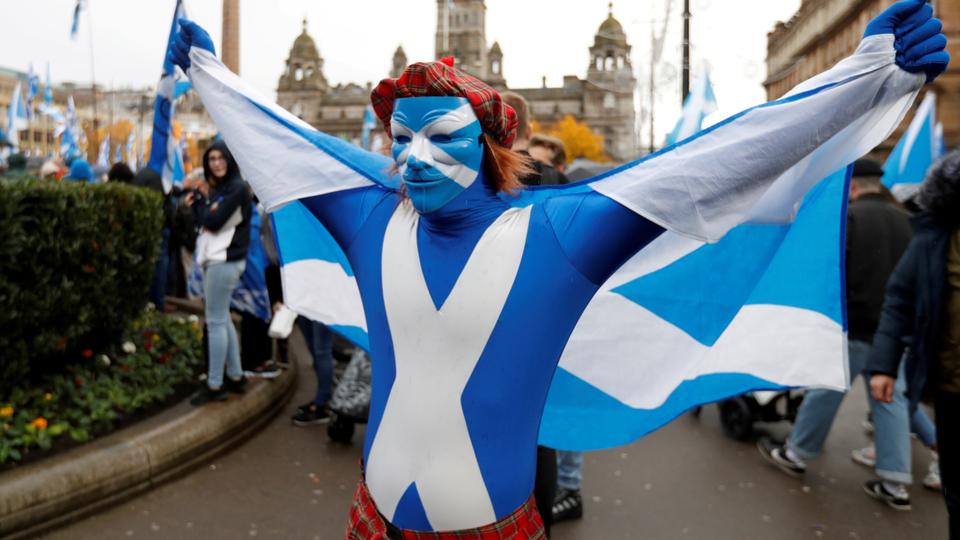
(A demonstrator holds a flag during a pro-Scottish Independence rally in Glasgow, Scotland, November 2, 2019. / Reuters)
The two candidates battling to be
Britain's next prime minister will vie to present themselves as
defenders of Scotland's place in the United Kingdom by promising more scrutiny of Scotland's government to undermine
a new push for independence.
Liz Truss, the foreign minister, and Rishi Sunak, the former finance minister, who are competing to replace Prime Minister Boris Johnson, set out their policies for Scotland before the only election hustings in the country on Tuesday.
Both candidates want more focus on the Scottish government's record on health and education.
Scotland has the highest drug deaths in Europe and two-thirds of the population is either obese or overweight, while a report last year said its education system is the weakest performing in the United Kingdom.
The Scottish National Party, which heads Scotland's
semi-autonomous government, wants to hold a second independence
referendum next year, which could rip apart the world's
fifth-biggest economy.
The bonds holding together the four countries that make up
the United Kingdom — England, Scotland, Wales and Northern
Ireland — have been severely strained over the last six years by
Brexit and the government's handling of the pandemic.
Liz Truss promised to give parliamentary privilege to members of
the Scottish parliament to allow more scrutiny of the
government, and said she would push to sign a trade deal with
India to end longstanding 150 percent tariffs on Scotch Whisky, the
country's biggest single product export.
"I'll make sure that my government does everything to ensure
elected representatives hold the devolved administration to
account," she said.
"As a nation we are stronger together and
the UK needs Scotland as much as Scotland needs the UK."
Voters in Scotland, which has a population of around 5.5
million, rejected independence in 2014. But Scotland's
government says Britain's departure from the European Union,
which was opposed by a majority of Scots, means the question
must be put to a second vote.
Sunak said that if he becomes prime minister, he will order
senior Scottish government officials to attend annual British
parliament committee hearings.
"For too long the SNP has been able to obscure its failures by picking and choosing the data it publishes - I would change that, ensuring the Scottish government’s record could be held to account," he said.