In an interview with IRNA, Kobri Rafiei said that in the next 24 hours, we will witness torrential rains in the north and east of Khuzestan, south of Lorestan, northwest of Chaharmahal and Bakhtiari, east and north of Sistan and Baluchistan.
He added: "Tomorrow (Saturday) torrential rains are predicted for the north and east of Khuzestan, west of Chaharmahal and Bakhtiari, east and south of Sistan and Baluchistan and east of Hormozgan."
An expert of the Meteorological Organization emphasized: On Sunday, rain is predicted for the heights of Tehran, Alborz, Mazandaran and East Khuzestan provinces, and there will also be dust rising in some areas.
Rafiee clarified: During the next five days in the north of Sistan and Baluchistan, South Khorasan, the southern half of Razavi Khorasan and the east of Yazd province, temporary strong winds and dust rising will be the dominant phenomenon. The same conditions will occur for the next 2 days in the southwest of the country in provinces such as Ilam and Kermanshah.
He said that the southern waters of the country, especially the eastern waters of the Oman Sea, will be turbulent and rough today, and added: Today, a clear sky with wind is predicted for Tehran, and the maximum temperature will reach 34 degrees above zero and tomorrow it will reach 33 degrees above zero. The minimum temperature today in Mehrabad station of Tehran will reach 23 degrees above zero.
The expert of the Meteorological Organization pointed out: Shahrekord with a temperature of 8 degrees above zero, Ardabil with a temperature of 9 degrees above zero, Zanjan with a temperature of 11 degrees above zero today, and the hottest center of the province was Ahvaz with a maximum of 48 degrees above zero.
The Georgian government called Sunday on its “brothers” in its breakaway regions of Abkhazia and South Ossetia to work with it to build a single, peaceful democratic state.
In a statement marking the 30th anniversary of the start of the Abkhazia war, Prime Minister Irakli Garibashvili said his government is in favor of a peaceful solution to the country’s longstanding problems with territorial integrity.
“I firmly believe that our peace policy, oriented towards mutual respect and dialogue, brings closer the day when we, together with our Abkhaz and Ossetian brothers, will continue to build a single, strong, peace-loving, democratic state that will create all the conditions for maintaining and strengthening the security, well-being and identity of every citizen,” said Garibashvili.
“The most dramatic event in our recent history, the confrontation between brothers, brought unjustified destruction, turned hundreds of thousands of people into refugees in their own homeland, and, the saddest thing, claimed the lives of many of our fellow citizens on both sides – soldiers and civilians,” he added.
A 13-month conflict erupted in August 1992 between the Georgian army and Abkhazian separatists supported by Russia.
In 2008, a five-day conflict referred to as the South Ossetia conflict broke out between Georgia and Russia over the breakaway regions of South Ossetia and Abkhazia.
Tbilisi ultimately lost control of both areas and Russia later recognized them as independent states.
In response, Georgia cut off diplomatic relations with Russia, after which Switzerland took up the role of mediator country.
Both regions remain internationally recognized Georgian territories.
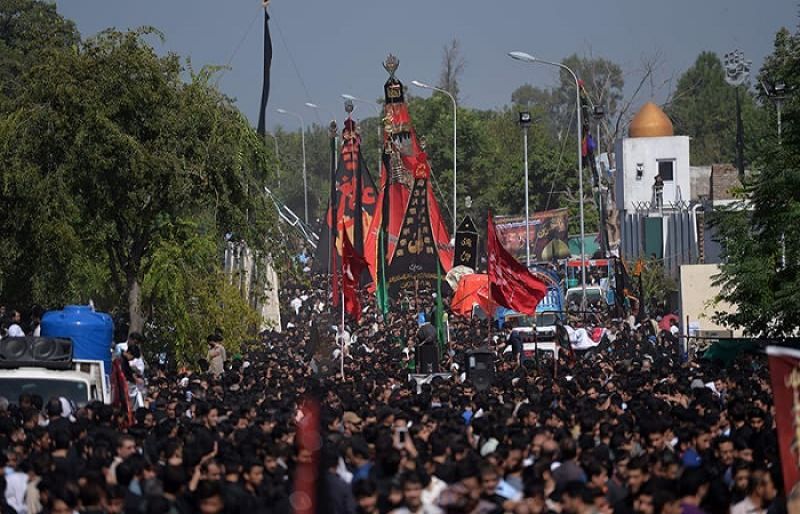
Mourners across the country took out processions on Tuesday to observe Yaum-i-Ashura amid tight security arrangements and with cellular services suspended in several areas.
Yaum-i-Ashura is observed every year on Muharram 10 with solemnity to pay homage to Imam Hussain and other martyrs of Karbala.
Strict security measures were taken to ensure the safe passage of processions in the major cities. Mobile phone services had remained suspended for the third consecutive day as part of the security measures, however, they started reopening after 6pm.
Later in the evening, Interior Minister Rana Sanaullah, in a press conference, said that not a single untoward incident had occurred during the first 10 days of Muharram.
He lauded the security institutions for playing a "seminal role for ensuring peace during the mourning processions and majalis".
Separately, Prime Minister Shehbaz Sharif also congratulated Sanaullah and all the security forces for protecting the lives and property of the people during the last three days.
"This day has been completed peacefully due to your team work," he said in a statement issued by the PM
The main procession in Karachi, which was taken out from Nishtar Park at 9:00am, culminated at Hussainian Iranian Imambargah after passing along MA Jinnah Road, according to a press release issued by traffic police.
During the course of this journey, mourners covered Sir Shahnawaz Bhutto Road, Mehfil-i-Shah-i-Khorasan, MA Jinnah Road, Mansfield street, Preedy street and Bolton Market.
In Karachi and other major cities of Sindh, more than 55,000 police and Rangers personnel have been deployed for the security of mourning processions and mobile phone and internet services are to remain suspended under a comprehensive security plan for Ashura.
After the processions culminated, Chief Minister Sindh Syed Murad Ali Shah, in a statement available with Dawn.com, lauded the police, Rangers and other law enforcement agencies for successfully fulfilling their responsibilities.
He also thanked the doctors and paramedic staff for providing their services to the participants of the processions.
Mourners participate in the procession on the tenth day of Ashura during the Islamic month of Muharram, in Hyderabad on August 9, 2022. — AFP/File
KARACHI: ‘Youm-e-Ashur’, the martyrdom day of Hazrat Imam Hussain (AS), his family and devoted companions, was commemorated across the country today (Tuesday).
The mourning processions were taken out in all the cities and towns of the country as Muslims were performing rituals to mark the Ashura.
Muharram is the month of mourning for the seventh-century martyrdom of Hazrat Imam Hussain (RA), the grandson of the last Prophet Hazrat Muhammad (SAW).
Interior Minister Rana Sanaullah announced that during Muharram procession, no untoward incidents were reported from anywhere across the country.
He revealed that since Muharram 1st till 9th, more than 6,000 Majalis were held amid tight security of 6,150 rangers’ personnel.
Strict security measures were ensured by the local management of different cities and some road closures were also in place to avoid any untoward incidents.
Law enforcers, including police, Rangers, FC and others were deployed along the procession routes. Meanwhile, mobile phone services were partially suspended as a security measure in different cities.
Procession in Karachi
The main procession was taken out from Nishtar Park after Majalis in the morning.
After passing through its traditional route, the procession concluded at Imam Bargah-e-Hussainan Iraniaan Kharadar in the evening.
Provincial Minister for Information Sharjeel Inam Memon and Minister for Labour Saeed Ghani visited the central control room, established to monitor the processions.
Procession in Lahore
In Lahore, the main mourning procession was taken out from Nisar Haveli at Mochi Gate, which after passing through its traditional route culminated at Karbala Gaamay Shah, where Shaam-e-Ghareeban will be held.
Overall 170 processions and 130 majalis were arranged in Multan district. The main procession was taken out from Imam Bargah Heera Haidri in the morning which reached Ghanta Ghar in the evening after passing its traditional route.
Procession in Rawalpindi
The main Alam and Zuljinah procession was taken out from Imambargah Colonel Maqbool Hussain which culminated at Imambargah Qadeemi while passing through the designated routes.
Besides, different processions emerged from various parts of the city and merged into the main procession.
Main points of Rawalpindi from where processions were taken out include Imam Bargah Teli Mohalla, Imam Bargah Hifazat Ali Shah Bohar Bazar, Imam Bargah Darbar Sakhi Shah Chann Chiragh and Yadgar e Hussain Satelite Town.
Elaborate security arrangements were made to avoid any untoward incident during the mourning processions.
Over 6,000 security officials were deployed to ensure security.
Procession in Peshawar
In Peshawar, the main Alam, Tazia and Zuljinah procession was taken out from Imam Bargah Agha Syed Ali Shah Qissa Khwani Bazaar this afternoon. Eleven other processions were also taken out from different Imam Bargahs which joined the main procession.
Similar processions of Tazia, Alam and Zuljinah were also taken out in Kohat, Khyber, Bannu, Hangu, Lakki Marwat, Kurram and Dera Ismail Khan districts.
Procession in Quetta
The main mourning procession of Alam, Tazia and Zuljanah was taken out from Nichari Imambargah at Alamdar Road this morning, which culminated at the same place in the evening after passing through its traditional routes.
'Islam is alive because of sacrifices of Imam Hussain (RA)'
Earlier, in his message on the occasion of Youm-e-Ashur, Prime Minister Shehbaz Sharif said Islam is alive because of the sacrifices of Hazrat Imam Hussain (RA) and his companions and these sacrifices give courage and hope to the faithful in the face of difficulties and challenges.
He said this day reminds of the unparalleled struggle between good and evil, when a group led by Hazrat Imam Hussain (RA) refused to show allegiance to evil and stood before a seemingly powerful faction.
Hazrat Imam Hussain (RA) became a symbol of courage, determination and bravery.
The prime minister said on the 9th and 10th of Muharram, the family of Hazrat Imam Hussain (RA) and his loyal companions despite a lack of resources challenged the forces of oppression and tyranny and made Islam alive with the sacrifice of their lives.
He said the martyrdom of Hazrat Imam Hussain (RA) is an important lesson for the Muslim Ummah.
The premier said we should all make the philosophy of sacrifice the beacon of light for us and face all kinds of challenges with bravery and steadfastness for the success of truth and virtue.
He said the country is going through a critical time which made it all the more important to act with courage and righteousness. He said we have to display patience, courage and solidarity to take the country out of the present difficulties.
Mexico, or large parts of it, is running out of water.
An extreme drought has seen taps run dry across the country, with nearly two-thirds of all municipalities facing a water shortage that is forcing people in some places to line up for hours for government water deliveries.
The lack of water has grown so extreme that irate residents block highways and kidnap municipal workers to demand more supply.
The numbers underlining the crisis are startling: In July, eight of Mexico’s 32 states were experiencing extreme to moderate drought, resulting in 1,546 of the country’s 2,463 municipalities confronting water shortages, according to the National Water Commission.
By mid-July, about 48 percent of Mexico’s territory was suffering drought, according to the commission, compared with about 28 percent of the country’s territory during the same period last year.
While tying a single drought to human-caused climate change requires analysis, scientists have no doubt that global warming can alter rainfall patterns around the world and is increasing the likelihood of droughts.
Across the border in recent years, most of the Western half of the United States has been in drought, with conditions ranging from moderate to severe.For the region, this period is now the driest two decades in 1,200 years.
The crisis is particularly acute in Monterrey, one of Mexico’s most important economic hubs and where the entire metropolitan area of about five million people is affected by drought, according to officials. Some neighborhoods in Monterrey have been without water for 75 days, leading many schools to close before the scheduled summer break.
The situation in the city has gotten so dire, a visiting journalist could not find any drinking water for sale at several stores, including a Walmart.
Buckets, too, are scarce at local stores — or being sold at astronomically high prices — as Monterrey’s residents scrape together containers to collect water supplied by government trucks sent to the driest neighborhoods. Some residents clean out trash cans to ferry water home, children struggling to help carry what can amount to 450 pounds of water.
While Monterrey’s poorest neighborhoods are the hardest hit, the crisis is affecting everyone, including the wealthy.
“Here you have to chase the water,” said Claudia Muñiz, 38, whose household is often without running water for up to a week. “In a moment of desperation, people explode,” she said about the violence that has flared as people fight over what water there is.
Monterrey is in northern Mexico, the most parched region of the country, which has seen its population grow in recent years as the economy boomed. But the area’s typically arid weather is struggling to support the population as climate change reduces what little rainfall the region has.
Monterrey’s residents can now walk across the floor of the reservoir that was created by the Cerro Prieto dam and that was once one of the city’s largest sources of water. The reservoir also used to be a major tourist attraction that the local government marketed for its lively waterfront restaurants and its fishing, boating and water-skiing.
Now Cerro Prieto is mostly popular because of the coins buried at the bottom of the reservoir that bakes under the sun. Residents swipe metal detectors across exposed rock and scrub, filling pouches with peso coins once tossed in by visitors as they made a wish.
Along with the Cerro Prieto reservoir, a seven-year drought —interrupted only by strong rains in 2018, according to a local official — has also dried up water along two other dams that provide most of Monterrey’s water supply. One dam reached 15 percent of its capacity this year, while the other reached 42 percent. The rest of the city’s water comes from aquifers, many of which are also running low.
The amount of rain in July in parts of the state of Nuevo León, which borders Texas and whose capital is Monterrey, was just 10 percent of the monthly average recorded since 1960, according to Juan Ignacio Barragán Villarreal, the general director of the city’s water agency.
“In March it did not rain a single drop in the entire state,’’ he said, adding that it was the first rain-free March since the government started keeping records in 1960.
Today, the government distributes a total of nine million liters of water daily to 400 neighborhoods. Every day “pipas,” large trucks filled with water and pipes for distribution, fan out across Monterrey and its suburbs to tend to the needs of the driest neighborhoods, often illegal settlements that are home to the poorest residents.
Alejandro Casas, a water truck driver, has been working for the government for five years and said that when he started, he supported the city’s firefighters and was called perhaps once or twice a month to deliver water to a fire scene. His workdays were often spent staring at his phone.
But since Monterrey’s water shortage became so acute that taps started runningdry in January, he now works every day, making up to 10 daily trips to various neighborhoods to supply about 200 families with water with each trip.
By the time Mr. Casas arrives, a long queue snakes through neighborhood streets with people waiting their turn. Some families carry containers that can hold 200 liters, or 53 gallons, and wait in the sun throughout the afternoon before finally receivingwater at midnight.
The water he delivers can be all the family gets for up to a week.
No one polices the lines so fights break out, as residents from other communities try to sneak in instead of waiting for trucks to reach their neighborhood days later. Residents are allowed to take home as much water as their containers can hold.
In May, Mr. Casas’s truck was stormed by several young men who got into the passenger seat and threatened him as he was delivering water to the San Ángel neighborhood.
“They spoke to me with a very threatening tone,” Mr. Casas said, explaining that they demanded he drive the truck to their neighborhood to distribute water. “They told me that if we don’t go to where they wanted, they were going to kidnap us.”
Mr. Casas headed to the other neighborhood, filled residents’ buckets and was set free.
Edgar Ruiz, another government water truck driver, has also seen the crisis worsen. Starting in January he has delivered water from the wells the government controls and has watched nervously each week as their levels plunge.
“In January I distributed two or three pipes,” he said, referring to individual water tanks that can carry up to 15,000 liters. “Now I distribute 10, and they have hired many more people” to drive water trucks. Neighboring states have also sent drivers and trucks to help out.
He now fears doing his job. Residents used to be grateful when they saw his water truck entering their neighborhood; now they are irate the government has not been able to fix the water shortage.
“They stoned a water truck,” he said.
María De Los Ángeles, 45, was born and raised in Ciénega de Flores, a town near Monterrey. She says the water crisis is straining her family and her business.
“I have never experienced a crisis like this before,” Ms. De Los Ángeles said. “The water only comes through our taps every four or five days.”
The crisis, she said, is pushing her into bankruptcy — a garden nursery she owns is her family’s only source of livelihood and needs more water than can be provided by the occasional water that flows through her home’s taps.
“I have to buy a water tank every week that costs me 1,200 pesos,” equal to $60, from a private supplier, she said. That consumes about half of her weekly income of $120.
“We can’t handle it anymore,” Ms. De Los Ángeles said.
Small business owners like Ms. De Los Ángeles are frustrated that they are left to fend for themselves while Monterrey’s big industries are largely able to operate normally. Factories are able to draw 50 million cubic meters of water per year because of federal concessions that give them special access to the city’s aquifers.
The government is struggling to respond to the crisis.
To try to mitigate future shortages, the state is investing about $97 million to build a plant to treat wastewater and plans to buy water from a desalination plant under construction in a neighboring state.
The government has spent about $82 million to rent more trucks to distribute water, pay additional drivers and dig more wells, according to Mr. Barragán, the general director of the water agency.
The governor of Nuevo León state, Samuel García, recently urged the world to act together to tackle climate change because it was beyond the capacity of any single government to confront.
“The climate crisis has caught up to us,” Mr. García wrote on Twitter.
“Today we have to take care of the environment, it is life or death.”
According to IRNA, Col Ahmed Shirani On Friday, he told reporters: Chalus Road and Tehran-North Freeway (return route) have been closed since 23:30 last night due to heavy rain and the possibility of asphalt settlement until further notice, as well as Haraz Road due to the continuation of cleaning operations. The mud is closed until further notice, and the road from Sulqan to Imamzadeh Dawood (AS) is also blocked due to the continued cleaning of the road surface.
He added: Currently, the alternate routes of Firuzkoh Road and Qazvin Rasht Freeway are open for traffic to the northern provinces and vice versa, and the road has smooth traffic. Most of the blocked routes have been reopened in the past day, and a number of main roads including Shahdad-Nehbandan, Regan-Iranshahr and Zahedan-Mirjaveh are still blocked.
Colonel Shirani continued: Bandar Khamir - Bandar Lange road in the area of Konkh village is closed until further notice and traffic is carried out through the alternative route of Bandar Khmir - Dezhgan - Bandar Lange.
Referring to the weather condition on the roads, he also said: some roads in the provinces of Gilan, Mazandaran, Golestan, Tehran, Qom, Isfahan, Yazd, Chahar Mahal and Bakhtiari, Kohkiloyeh and Boyer Ahmad, Fars, Kerman and Bushehr are affected by wind and It is a storm and rain, for this reason, strong wind causes dust and reduces the driver's field of vision and increases the possibility of chain accidents, rains increase the slipperiness of the road surface and maintain a safe speed and increase the length distance from the car in front. It is necessary in this situation.
The head of Traffic Police Information and Control Center advised: Driving in these conditions requires more caution and full preparation in facing these conditions. We advise the drivers, especially in the goods and passenger transport sector, to take more time to reach their destination during these days and to travel with more caution and reduce the driving speed compared to normal conditions and to be informed about the weather conditions along the route before traveling.
also Pirhossein Kolivand, head of the Red Crescent Society Yesterday, in an interview with IRNA, stating that 18 provinces of the country are affected by floods, he advised people to avoid being near rivers and mountainous areas until the 10th of August.
The provinces of Sistan and Baluchistan, Isfahan, Kohgiluyeh and Boyer Ahmad, Chaharmahal and Bakhtiari, Kerman, Yazd, Fars, Bushehr, Semnan, Alborz, Qazvin, Qom, Tehran, Zanjan, Gilan, Mazandaran, Golestan and North North Khorasan, Hormozgan and Khuzestan. The provinces are affected by floods and Red Crescent services are being carried out non-stop to deal with floods and help fellow citizens.