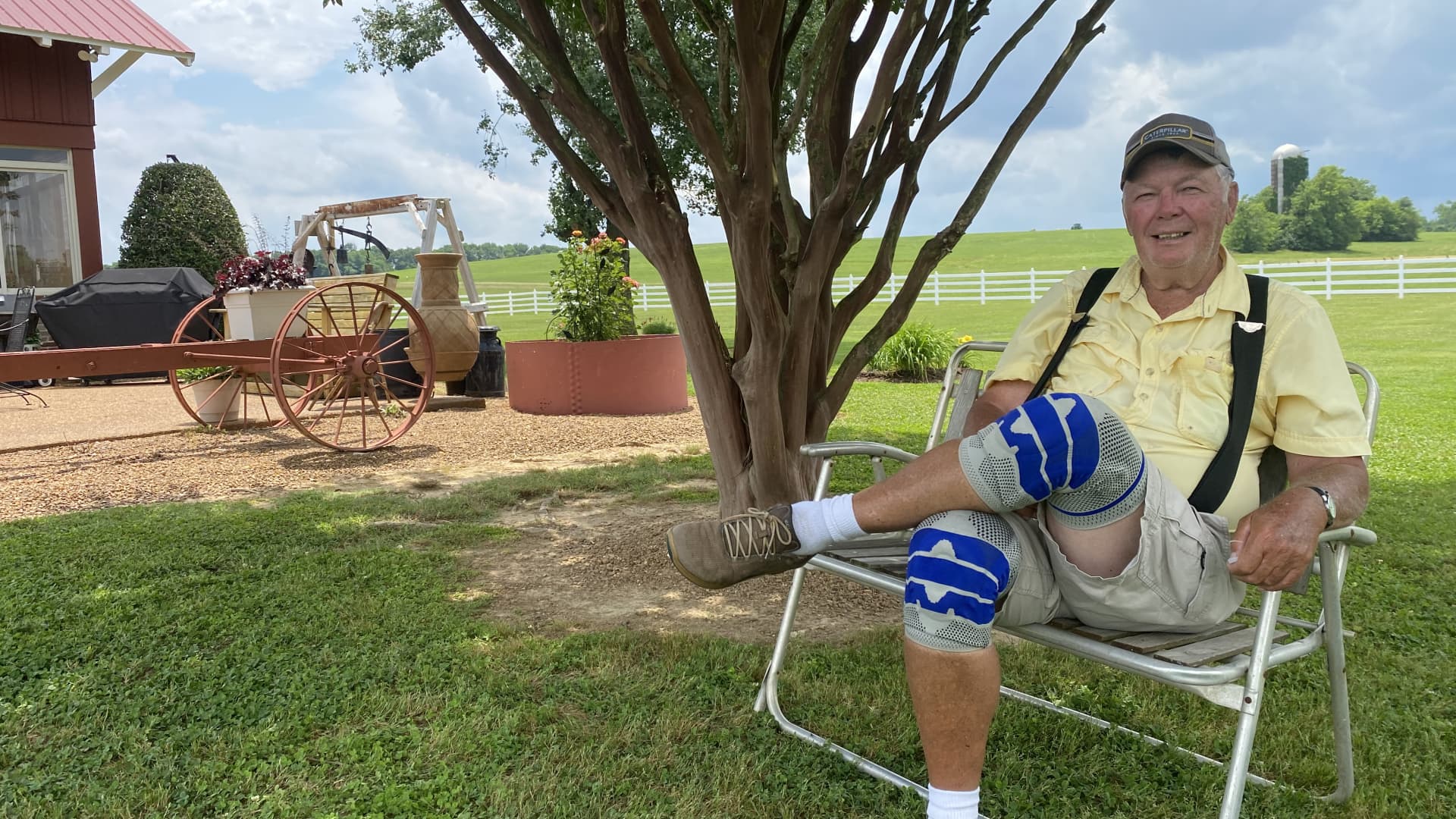
Jack Weaver, an 82-year-old retired dairy farmer whose house sits on a Civil War battlefield, lives near General Motors' Spring Hill plant in Tennessee.
Michael Wayland / CNBC
SPRING HILL, Tenn. – Jack Weaver can point to a cannon on a Civil War battlefield from the comfort of a shaded bench in his backyard — a visible marker of his land's rich past. As he speaks about his small town, it's over the loud rumble of cars and trucks at the intersection in front of his farmhouse red home.
The 82-year-old retired dairy farmer has lived in Spring Hill nearly his entire life. He's watched the once-quiet town in middle Tennessee grow into a burgeoning Nashville suburb. The evolution of Spring Hill has come in conjunction with a population boom in the state as well as the introduction of new industries — in particular, auto companies — that have poured billions of dollars in new investments into the state.
"It's good and it's bad," says Weaver, who complains about cars hitting his fence and the traffic General Motors' Spring Hill plant has brought since it opened in 1990. "I'm not against development at all. I'm not. I think a man outta do what he wants with his own land."
Detroit is the city that "put the world on wheels," but it's towns like Spring Hill and others in neighboring states that are attracting the most investments from automakers in recent years, as production priorities shift to a battery-powered future with electric vehicles.
Companies more than ever want to build EVs where they sell them, because the vehicles are far heavier and more cumbersome to ship than traditional models with internal combustion engines. They also want facilities for battery production to be close by to avoid supply chain and logistics problems.
Among the first to invest in southern states was Ford Motor in the 1950s and 1960s in Kentucky, followed by foreign-based, or transplant, automakers starting with Nissan Motor, which established a plant in Smyrna, Tennessee, in 1983. Others such as General Motors, Subaru, Toyota Motor and BMW followed suit through the 1990s. More have followed since then, including recent announcements by Hyundai Motor and Rivian Automotive to build multibillion-dollar plants in Georgia.
As more companies look to the American South, the investments are changing the landscape of towns across the region and of the automotive industry's workforce, supply chain and logistics. Companies first to set up shop in the South earn early advantages over their northern competitors, and future newcomers, according to officials.
Auto executives say they're investing in the South for a combination of reasons: lower energy costs, available workforce and livability among them. Many southern states also come with other benefits, potentially controversial, such as all-in lower pay for workers, millions in tax breaks and a largely non-unionized workforce in many of the Republican-controlled, right-to-work states.
But the shift brings unique challenges, too. As the Motor City moves and expands south, it has to grapple with preservation of historic plantation farms, unearthing of slave burial grounds and pushback from citizens and local politicians who aren't used to the traffic or industries.
Investments shifting
Automakers have announced $45.9 billion of investments in southern states since 2017, according to The Center for Automotive Research, a nonprofit think tank based in Ann Arbor, Michigan. That's the first year the South outpaced the Midwest, or Great Lakes region, for announced investments since at least 2010.
Midwest states such as Michigan, Ohio and Indiana saw $39.9 billion in announced investments in that same timeframe.
Most of the money heading south – $34.2 billion, or 74% – has come in since last year from traditional automakers such as GM, Hyundai and Ford Motor as well as EV startup Rivian. Others such as Volkswagen and Nissan continue to invest and expand their operations in the South, largely for new electric vehicles.
"We are basically undergoing the single biggest industrial transformation, I would say, not to understate it, in the history of America," Scott Keogh, CEO at Volkswagen of America, told CNBC in June at the automaker's new battery lab in Chattanooga, Tennessee. "It's happening right now in this area."
Scott Keogh of Volkswagen of America at the VW plant in Chattanooga, TN, June 8, 2022.
Michael Wayland | CNBC
Keogh singled out energy capacity and costs as the top priority for the company's investments in Tennessee, including the potential for new assembly and battery facilities that the company is "actively" scouting locations for. He and other executives have also cited incentives, tax support, labor and workforce training as other key elements.
Ford CEO Jim Farley put a similar emphasis on the cost and availability of energy in September, announcing an $11.4 billion investment in new vehicle and battery plants in Tennessee and Kentucky.
"We want to work with states who are really excited about doing that training and giving you access to that low energy cost," Farley told the Associated Press then.
Tennessee has among the lowest electricity prices in the country, according to the most recent data from the U.S. Energy Information Administration. The state's average industrial price of electricity per kilowatt-hour was 6.31 cents as of May. Michigan's industrial energy cost was 8.72 cents per kilowatt-hour, and the national average was 8.35 cents.
Mississippi and South Carolina were under 7 cents, while Georgia was 9.05 cents – among the highest in area, according to the U.S. Energy Information Administration.
While those cost differences seem minimal, they add up quickly. Ford's new battery plants will have an annual capacity for 43 megawatt-hours of production. There are 1,000 kilowatt-hours of electricity in a megawatt-hour, meaning tens of thousands of dollars in savings per year.
The expansion south is expected to continue for years to come, according to AlixPartners. The global consulting firm expects investments from automakers and suppliers in southern states such as Alabama, Georgia and Kentucky to total $58 billion for electric vehicles between 2022 and 2026. That's nearly four times the $15 billion that's expected in Midwest states, and $20 billion elsewhere in the country.
"It definitely will change but right now there's a lot more interest and activity happening in the Southern states, particularly with all these automakers making investments on the EV front," said Arun Kumar, a managing director in the automotive and industrial practice at AlixPartners.
Southern hospitality
State economic development officials from Tennessee and Georgia say their states have made the automotive industry a priority because of the supply chain jobs that typically follow. They also say electric vehicles have helped to level the playing field for new investments.
"This is almost like a seed field of opportunity, as this industry changes because we're building the supply chain in the United States for electrification from scratch," said Pat Wilson, commissioner of Georgia's economic development unit. "There's a huge amount of opportunity."
As of July, EV-related projects contributed more than $12.6 billion in investments and more than 17,800 new jobs in Georgia since 2020, officials said.
Tennessee reports automotive companies have added more than 43,800 new jobs and invested $16.5 billion in private capital in the state since 2012, representing nearly 30% of private capital investments during that time.
Nissan's Smyrna Vehicle Assembly Plant opened in 1983, marking Tennessee's first major auto facility. The plant employs more than 7,000 people are produces a variety of vehicles, including the Leaf EV and Rogue crossover.
Michael Wayland / CNBC
With billions of dollars on the line and tens of thousands of new jobs, states have offered enormous incentive packages for the companies in the forms of land, tax abatements/incentives and other support such as installation of utilities and roadways.
For example, Tennessee approved an $884 million incentive package for Ford's plans to spend $5.6 billion in the state, as well as in-kind services and a $2 million grant for training services. Ford's investment includes a new electric truck plant and battery facility with supplier South Korea-based SK Innovation.
Bob Rolfe, who oversees The Volunteer State's economic development, said such actions are needed to compete with others. He said to attract Ford last year the state spent years accumulating enough land for an "electric vehicle mega site" ahead of securing the automaker's commitment.
"We tell our team every day to continue to recruit. Is enough, enough?" Lewis said ahead of a trip to Japan for automotive recruitment in June. "The more great companies that call Tennessee home, the softer the landing when we do hit the next wind shear that's going to be developed around the next recession."
Unique issues
But not all agree that the automotive industry should be expanding South into rural areas. Rivian has faced notable pushback since announcing plans last year to build a $5 billion plant about 45 miles east of Atlanta, Georgia.
While hailed by many politicians, including Gov. Brian Kemp, local news outlets report residents of the rural area are concerned with how it will impact their community. Others, including politicians, oppose a $1.5 billion in tax breaks and other incentives that state and local officials have offered Rivian.
Haynes Haven is a historic landmark in Spring Hill, Tennessee that has been maintained by GM since the automaker built an assembly plant near the site in the 1980s.
"[Union Army General] Sherman and his troops destroyed our community. Now this supposedly green company is coming to destroy it again," JoEllen Artz told NBC News in May. Artz is president of the grassroots No2Rivian group, which says it has raised over $250,000 and hired Atlanta lawyers to fight the plant. "We want to keep it just like it is."
Building massive assembly plants in traditionally rural areas can also involve a unique set of challenges.
Decades ago, when GM was building its Spring Hill plant, the company unearthed an unmarked slave graveyard. GM paid for the remains to be moved to a nearby burial site.
"When we invest in properties, we're also investing in communities, their history and culture," GM said in an emailed statement to CNBC. "With any building or renovation project, we expect to encounter the unexpected, and we try to work with community members to find solutions to fit the unique needs of each situation. In many cases, like in Spring Hill, the unexpected finds become intertwined in our own history, as well."
It wasn't the first time GM has operated around such a site. On the property of its Detroit-Hamtramck plant, there's an active Jewish graveyard that the company agreed to build around when it built the plant in the 1980s.
There was reportedly another cemetery moved in Smyrna, Tennessee – located about 28 miles northeast of Spring Hill – when Nissan's plant and railroads were built there in the early 1980s.
GM maintained and updated a historic plantation in Spring Hill, Tenn. called Rippavilla as part of a deal for land to build an assembly plant in the city in the 1980s.
Michael Wayland / CNBC
Since GM's Spring Hill Assembly plant was built, the company also has maintained two historic plantations as part of land deals struck during the construction. It still maintains one called Haynes Haven, whose historic horse stables were turned into a welcome center and used for other events. The surrounding area is currently being used for employee parking during construction of the company's new $2.3 billion battery plant, next to the original plant.
The other site, called Rippavilla, sits across the street from the plant and was donated by the company to the city in 2016. It is now being run by a nonprofit organization, The Battle of Franklin Trust, committed to Civil War preservation and education.
"The last people that owned Rippavilla were pretty insistent that they wanted it to be a historic site. They did not want to happen to what happened to Haynes Haven, which Haven is owned by GM and able to use however they see fit," said Eric Jacobson, CEO of the organization.
Jacobson credits GM with saving and maintaining the site in the form of $100,000 a year up until 2016, when a 10-year deal to maintain the property ended. GM said it continues to support the site.
Battling the union
While the automakers may have to navigate battlefields of the South, they don't have to worry as much about battling unions.
The United Auto Workers has failed to successfully organize a non-Detroit automaker plant in the South, despite decades of attempts. The prominent union also now faces challenges of organizing joint venture battery plants from GM and Ford in the South.
"It's a very critical time for the UAW," Ray Curry, president of the union, told CNBC. "This transformation piece is about our future. It's about 86-plus years of longstanding history."
Ford's more than $11.4 billion investment to build new U.S. facilities in Tennessee and Kentucky is expected to create nearly 11,000 jobs to produce electric vehicles and batteries.
Both GM and Ford officials have said the decision of whether to unionize at their U.S. battery plants, which are joint ventures, will be left to the workers.
While the labor cost gap has narrowed between the Detroit automakers and other non-unionized automotive plants, organized labor costs are higher for the companies.
At the end of a current four-year contract between the Detroit automakers and UAW in 2023, the Center for Automotive Research estimates average hourly labor costs per worker will be $71 for GM; $69 for Ford; and $66 for Stellantis, formerly Fiat Chrysler.
"There's quite a bit of anti-union attitude that prevails in the international carmakers," said James Rubenstein, a professor emeritus at the University of Miami Ohio, who specializes in the automotive industry. "It's a little bit easier to do that down South, to keep the union out."
Correction: A graphic in an earlier version of this article misrepresented industrial energy costs from the U.S. Energy Information Administration. They should have been in cents, not dollars.