Democrats and Republicans introduce identical versions of bill in Congress, days before first anniversary of final US troop withdrawal from Afghanistan.
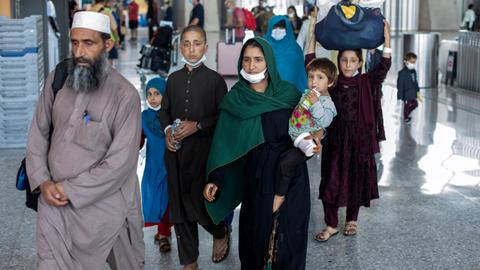
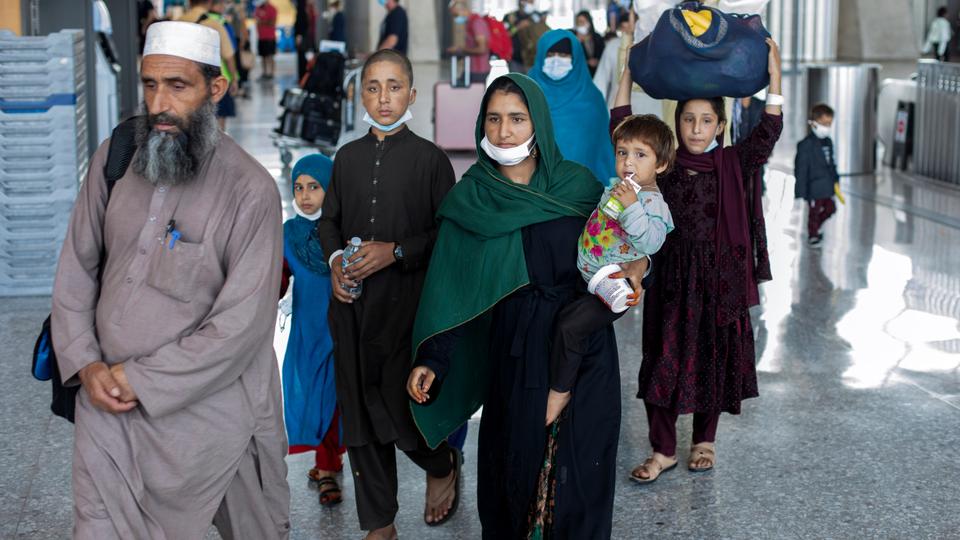
Many of the 76,000 Afghans flown out in last year's evacuation operation entered the United States on humanitarian parole.
(AP Archive)
Bipartisan legislation has
been introduced in both houses of US Congress to establish a
path to American citizenship for thousands of Afghan evacuees
admitted to the US on temporary immigration status.
"We must keep our commitment to provide safe, legal refuge to those who willingly put their lives on the line to support the US mission in Afghanistan," Democratic Representative Earl Blumenauer, co-sponsor of the House bill with Republican Peter Meijer, said in a statement on Tuesday.
The bill also would expand eligibility for Special
Immigration Visas (SIVs) beyond Afghans who worked for the US
government to those who fought alongside US forces as
commandoes and air force personnel, and to women who served in
special counterterrorism teams.
Identical versions of the bill were introduced days before
the first anniversary of the final US troop withdrawal and the
chaotic evacuation operation that ended America's longest war
and saw the Taliban taking over Kabul.
Resistance to bill
Three minority Republicans, including Senator Lindsey
Graham, joined three majority Democrats in introducing an
identical version of the Afghanistan Adjustment Act in the
thinly divided Senate, enhancing its chances of passage.
Even so, a congressional aide, speaking on condition of
anonymity, said the measure likely will face "resistance" from
anti-immigration Republicans.
Many of the 76,000 Afghans flown out in last year's
evacuation operation entered the United States on humanitarian
parole, a temporary immigration status that typically only lasts
up to two years.
The legislation would allow those evacuees to apply for
permanent legal status if they submit to additional background
checks.
Generally, those Afghans only can gain permanent legal status in the United States by applying for asylum or through SIVs, programmes beset by major backlogs.

 Amid escalating attacks around Zaporizhzhia power plant in Ukraine, evacuees find themselves at a refugee reception center looking to escape the violence.