The $430 billion Inflation Reduction Act aims to cut domestic greenhouse gas emissions, lower drug costs and tax corporations.
"Every single Republican in Congress voted against this bill," says Biden.
(AP)
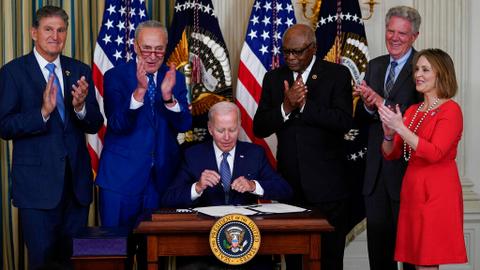
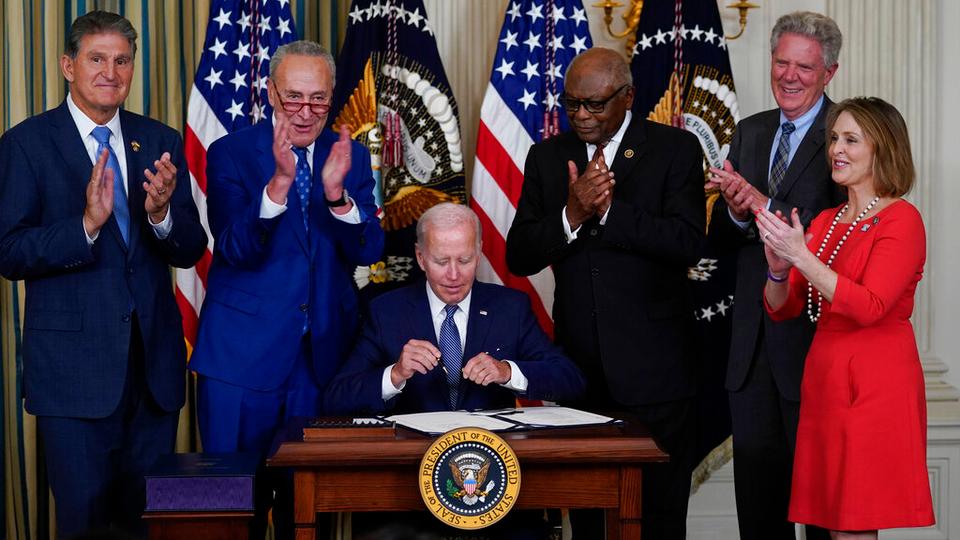
President Joe Biden has signed into law a $430 billion bill that is seen as the biggest climate package in US history, designed to cut domestic greenhouse gas emissions as well as lower prescription drug prices.
Biden was joined by Democratic leaders including Senator Joe Manchin of West Virginia, whose support was crucial to the passage of the Inflation Reduction Act along party lines after he had initially opposed a similar measure.
"Joe, we never had a doubt," Biden said of Manchin on Tuesday at the White House.
Biden used the event to criticise Republicans as he sought to use a string of Democratic-led legislative victories to help boost Democrats in congressional midterm elections in November.
"In this historic moment, Democrats sided with the American people and every single Republican sided with the special interests," said Biden.
"Every single Republican in Congress voted against this bill," he added.
It will also allow Medicare to negotiate lower drug prices for the elderly and ensure that corporations and the wealthy pay the taxes they owe.
Democrats say it will help combat inflation by reducing the federal deficit.
Senate Republican leader Mitch McConnell said the new law will have the opposite impact.
"Democrats robbed Americans last year by spending our economy into record inflation. This year, their solution is to do it a second time. The partisan bill President Biden signed into law today means higher taxes, higher energy bills, and aggressive IRS audits," he said, referring to the Internal Revenue Service.
Democratic-led House of Representatives approves $430 billion bill that is seen as biggest climate package in US history, delivering a major legislative victory for President Biden ahead of November 8 midterm elections.
The House voted 220-207 along party lines to pass the measure titled "Inflation Reduction Act" and send it on to Biden to sign into law.
(Reuters)
US lawmakers have adopted President Joe Biden's sprawling climate, tax and health care plan –– a major win for the veteran Democrat that includes the biggest ever American investment in the battle against global warming.
The House of Representatives on Friday approved the measure by a 220-207 vote along party lines following its adoption in the Senate on Sunday by a razor-thin margin, with Vice President Kamala Harris casting the tie-breaking vote.
The legislation to fight the climate crisis and lower prescription drug prices aim to cut domestic greenhouse gas emissions.
It will also allow Medicare to negotiate lower drug prices for the elderly and ensure that corporations and the wealthy pay the taxes they owe.
Democrats say it will help combat inflation by reducing the federal deficit.
Democrats hope the legislation will help them at the polls in November, when voters decide the balance of power in Congress ahead of the 2024 presidential election.
Republicans are favoured to win a majority in the House and could also take control of the Senate.
Biden quickly hailed the adoption of his plan, which includes a $370 billion investment aimed at bringing about a 40 percent drop in greenhouse gas emissions by 2030.
"Today, the American people won. Special interests lost," the president tweeted in the minutes after the vote.
Republicans say 'it will kill jobs'
The bill's main revenue source is a 15 percent corporate minimum tax aimed at stopping large, profitable companies from gaming the Internal Revenue Service code to slash their tax bills to zero, which has led to mixed reactions from business groups to the legislation.
Republicans oppose the legislation, warning it will kill jobs by raising corporate tax bills, further fuel inflation with government spending and inhibit the development of new drugs.
"Democrats more than any other majority in history are addicted to spending other people's money, regardless of what we as a country can afford," House Republican leader Kevin McCarthy said in a floor speech.
But the bill does not leave the US fossil fuels industry out in the cold.
Some provisions allow the federal government to authorise new wind and solar energy developments on federal land only when it is also auctioning rights to drill for oil and natural gas.
The fossil fuel protections disappointed progressives but posed no barrier to Democratic support.
About half of Americans support the climate and drug pricing legislation, including 69 percent of Democrats and 34 percent of Republicans, according to a Reuters news agency/Ipsos poll conducted on August 3 and 4.
Democrats and Republicans introduce identical versions of bill in Congress, days before first anniversary of final US troop withdrawal from Afghanistan.
Many of the 76,000 Afghans flown out in last year's evacuation operation entered the United States on humanitarian parole.
(AP Archive)
Bipartisan legislation has
been introduced in both houses of US Congress to establish a
path to American citizenship for thousands of Afghan evacuees
admitted to the US on temporary immigration status.
"We must keep our commitment to provide safe, legal refuge to those who willingly put their lives on the line to support the US mission in Afghanistan," Democratic Representative Earl Blumenauer, co-sponsor of the House bill with Republican Peter Meijer, said in a statement on Tuesday.
The bill also would expand eligibility for Special
Immigration Visas (SIVs) beyond Afghans who worked for the US
government to those who fought alongside US forces as
commandoes and air force personnel, and to women who served in
special counterterrorism teams.
Identical versions of the bill were introduced days before
the first anniversary of the final US troop withdrawal and the
chaotic evacuation operation that ended America's longest war
and saw the Taliban taking over Kabul.
Resistance to bill
Three minority Republicans, including Senator Lindsey
Graham, joined three majority Democrats in introducing an
identical version of the Afghanistan Adjustment Act in the
thinly divided Senate, enhancing its chances of passage.
Even so, a congressional aide, speaking on condition of
anonymity, said the measure likely will face "resistance" from
anti-immigration Republicans.
Many of the 76,000 Afghans flown out in last year's
evacuation operation entered the United States on humanitarian
parole, a temporary immigration status that typically only lasts
up to two years.
The legislation would allow those evacuees to apply for
permanent legal status if they submit to additional background
checks.
Generally, those Afghans only can gain permanent legal status in the United States by applying for asylum or through SIVs, programmes beset by major backlogs.
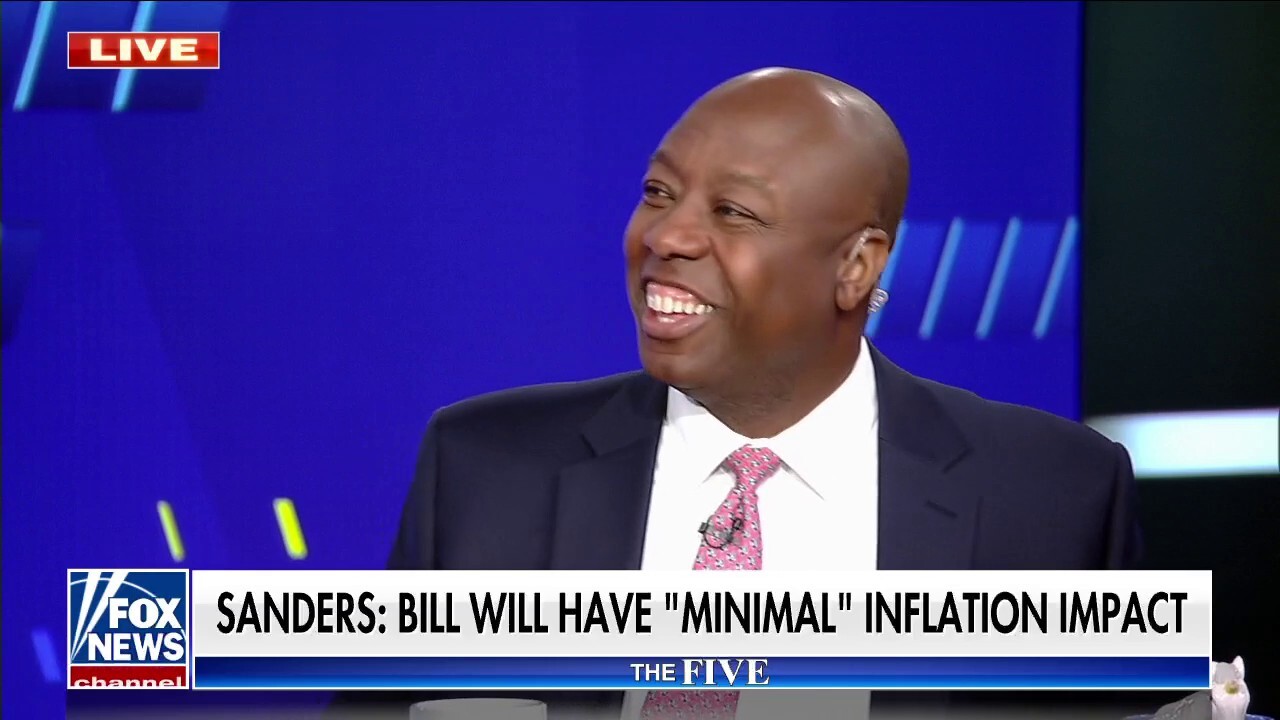
Sen. Tim Scott, R-S.C., laid out why he believes a $750 billion-dollar spending package won't help the economy Monday on "The Five."
SEN. TIM SCOTT:If you have all four of those departments together, you will still have a bigger IRS and the scariest part for our viewers is there’s 87,000 new employees hunting for taxes from people making less than $200,000. It’s not the billionaires and millionaires. It is middle-income families, low-income families, and entrepreneurs who are trying to figure out how to keep their employees working and invest in their future.
I call it the "Inflation Seduction Act." It literally has nothing to do with reducing inflation and when Bernie Sanders, Tim Scott, and Ted Cruz are all on the same side, that tells you that whatever they are selling we are not buying.
The Senate on Sunday passed the Inflation Reduction Act (IRA) along party lines, 51-50, handing Democrats a crucial legislative win as the midterm cycle ramps up.
Vice President Kamala Harris cast the tie-breaking vote with all Democrats in support of the legislation and all Republicans opposed. The proposal was passed via the budget reconciliation process, which allows it to be passed with a simple majority rather than the 60 votes typically needed to overcome a filibuster.
The passage of the sprawling climate, tax and health care legislation now sets up a vote in the Democratic-controlled House, where the bill is expected to pass before President Joe Biden signs it into law.
Included in the bill, supporters say, are measures to support job creation, raise taxes on large corporations and the wealthy, allow Medicare to negotiate down some prescription drug costs, expand the Affordable Care Act health care program and invest in combating climate change by implementing tax credits for clean energy initiatives, among other things.
The legislation's tax provisions, prescription drug-pricing reform, as well as boosted IRS tax enforcement measures, are anticipated to raise an estimated revenue of $739 billion -- $300 billion of which Democrats say would go toward reducing the deficit.
The plan would reduce federal budget deficits by $102 billion over 10 years, according to the nonpartisan Congressional Budget Office.
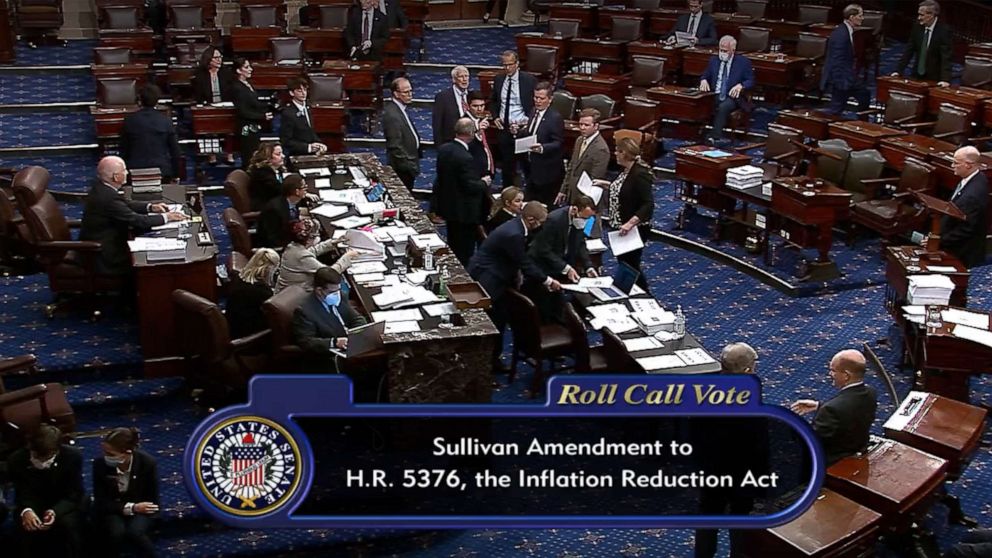
The bill passed the Senate after a punishing, approximately 16-hour "vote-a-rama," in which any senator could introduce an amendment to the bill as part of the budget reconciliation process.
The amendment process fueled painful votes for each party.
Vulnerable Democratic incumbents up for reelection this year had to dance around a vote on the Biden administration's decision to scrap Title 42, a Trump-era order using coronavirus concerns to prevent migrants from entering the country while seeking asylum. Republicans, meanwhile, mostly voted against a Democratic amendment that would have capped out-of-pocket insulin costs at $35 a month for people with private health insurance.
The IRA passage marks the culmination of grueling negotiations between Senate Majority Leader Chuck Schumer, D-N.Y., and Sen. Joe Manchin, D-W.Va., who had been a consistent obstacle to cobbling together a Democrats-only social spending bill via reconciliation.
The pathway for a successful vote was cemented late last week when Sen. Kyrsten Sinema, D-Ariz., another key centrist, signed on after winning some tweaks to the bill.
Senator Patrick Leahy is wheeled to an elevator from the Senate floor during amendment votes, also called the "vote-a-rama", on the Inflation Reduct Act 2022, at the U.S. Capitol building in Washington, Aug. 7, 2022.
Ken Cedeno/Reuters
Among the changes Sinema won were the eliminations of tax provisions targeting wealthy hedge fund managers and private equity executives. The Senate rules official also scrapped a provision intended to reprimand drug companies that raise the prices of some prescription drugs faster than inflation for patients with private insurance.
Still, the bill's passage marks a major step toward President Biden's campaign promises to tackle climate change, reform prescription drug pricing and other issues; and it gives Democrats a new legislative win to run on heading into the November midterms, in an environment where many voters have soured on Biden's handling of the economy and historic inflation.
The IRA also extends a streak of achievements for Biden and congressional Democrats, including passage of a bipartisan anti-gun violence bill and legislation to boost the domestic semiconductor industry.
"This bill is going to change America for decades," Schumer crowed after final passage.
"This vote crystalizes the contrast of the midterms. Senate Democrats have taken a historic step to lower costs like prescription drug prices, tackle inflation and address working families' most pressing concerns. Every Republican voted against the bill because it holds Big Oil, Big Pharma and other corporations that have been jacking up prices accountable, and finally makes them pay their fair share," added Sen. Gary Peters, D-Mich., the chair of Senate Democrats' campaign arm.
Republicans have already forecasted that they'll paint Democrats as uncaring about Americans' financial burdens at a time of rapid price hikes while passing billions of dollars in new spending.
"This idea that this massive tax increase will just somehow be absorbed by corporate America when they will pass those costs along to consumers, and it will make inflation worse," Senate Minority Whip John Cornyn, R-Texas, said last week.
U.S. Senate Majority Leader Chuck Schumer (D-NY) holds his weekly news conference after the Democratic caucus party luncheon at the U.S. Capitol in Washington, August 2, 2022.
Jonathan Ernst | Reuters
The $430 billion climate change, health-care and tax bill passed by the U.S. Senate on Saturday delivers a major win for Democrats, and will help reduce the carbon emissions that drive climate change while also cutting costs for the elderly.
Democrats hope the bill, which they pushed through the Senate over united Republican opposition, will boost their chances in the Nov. 8 midterm elections, when Republicans are favored to recapture the majority in at least one chamber of Congress.
The package, called the Inflation Reduction Act, is a dramatically scaled-back version of a prior bill backed by Democratic President Joe Biden that was blocked by maverick Senate Democrats Joe Manchin and Kyrsten Sinema as too expensive.
"It's what the American people want," Senate Majority Leader Chuck Schumer told reporters. "We're prioritizing the middle class, working families, those struggling to get to the middle class, instead of what Republicans do: prioritize those at the very top."
The Senate's partisan 51-50 vote, with the tiebreaking vote coming from Vice President Kamala Harris, sends the legislation on to the Democratic-controlled House of Representatives, which is expected to pass it on Friday, after which Biden could sign it into law.
Republicans blasted the bill as a spending "wish list" that they argued would hurt an economy weighed down by inflation, saying it would kill jobs, raise energy costs and undermine growth at a time when the economy is facing a potential recession.
"Senate Democrats are misreading the American people's outrage as a mandate for yet another reckless taxing-and-spending spree," top Senate Republican Mitch McConnell said on Saturday. "Democrats want to ram through hundreds of billions of dollars in tax hikes and hundreds of billions of dollars in reckless spending -- and for what?"
About half of Americans -- some 49% -- support the bill, including 69% of Democrats and 34% of Republicans, according to a Reuters/Ipsos poll conducted Aug. 3 and 4. The most popular element of the bill is giving Medicare the power to negotiate drug prices, which 71% of respondents support, including 68% of Republicans.
Economists, who say the legislation could help the Federal Reserve combat inflation, do not expect a sizeable impact on the economy in the coming months.
Climate focus
With $370 billion in climate-focused spending, it would become the most consequential climate change bill ever passed by Congress.
The bill offers businesses and families billions in incentives to encourage purchases of electric vehicles and energy-efficient appliances, as well as to spur new investments in wind and solar power that would double the amount of new, clean electricity-generating capacity coming online in the United States by 2024, according to modeling by the Repeat Project at Princeton University.
That would help put the U.S. on course to meet its pledge to slash its greenhouse gas emissions in half by 2030 below 2005 levels, made at last year's Glasgow climate summit.
While environmental groups largely embraced the bill, they noted that compromises secured by Manchin, who represents coal-producing West Virginia, would prolong U.S. use of fossil fuels.
Those provisions include rules that would only allow the federal government to authorize new wind and solar energy developments on federal land when it is also auctioning rights to drill for oil and natural gas.
Drug costs
The legislation would lower drug costs for the government, employers and patients, said Juliette Cubanski, deputy director of the Medicare program at the Kaiser Family Foundation.
"Perhaps the biggest effect would be for people with prescription drug coverage through Medicare," she said.
A key change is the provision allowing the federal Medicare health plan for older and disabled Americans to negotiate lower prescription drug prices.
The pharmaceutical industry says price negotiation would stifle innovation. Negotiated prices for 10 of the costliest drugs for Medicare would apply starting in 2026, with that number rising until it caps at 20 a year in 2029.
The nonpartisan Congressional Budget Office estimates Medicare would save $101.8 billion over 10 years by negotiating drug prices.
The provision also introduces a $2,000 annual cap on out-of-pocket costs for the elderly through the Medicare program.
Tax provisions
The bill also imposes a new excise tax on stock buybacks, a late change after Sinema raised objections over another provision that would have imposed new levies on carried interest, currently a tax loophole for hedge fund and private equity financiers. The provision was dropped.
The excise tax is expected to raise an additional $70 billion in tax revenue per year, lawmakers said. That is more than the carried interest provision had been forecast to raise.
A report by the nonpartisan Congressional Budget Office released prior to that last change estimated the measure would reduce the federal deficit by a net $101.5 billion over the next decade.
That was about one-third of the $300 billion in deficit reduction predicted by Senate Democrats, but excluded a projected $204 billion revenue gain from increased Internal Revenue Service enforcement.
Prime Minister Shehbaz Sharif and Microsoft co-founder Bill Gates. — AFP/Reuters/File
PM Shehbaz and Bill Gates exchange views on issues in the health and social sector of Pakistan.
The government is committed to eradicating polio from the country, says PM Shehbaz.
Bill Gates expresses concerns over increasing polio cases in Pakistan.
Prime Minister Shehbaz Sharif and Co-Chair of the Bill & Melinda Gates Foundation (BMGF) Bill Gates held talks on the phone and discussed the anti-polio campaign, Geo News reported.
In a telephonic conversation, PM Shehbaz and Bill Gates exchanged views on issues in the health and social sector of Pakistan.
PM Shehbaz appreciated BMGF's support in eradicating polio and said that the government of Pakistan was committed to eradicating the crippling disease across the country.
On the occasion, Bill Gates expressed concerns over the increasing number of polio cases and assured to continue support in eradicating the polio virus from the country.
Indiana senators on Friday approved a measure to direct funding toward programs that help pregnant women, children and people who adopt during a divided special session where lawmakers have been wrangling over a proposal to ban nearly all abortions in the state.
The spending bill from Senate Republicans, which passed 46–1, allocates $45 million more in the coming year toward state agencies that "support the health of pregnant women, postpartum mothers, and infants," especially among low-income families. The wraparound services would be available for families with children under 4 years old and comes with an estimated $5 million expansion in adoption tax credits.
Alone in his dissent was Senate Democratic Leader Greg Taylor, who said that while he thinks it is important to send assistance to families in need, disbursing the funds through the state’s budget agency is "not fiscally responsible."
"Sending $45 million to the budget agency does not get the money to the people," he said before voting. "It puts it in a fund that allows the budget agency to determine who gets it and where it goes."
The House on Friday also approved a similar bill that comprises millions in tax credits for families adopting, repeals the state tax on children’s diapers and expands eligibility for direct payments through the state’s automatic taxpayer refund law.
Approved by House legislators 93-2, the bill will distribute $225 to taxpayers, and Indiana residents who were not required to file a tax return can sign an affidavit to claim a tax rebate. It’s an echo of Republican Gov. Eric Holcomb’s first call for a special session on inflation relief in June.
Senate Republicans have so far been opposed to issuing direct payments in their legislation. The Senate is also considering an inflation relief bill without a tax rebate, and a Democratic amendment that would have included one was shot down Friday.
"We think the programs that we’re supporting are the right programs to support," House Speaker Todd Huston told reporters. "People need the dollars right now."
The final Senate vote happened about 10 hours after the Republican-dominated chamber declined to remove exceptions for rape and incest victims in the proposed abortion ban. Indiana is among GOP-controlled states moving quickly to further restrict or ban abortion after the U.S. Supreme Court overturned the landmark Roe v. Wade decision.
The Indiana senate passed a bill that will help women, children, and people who adopt in the state, the vote was 46-1.
Lawmakers wrapped past midnight due to an approximately five-hour delay in Thursday’s session, and Senate restrictions prohibited lawmakers from voting on the ban Friday. The Senate vote is now expected Saturday, and the House could take up the proposal next week.
As for the spending proposal, Republicans have said it shows dedication to mothers and babies, while Democrats say the money isn't enough for services that will be in greater demand if the abortion ban passes. House Democrats emphasized a similar note of dissatisfaction in their own social services bill.
Republican Sen. Travis Holdman called the bill "a start" and addressed Democrats' calls for mental health funding in the bill.
"We have a whole new budget session coming up here in January, and hopefully we can supplement some of the funds and respond in kind as we should to the mental health situation and the needs of young mothers, pregnant women and young children," Holdman said.
Twice in recent years, GOP legislators turned aside Republican Gov. Eric Holcomb’s call for a law requiring businesses to provide workplace accommodations for pregnant women.
Supporters for previous bills — such as provisions to grant pregnant workers longer breaks or transfers to less physical work — said they would improve Indiana’s infant mortality rate. Federal statistics show the state had the country’s ninth worst in 2020, with 527 infant deaths.
An amendment to the wraparound services bill approved Thursday requires state offices to research neighboring states' Medicaid reimbursement rates for pregnancy-related services, with a report required by Dec. 31, 2022.
Legislative leaders have acknowledged the abortion ban could increase the state’s Medicaid and other expenses. A ban on most of the approximately 8,400 abortions performed in Indiana in 2021 would add an unknown number to the state’s live births, about 80,000 of which occurred last year, according to the state Health Department.
The legislation — passed by both Senate and House of Representatives — was headed to US President Joe Biden's desk for signing.
A Renesas Electronics Corp's chip is pictured at the company's office in Tokyo, March 21, 2013.
(Reuters)
The House passed a $280 billion package to boost the semiconductor industry and scientific research in a bid to create more high-tech jobs in the United States and help it better compete with international rivals, namely China.
The “Chips and Science Act” authorises about $52 billion in government subsidies for US semiconductor production and research, and an investment tax credit for chip plants estimated to be worth $24 billion.
The approved bill by a solid margin of 243-187, sending the measure to President Joe Biden to be signed into law and providing the White House with a major domestic policy victory. Twenty-four Republicans voted for the legislation.
“Today, the House passed a bill that will make cars cheaper, appliances cheaper, and computers cheaper," Biden said. “It will lower the costs of every day goods. And it will create high-paying manufacturing jobs across the country and strengthen US leadership in the industries of the future at the same time."
Republicans argued the government should not spend billions to subsidise the semiconductor industry and GOP leadership in the House recommended a vote against the bill, telling members the plan would provide enormous subsidies and tax credits "to a specific industry that does not need additional government handouts.”
Increasing deficits
The bill provides more than $52 billion in grants and other incentives for the semiconductor industry as well as a 25 percent tax credit for those companies that invest in chip plants in the US. It calls for increased spending on various research programs that would total about $200 billion over 10 years, according to the Congressional Budget Office.
The CBO also projected that the bill would increase deficits by about $79 billion over the coming decade.
A late development in the Senate — progress announced by Wednesday night by Democrats on a $739 billion health and climate change package — threatened to make it harder for supporters to get the semiconductor bill over the finish line, based on concerns about government spending that GOP lawmakers said would fuel inflation.
Some Republicans criticised the bill as not tough enough on China, and GOP leaders emphasised that point in recommending a “no” vote. Their guidance acknowledged the threat China poses to supply chains in the US, but said the package "will not effectively address that important challenge."
Zhao Lijian, a Chinese foreign ministry spokesman, commenting before the House vote, said the US “should not put in place obstacles for normal science, technology and people-to-people exchanges and cooperation” and "still less should it take away or undermine China’s legitimate rights to development.”
U.S. House Speaker Nancy Pelosi (D-CA) holds her weekly news conference with reporters on Capitol Hill in Washington, July 14, 2022.
Elizabeth Frantz | Reuters
The House on Thursday passed bipartisan legislation to boost U.S. competitiveness with China by allocating billions of dollars toward domestic semiconductor manufacturing and science research.
The bill passed 243-187, with no Democrats voting against the bill. Twenty-five Republicans voted for the legislation, even after a last-minute push by GOP leaders to oppose it.
The bill, which passed the Senate on Wednesday, now heads to the White House for President Joe Biden to sign into law.
Lawmakers pushed to quickly approve the package before they depart Washington, D.C., for the August recess. But the final vote came after years of wrangling on Capitol Hill, with the legislation taking numerous forms, and names, in both chambers of Congress.
The ultimate version, known as the Chips and Science Act, includes more than $52 billion for U.S. companies producing computer chips, as well as billions more in tax credits to encourage investment in chip manufacturing. It also provides tens of billions of dollars to fund scientific research, and to spur the innovation and development of other U.S. technologies.
House Speaker Nancy Pelosi, D-Calif., called the bill "a major victory for American families and the American economy."
But House Republican Leader Kevin McCarthy, R-Calif., urged his colleagues to "reject this deeply flawed bill" and "start from scratch" in floor remarks before the vote.
The Senate passed the bill Wednesday in a 64-33 vote, drawing support from 17 Republicans. Among those yea votes was Senate Minority Leader Mitch McConnell, R-Ky., who previously warned that Republicans would not back the China competition bill if Democrats continued to pursue an unrelated reconciliation package.
CNBC Politics
Read more of CNBC's politics coverage:
Hours after Wednesday's bipartisan Senate vote, Senate Majority Leader Chuck Schumer, D-N.Y., and Sen. Joe Manchin, D-W.Va., revealed that they have struck a deal on a sweeping reconciliation bill. They hope to pass that package next week with just a simple majority in the Senate, which is evenly split between Republicans and Democrats with Vice President Kamala Harris casting any tiebreaking votes.
Shortly after that deal was announced, House Republican leaders urged their members to vote down the Chips and Science Act. They argued against giving multibillion-dollar subsidies to chipmakers at a time of historically high inflation, while also noting the timing of the Democrats' reconciliation deal.
"The partisan Democrat agenda has given us record inflation, and now they are poised to send our country into a crushing recession," the office of House Minority Whip Steve Scalise, R-La., said in a memo Wednesday night.
Some Republicans who opposed the bill said it lacked "guardrails" to prevent any of the funding from winding up in China's hands. Other critics have argued that the U.S. would have to spend many billions more to have a real chance at competing with the world's leading chipmakers.
But the bill's advocates say it is vital to America's economy and national security to build more chips, which are increasingly critical components in a vast array of products including consumer electronics, automobiles, health-care equipment and weapons systems.
The chips have been in short supply during the Covid-19 pandemic. Factory shutdowns at the beginning of the outbreak sidelined chip production in Asia while consumer demand for autos and upgraded home electronics that need the chips surged during the lockdowns. The U.S. share of global chip production also has fallen sharply in recent decades, while China and other nations have invested heavily in the industry.
The U.S. also makes few of the most advanced types of semiconductors, which are largely produced in Taiwan, the epicenter of rising political tensions with China.
Read more about tech and crypto from CNBC Pro
Much modern warfare requires sophisticated semiconductors — each Javelin missile launching system contains hundreds, for instance — leading U.S. defense officials to worry about the nation's reliance on foreign producers for its chip supply.
Biden has also blamed the chip shortage for the sky-high inflation that has dogged his presidency. A lack of chips available for new-car manufacturing has been linked to soaring prices for used cars, which are pushing inflation higher.
"America invented the semiconductor. It's time to bring it home," Biden said this week.