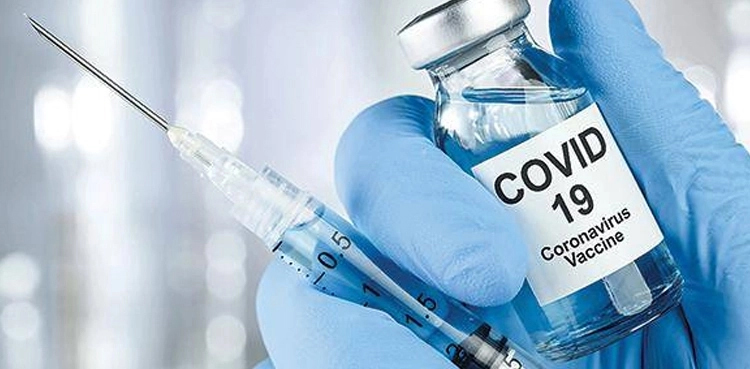
BERLIN: Germany can next week start using COVID-19 vaccines which have been adapted for the Omicron variant and got approval for use in the European Union on Thursday, Health Minister Karl Lauterbach said.
He said approval of the BA.1 vaccine was a quantum leap in the fight against the pandemic as vaccines were now available that work well against all previously known virus variants.
“From next week, vaccinations can begin with the new doses. Now is the optimal time to close the gaps in vaccination for the autumn,” he said in a statement.
On the other hand, Britain’s medicines regulator on Friday approved Novavax’s COVID-19 vaccine for children aged between 12 and 17 years.
Read more: Britain approves Novavax COVID vaccine for 12-17 year-olds
The mRNA vaccines made by Moderna as well as the partnership between Pfizer-BioNTech are also cleared for use by this age group, the Medicines and Healthcare products Regulatory Agency (MHRA) said.
In the 12 through 17 year-old population, the Novavax COVID-19 vaccine has been granted authorization in the U.S., India, the European Union, Australia, Japan, Thailand, and New Zealand, and is actively under review in other markets.
"Germany has never really accounted for its crimes against Poland," says top politician Jaroslaw Kaczynski, claiming many Germans who committed crimes lived in impunity in Germany after World War 2.
"We will turn to Germany to open negotiations on the reparations," says Jaroslaw Kaczynski.
(AP)
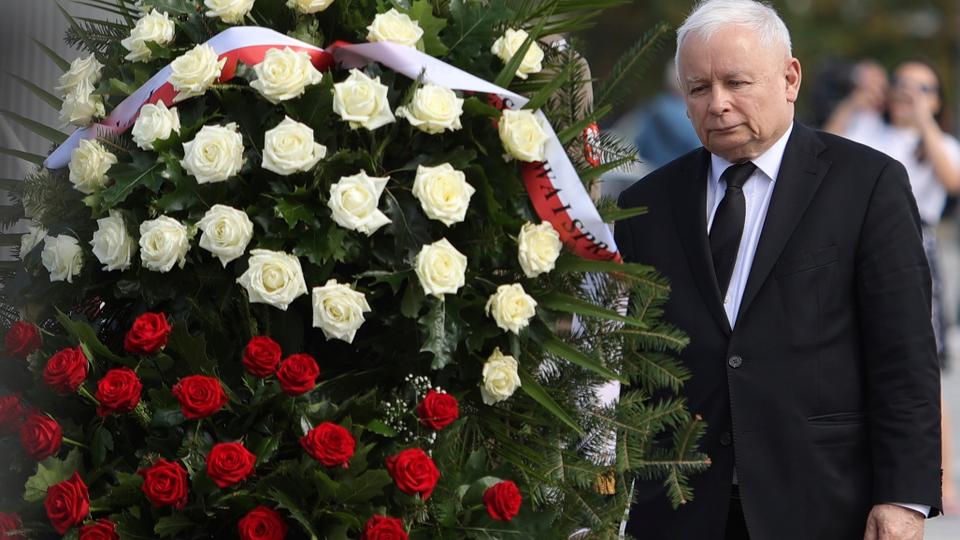
Poland's top politician has said that the government will seek the equivalent of some $1.3 trillion in reparations from Germany for the Nazis' World War 2 invasion and occupation of his country.
Jaroslaw Kaczynski, leader of the Law and Justice party, announced on Thursday the huge claim at the release of a long-awaited report on the cost to the country of years of Nazi German occupation as it marks 83 years since the start of World War II.
"We not only prepared the report but we have also taken the decision as to the further steps," Kaczynski said during the report's presentation.
"We will turn to Germany to open negotiations on the reparations," Kaczynski said, adding it will be a "long and not an easy path" but "one day will bring success."
He insisted the move would serve "true Polish-German reconciliation" that would be based on "truth."
Poland's right-wing government argues that the country which was the war's first victim has not been fully compensated by neighbouring Germany, which is now one of its major partners within the European Union.
"Germany has never really accounted for its crimes against Poland," Kaczynski said, claiming that many Germans who committed war crimes lived in impunity in Germany after the war.
He claimed the German economy is capable of paying the bill.
READ MORE:Poland lambasts Germany, France for their 'imperialist' behaviour in EU
NEW - Poland demands $1.3 trillion in "war reparations" from Germany.
Berlin says compensations already paid
Germany argues compensation was paid to Eastern Bloc nations in the years after the war while territories that Poland lost in the East as borders were redrawn were compensated with some of Germany's pre-war lands.
Berlin calls the matter closed.
"Poland long ago, in 1953, waived further reparations and has repeatedly confirmed this waiver," the Foreign Ministry said in an emailed response to an Associated Press query about the new Polish report.
Top leaders including Kaczynski, who is Poland's chief policy maker, and Prime Minister Mateusz Morawiecki attended the ceremonial release of the report at the Royal Castle in Warsaw, rebuilt from wartime ruins.
The release of the three-volume report was the focus of national observances of the anniversary of the war that began on September 1, 1939, with Nazi Germany's bombing and invasion of Poland that was followed by more than five years of brutal occupation.
A team of more than 30 economists, historians and other experts worked on the report since 2017. The issue has created bilateral tensions.
Some six million of Poland’s citizens, including three million Jews, were killed in the war. Some of them were victims of the Soviet Red Army that invaded from the east.
Source: AP
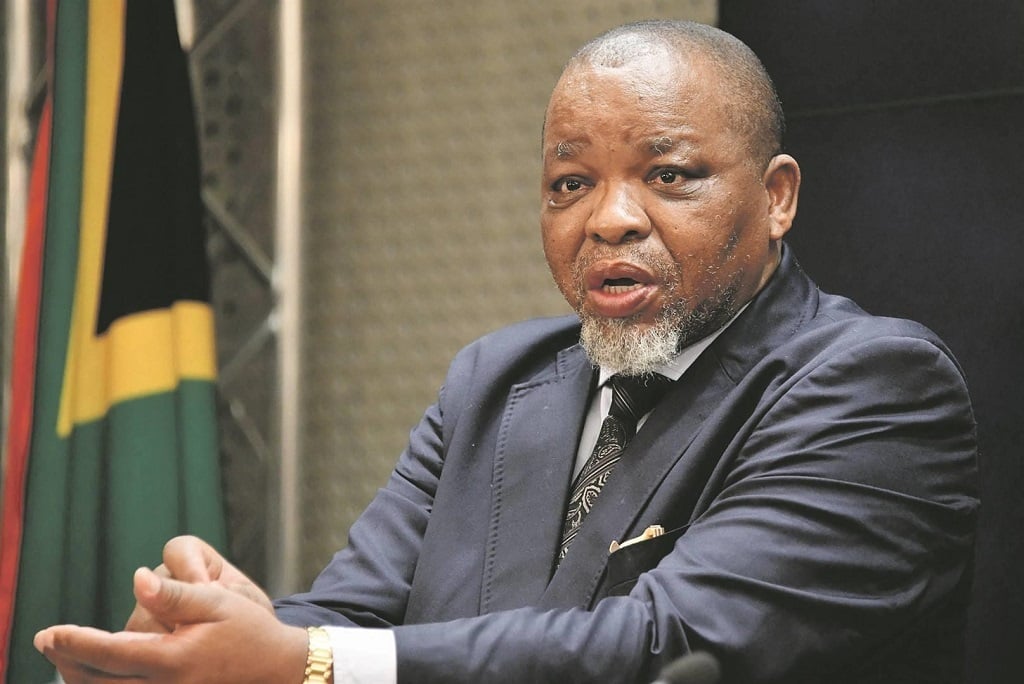
South Africa’s energy minister dismissed the notion that renewable electricity can bring an end to years of load shedding, pointing to Europe’s pivot back to the use of fossil fuels as evidence of the constraints of using green energy. Solar and wind plants could be used to supplement coal, gas and nuclear power generation, but had limitations when it came to meeting South Africa’s needs, such as supplying mines, Mineral Resources and Energy Minister Gwede Mantashe said.
“The excitement of moving from coal to renewables is becoming a myth,” Mantashe, a former miner and labour-union leader, said in an August 30 interview in his office in Pretoria, the capital. “Many think that renewables are the so-called saviour, and we know that it is not. Germany has learnt that painfully.”
South Africa relies on coal to generate more than 80% of its electricity, and has been subjected to intermittent outages since 2008 because state utility Eskom can’t meet demand from its old and poorly maintained plants. While the government has pledged to reduce greenhouse gas emissions to net zero by 2050 and taken steps to increase purchases of renewable power from private producers, it’s encountered opposition from Mantashe and unions who represent coal miners and fear job losses.
The argument for the continued use of fossil fuels has gained traction as Europe grapples with its worst energy crisis in decades, with Russia down-scaling natural gas deliveries to the region, France contending with nuclear power-plant outages and electricity prices reaching record highs.
Germany, which has the European Union’s biggest economy, and other countries intend restarting mothballed coal-fired power plants and extending the life of their nuclear power plants to reduce their reliance on Russian gas and coal following its invasion of Ukraine.
Tesla Chief Executive Officer Elon Musk weighed in this week, saying the world needs more oil and gas now to counter energy shortages even as it transitions to renewable power.
South Africa should consider investing in additional coal and nuclear generation capacity, with backup coming from renewable energy, according to Mantashe. While options such as battery storage or pump storage are currently expensive, they will still be considered, said Thabang Audat, a chief director in his department.
Mantashe said a pledge made last year by developing nations to help raise $8.5 billion to help South Africa transition to clean energy is still being discussed, and that any final decisions on how the money should be used will be accommodative of the country’s energy needs. The availability of the funds has become a “moving target,” he said.
The minister called for an end to the “polarised” debate on South Africa’s energy transition.
“The co-existence of various technologies” is required to meet the country’s needs, he said.
- With assistance from Loni Prinsloo, Paul Richardson and Arijit Ghosh.
COLOGNE, Germany
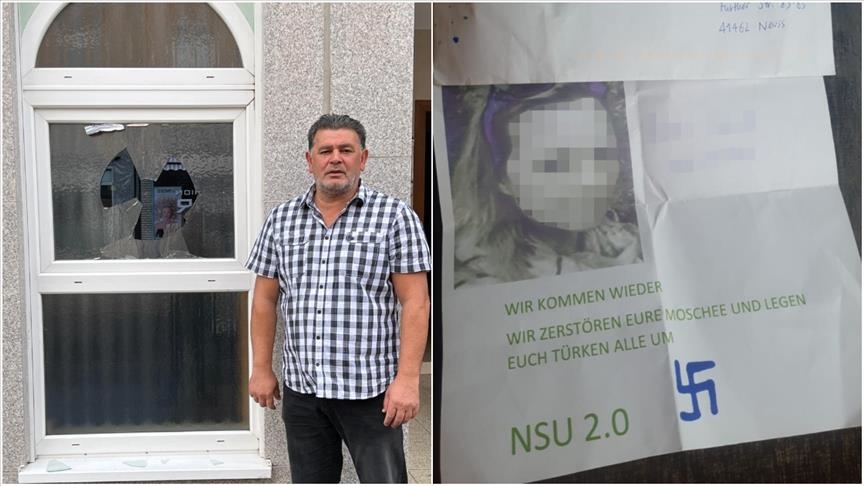
A Turkish cultural center in the German town of Neuss received a racist letter with death threats, the head of the center said Tuesday.
Speaking to Anadolu Agency, Tansel Ciftci said the Neuss Turkish Cultural Center was the target of racists for the second time in two weeks.
"A letter came in the mail today. It was signed with a swastika and ‘NSU 2.0’ and included racist statements like 'We will burn down your mosques and kill you Turks,’" said Ciftci, noting that members of the cultural center as well as locals of Turkish descent in Neuss are in fear and anxiety over the recent incidents.
NSU 2.0 refers to the National Socialist Underground, a neo-Nazi extremist group uncovered in 2011 that murdered 10 people and planted three bombs.
"Two weeks ago, the windows of our building were broken in an attack on our association. Due to the frequency of these events, our members and those living here began to feel uneasy. We want the authorities to arrest those responsible and impose the necessary punishment," Ciftci added.
He further emphasized that they are living in the middle of Europe with death threats and called it "unacceptable."
Ciftci also noted that the police, to whom they filed a criminal complaint, had begun an investigation into the incidents.
Germany has witnessed growing racism and Islamophobia in recent years, fueled by the propaganda of neo-Nazi groups and the far-right Alternative for Germany (AfD) party.
With a population of over 84 million people, the country has the second-largest Muslim population in Western Europe after France. Among the country’s nearly 5.3 million Muslims, 3 million are of Turkish origin.
Anadolu Agency website contains only a portion of the news stories offered to subscribers in the AA News Broadcasting System (HAS), and in summarized form. Please contact us for subscription options.
More than 5,600 people filed discrimination complaints last year — and 37 percent of those cases were of discrimination in the workplace, a report by Germany's anti-discrimination agency says.
Since 2019, the Federal Anti-Discrimination Agency publishes annual reports about its activities.
(Reuters)
More than 2,000 cases of racist discrimination were reported in Germany last year, according to a new report by the country’s top anti-discrimination agency.
The country’s anti-discrimination commissioner, Ferda Ataman, said the figures are alarming and called for stronger legal measures.
“People in Germany still experience discrimination every day, especially in the job market and in everyday business and when looking for accommodation, and sometimes by public authorities or on the street," Ataman said.
“I also want people to know their rights and that discrimination is illegal. I want to make the German Equality Law better known and show how discrimination can be specifically prevented,” she added.
According to the report, over 5,600 people filed discrimination complaints, 37 percent of those cases were of discrimination in the workplace.
Some 9 percent of those complaints were filed by people who experienced discrimination or disadvantages due to their religion.
The Federal Anti-Discrimination Agency offers consultation to people who in their professional or private lives have experienced discrimination on grounds of their ethnic origin, religion, belief, sexual identity, age, disability or their gender.
To meet a significant increase in enquiries, the Anti-Discrimination Agency set up a service centre last year to provide new and expanded telephone consultation services.
"It is very important to me that we can better help affected people in Germany,” Ataman said.
"We also notice from the results of our study that the law that we have at the moment does not always help enough, unfortunately the anti-discrimination agency only has the opportunity to make a legal assessment," she added.
Ataman said "the current anti-discrimination law is very weak, people have to go to court alone if they want to go to court."
"But what we can do as an anti-discrimination body is we can ask for a statement from the employer, or from the other person involved, we can try to help them reach a settlement, but in order to take legal action, people have to make that decision themselves and, for now, we can only give them a legal opinion,” she added.
Since 2019, the Federal Anti-Discrimination Agency publishes annual reports about its activities.
Russian energy giant Gazprom said Wednesday that delivery of a turbine needed to keep gas flowing to Europe via the Nord Stream 1 pipeline was "impossible" due to sanctions on Moscow.
"Sanctions regimes in Canada, in the European Union and in Britain, as well as the inconsistencies in the current situation concerning the contractual obligations of [turbine maker] Siemens make the delivery impossible," Gazprom said in a statement.
The statement risks further increasing concern in European countries who suspect Moscow is looking for an excuse to delay the turbine's return to Russia and further reduce its gas deliveries.
German Foreign Minister Annalena Baerbock said Russian President Vladimir Putin was trying to "play games with us" but said there was "no chance" he could split the Western alliance.
Earlier on Wednesday, Chancellor Olaf Scholz accused Russia of blocking the delivery of the key turbine to throttle gas supplies to Europe, as he raised the possibility of keeping nuclear plants going.
The continent's biggest economy has been scrambling for energy sources to fill a gap left by a reduction in gas supplies from Moscow.
Baerbock acknowledged it had been "a mistake to be so dependent on Russian cheap gas", prompting a drastic change in German energy policy to phase it out.
The delayed return of the turbine from Canada, where the unit was being serviced, was behind an initial reduction in gas deliveries via the Nord Stream 1 gas pipeline in June, according to Gazprom.
Canadian Foreign Minister Melanie Joly on Wednesday admitted that returning the turbine to Russia was "a difficult decision," also condemning Putin's attempt to "sow division."
Supplies via the energy link were further reduced to around 20% of capacity in late July, after Gazprom halted the operation of one of the last two operating turbines due to the "technical condition of the engine."



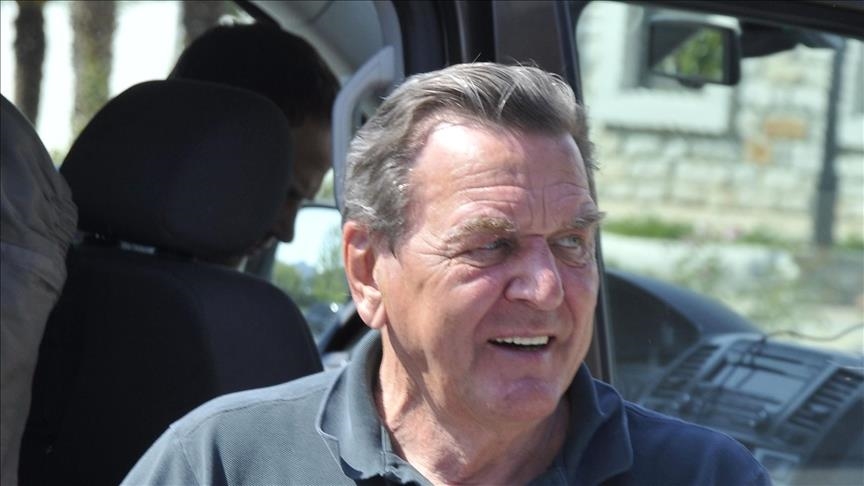 Party's arbitration body says there are no grounds to expel Gerhard Schroeder over his Russian ties