Leaders of Türkiye, Ukraine and UN discuss ways to end Russia's onslaught in Ukraine and secure Europe's largest nuclear power station as fighting rages on 177th day of conflict.
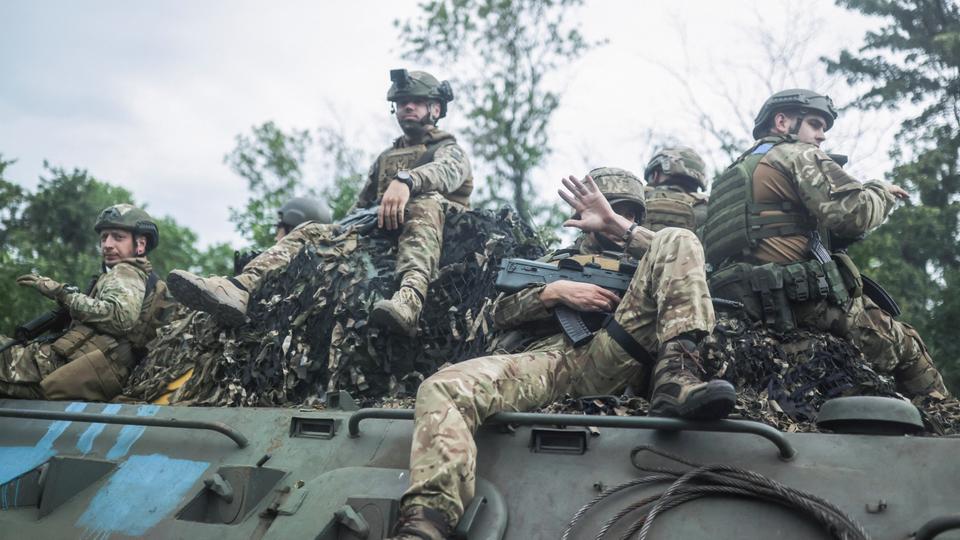
Ukrainian servicemen travel on a Wheeled-BTR fighting vehicle near Bakhmut in the Donetsk region.
(Reuters)
Friday, August 19, 2022
UK spy chief: Putin losing 'information war' in Ukraine
Russia has failed to gain ground in cyberspace against Ukraine almost six months after its onslaught on the country, the head of Britain's GCHQ intelligence service has said.
Jeremy Fleming, the intelligence head, in an op-ed in The Economist, wrote that both countries have been using their cyber capabilities in the fighting in Ukraine.
"So far, President Putin has comprehensively lost the information war in Ukraine and in the West. Although that's cause for celebration, we should not underestimate how Russian disinformation is playing out elsewhere in the world," Fleming wrote.
Fleming said Russia had deployed WhisperGate malware to destroy and deface Ukrainian government systems. He also said Russia has used the same playbook before on Syria and the Balkans and said online disinformation is a major part of Russia's strategy.
For live updates from Wednesday (August 17), click here
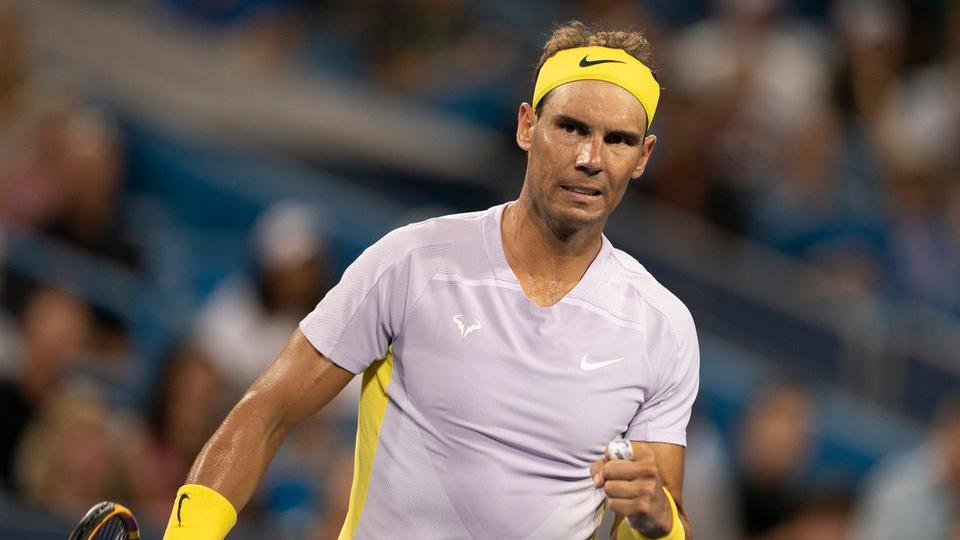
Nadal had not played a competitive match since pulling out of his Wimbledon semi-final against Kyrgios due to injury in early July.
"In terms of practice, I need to start to be in a Grand Slam mode, practising the way that I need to practise to be competitive," says Rafael Nadal
(Reuters)
Rafa Nadal was not too downhearted by defeat at the Cincinnati Open on Wednesday after the Spaniard lost 7-6(9) 4-6 6-3 to Borna Coric on his return from a six-week injury layoff.
Nadal, who will aim for a record-extending 23rd Gram Slam title at the US Open, had not played a competitive match since pulling out of his Wimbledon semi-final against Nick Kyrgios due to an abdominal injury in early July.
The 36-year-old also withdrew from last week's ATP Masters event in Montreal due to the issue but did not seem hampered by it against former world number 12 Coric, and instead put his defeat down to a lack of time on court.
"Obviously I didn't play my best match, something that can happen," Nadal told reporters. "So coming back from a tough period of time, something that's easy to accept and easy to say congrats to Borna that he played better.
"I need to improve. I need to practise. I need to return better. I need days, and that's the truth. It's obvious that I was not ready enough to win the match today.
"(It) has been a difficult injury to manage. The last month and a half haven't been easy."
Flushing Meadows has been a happy hunting ground for Nadal, who has won the US Open four times, the last title coming in 2019.
He will undergo tests to confirm everything is fine with the injury, which he said still created doubt in his mind during his service motion.
"I am positive," he said. "In terms of practice, I need to start to be in a Grand Slam mode, practising the way that I need to practise to be competitive since the beginning there, and I hope I will be able to make that happen.
"I need to move forward and just start to think about the energy that the crowd gives me in New York. I know it's a very special place for me, and I enjoy it, unforgettable moments there, and I'm going to try my very best every single day to be ready for that."
Rep. Chip Roy, R-Texas, said Rep. Liz Cheney losing the Wyoming GOP House primary happened because voters finally spoke out again the swamp Tuesday on "The Ingraham Angle."
REP. CHIP ROY: The Declaration of Independence is very clear. The government derives its power from the consent of the governed. The people of Wyoming spoke tonight, and they spoke because they want the agenda that they saw in terms of draining the swamp. They didn't want more of the swamp. That's, I think, what this boils down to. History has a way of cleansing all of the noise.
And when history is judged, when we look at this moment, it's about a change. It's about moving forward. It's about not 2022 or 2024, but 2026 when America turns 250 years old. Are we going to live free or are we going to continue to fund the bureaucracy, continue to expand government at the expense of our freedom? It is time for a change. That time is now, and I think the people are speaking across the country, and this is one example of it.
A recent study raises new concerns about how fast the climate crisis is weakening Antarctica's floating ice shelves and accelerating the rise of global sea levels.
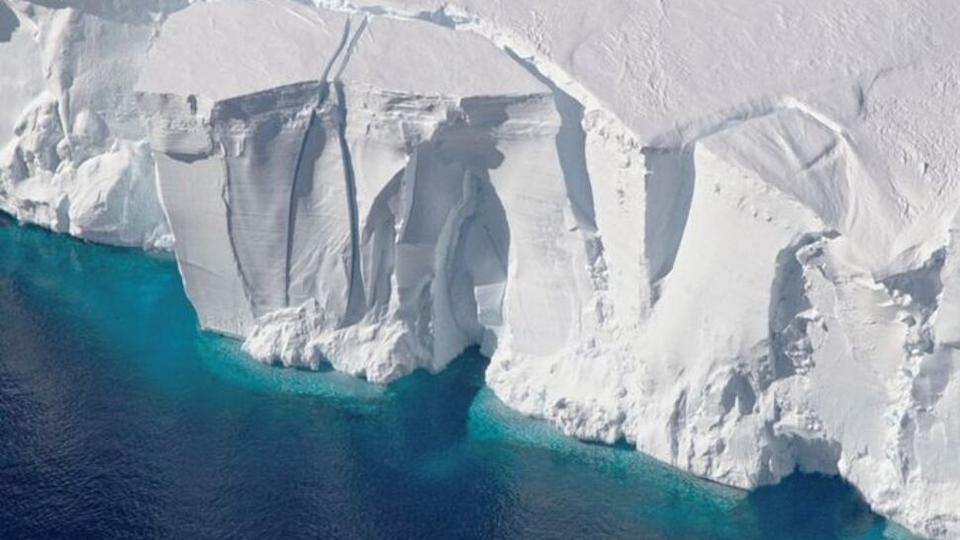
An aerial view of the 60-metre-tall front of the Getz Ice Shelf with cracks, in Antarctica, in this undated handout image.
(Reuters)
Antarctica's coastal
glaciers have been shedding icebergs more rapidly than nature can
replenish the crumbling ice, doubling previous estimates of
losses from the world's largest ice sheet over the past 25
years, a satellite analysis showed.
The first-of-its-kind study, led by researchers at NASA's
Jet Propulsion Laboratory (JPL) near Los Angeles was published
in the journal Nature on Wednesday.
The study's key finding was that the net loss of Antarctic
ice from coastal glacier chunks "calving" off into the ocean is
nearly as great as the net amount of ice that scientists already
knew was being lost due to thinning caused by the melting of ice
shelves from below by warming seas.
Taken together, thinning and calving have reduced the mass
of Antarctica's ice shelves by 12 trillion tonnes since 1997,
double the previous estimate, the analysis concluded.
The net loss of the continent's ice sheet from calving alone
in the past quarter-century spans nearly 37,000 square kilometres, an area almost the size of Switzerland, according to JPL
scientist Chad Greene, the study's lead author.
"Antarctica is crumbling at its edges," Greene said in a
NASA announcement of the findings. "And when ice shelves dwindle
and weaken, the continent's massive glaciers tend to speed up
and increase the rate of global sea level rise."
The consequences could be enormous. Antarctica holds 88 percent of the sea level potential of all the world's ice, he said.
Ice shelves, permanent floating sheets of frozen freshwater attached to land, take thousands of years to form and act like buttresses holding back glaciers that would otherwise easily slide off into the ocean, causing seas to rise.
In recent decades, though, warming oceans have weakened the shelves from underneath, a phenomenon previously documented by satellite altimeters measuring the changing height of the ice and showing losses averaging 149 million tonnes a year from 2002 to 2020, according to NASA.
For their analysis, Greene's team synthesised satellite
imagery from visible, thermal-infrared and radar wavelengths to
chart glacial flow and calving since 1997 more accurately than
ever over 50,000 kilometres of Antarctic coastline.
The losses measured from calving outpaced natural ice shelf
replenishment so greatly that researchers found it unlikely
Antarctica can return to pre-2000 glacier levels by the end of
this century.
The accelerated glacial calving, like ice thinning, was most
pronounced in West Antarctica, an area hit harder by warming
ocean currents.
But even in East Antarctica, a region whose ice
shelves were long considered less vulnerable, "we're seeing more
losses than gains," Greene said.
Failure to curb greenhouse gas emissions, however, would
risk contributing "many meters of sea level rise over the next
few centuries," he said.