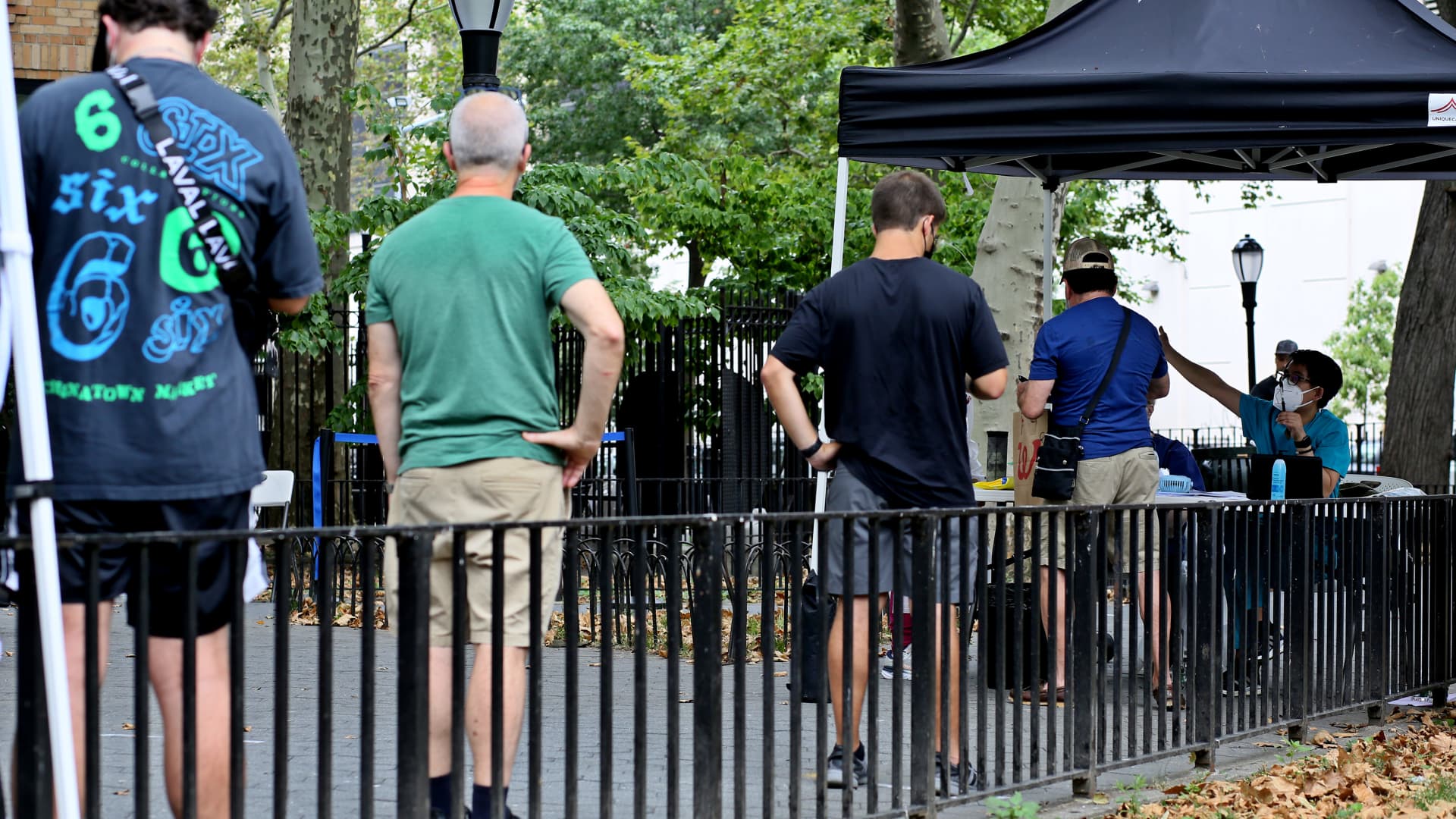
(FILES) In this file photo taken on July 17, 2022 people wait in line to recieve the Monkeypox vaccine before the opening of a new mass vaccination site at the Bushwick Education Campus in Brooklyn in New York City. - The United States on August 4, 2022 declared monkeypox a public health emergency, a move that should free up funds, assist in data gathering and deploy additional personnel in the fight against the disease. (Photo by Kena Betancur / AFP) (Photo by KENA BETANCUR/AFP via Getty Images)
Laboratory studies are investigating whether the rise in infections is driven by the observed genotypic changes in the virus or by host (human) factors, says World Health Organization.
An electron microscopic image shows mature, oval-shaped monkeypox virus particles as well as crescents and spherical particles of immature virions.
(CDC Handout / Reuters)
Studies are under way to see whether genetic changes in the monkeypox virus are driving the rapid spread of the disease.
"Looking through the genome, indeed there are a few genetic differences between the viruses from the current outbreak and the older Clade IIb viruses," the World Health Organization told the AFP news agency on Wednesday.
The two distinct variants of the virus were called the Congo Basin (Central African) and West African clades, after the two regions where they are each endemic. On Friday, the WHO renamed the groupings as Clade I and Clade II respectively, to avert the risk of geographic stigmatisation.
It also announced that Clade II had two sub-clades, IIa and IIb, the latter identified as being behind the current global outbreak.
On Wednesday, the UN health agency specified that Clades IIa and IIb are related and share a recent common ancestor – therefore IIb is not an offshoot of IIa.
Clade IIb contains viruses collected in the 1970s, and from 2017 onwards.
"However, nothing is known about the significance of these genetic changes, and research is ongoing to establish the effects (if any) of these mutations on transmission and disease severity.
"It is still early on in both the outbreak and laboratory studies to tell if the rise in infections could be driven by the observed genotypic changes in the virus, or are due to host (human) factors," the WHO said.
There is also no information yet on what the mutations mean in terms of how the virus interacts with the human immune response.
A surge in monkeypox infections has been reported since early May outside the endemic African countries.
The WHO declared the situation an international public health emergency on July 23.
More than 35,000 cases in 92 countries, and 12 deaths, have now been reported to the WHO.
Almost all new cases are being reported from Europe and the Americas.
Experts have been studying samples from cases.
"The diversity between the viruses responsible for the current outbreak is minimal, and there are no obvious genotypic differences between the viruses from the non-endemic countries," the WHO said.
When viruses jump the species barrier it often sparks concern that they could mutate dangerously, but WHO has stressed that so far there were no reports that was happening with monkeypox.
Monkeypox causes fever, muscular aches and large boil-like skin lesions.
()
The World Health Organization has called for people infected with monkeypox to avoid exposing animals to the virus following a first reported case of human-to-dog transmission.
A first case of human-to-dog transmission of monkeypox was reported last week in the medical journal The Lancet. The case was reported in a greyhound in Paris.
"This is the first case reported of human-to-animal transmission... and we believe it is the first instance of a canine being infected," Rosamund Lewis, the WHO's technical lead for monkeypox, told reporters on Wednesday.
Experts had been aware of the theoretical risk that such a jump could happen, she said, adding that public health agencies had already been advising those suffering from the disease to "isolate from their pets".
She also said "waste management is critical" to lowering the risk of contaminating rodents and other animals outside the household.
When viruses jump the species barrier it often sparks concern that they could mutate dangerously.
Lewis stressed that so far there were no reports that was happening with monkeypox.
But she acknowledged that "as soon as the virus moves into a different setting in a different population, there is obviously a possibility that it will develop differently and mutate differently".
The main concern revolves around animals outside of the household.
"The more dangerous situation... is where a virus can move into a small mammal population with high density of animals," WHO emergencies director Michael Ryan told reporters.
"It is through the process of one animal infecting the next and the next and the next that you see rapid evolution of the virus."
He stressed though that there was little cause for concern around household pets.
"I don't expect the virus to evolve any more quickly in one single dog than in one single human," he said, adding that while "we need to remain vigilant... pets are not a risk."
Monkeypox was originally identified in monkeys kept for research in Denmark in 1958, though it is found most frequently in rodents.
The disease was first discovered in humans in 1970, with the spread since then mainly limited to certain West and Central African countries.
But in May, cases of the disease, which causes fever, muscular aches and large boil-like skin lesions, began spreading rapidly around the world.
Worldwide, more than 35,000 cases have been confirmed since the start of the year in 92 countries, and 12 people have died, according to the WHO, which has designated the outbreak a global health emergency.
With global case numbers jumping by 20 percent in the past week alone, the UN health agency is urging all countries to do more to rein in the spread, including ensuring at-risk populations have access to services and information about the dangers and how to protect themselves.
There is also a vaccine, originally developed for smallpox, but it is in short supply.
Lewis also stressed that there was still little data on the effectiveness of the vaccine in protecting against monkeypox in the current outbreak.
Announcement is billed to help bolster response to the outbreak that has infected more than 6,600 Americans, around a quarter of them from New York state.
Announcement frees federal funding and resources to fight virus, which may cause fever, body aches, chills, fatigue and pimple-like bumps on many parts of body.
(Richard Vogel / AP)
The United States has declared a public health emergency to bolster the federal response to the outbreak of monkeypox that already has infected more than 6,600 Americans.
"We're prepared to take our response to the next level in addressing this virus, and we urge every American to take monkeypox seriously and to take responsibility to help us tackle this virus," Health and Human Services secretary Xavier Becerra said in a call on Thursday.
The declaration, which is initially effective for 90 days but can be renewed, came as nationwide cases topped 6,600, around a quarter of them from New York state.
Experts believe the real number could be much higher in the current outbreak since the symptoms can be subtle, including single lesions.
The announcement frees federal funding and resources to fight the virus, which may cause fever, body aches, chills, fatigue and pimple-like bumps on many parts of the body.
The declaration comes as the the Biden administration has faced criticism over the pace of vaccine availability for monkeypox.
Clinics in major cities like New York and San Francisco say they haven't received enough of the two-shot vaccine to meet demand and some have had to stop offering the second dose of the vaccine to ensure the supply of first doses.
The US has so far delivered some 600,000 JYNNEOS vaccines –– originally developed against monkeypox's related virus, smallpox –– but this number figure is still far short of the approximately 1.6 million people considered at highest risk and who need the vaccine most.
The monkeypox virus spreads through prolonged and close skin-to-skin contact, including hugging, cuddling and kissing, as well as sharing bedding, towels and clothing.
But health officials emphasise that the virus can infect anyone.
The announcement comes three days after the Biden administration named top officials from the Federal Emergency Management Agency and the Centers for Disease Control and Prevention to serve as the White House coordinators to combat the monkeypox outbreak.
The US declaration comes after the World Health Organization also designated the outbreak an emergency last month –– something it reserves for diseases of highest concern.
Biden administration has been criticised for the pace of vaccine availability for monkeypox, while the White House said it has helped to boost domestic diagnostic capacity to 80,000 tests per week.
Clinics in major cities like New York and San Francisco say they haven’t received enough of the two-shot monkeypox vaccine to meet demand.
(Richard Vogel / AP)
The US will declare a public health emergency to bolster the federal response to the outbreak of monkeypox that already has infected more than 6,600 Americans, two people familiar with the matter have said.
The announcement will free up federal funding and resources to fight the virus, which may cause fever, body aches, chills, fatigue and pimple-like bumps on many parts of the body. The people spoke on Thursday on the condition of anonymity ahead of the announcement.
The declaration comes as the the Biden administration has faced criticism over the pace of vaccine availability for monkeypox.
Clinics in major cities like New York and San Francisco say they haven’t received enough of the two-shot vaccine to meet demand and some have had to stop offering the second dose of the vaccine to ensure supply of first doses.
The White House said it has made more than 1.1 million doses of vaccine available and has helped to boost domestic diagnostic capacity to 80,000 tests per week.
The monkeypox virus spreads through prolonged and close skin-to-skin contact, including hugging, cuddling and kissing, as well as sharing bedding, towels and clothing.
But health officials emphasise that the virus can infect anyone.
The announcement comes three days after the Biden administration named top officials from the Federal Emergency Management Agency and the Centers for Disease Control and Prevention to serve as the White House coordinators to combat the monkeypox outbreak.
News of the expected declaration was first reported Thursday by Politico.
New York City Mayor Eric Adams on Monday declared a state of emergency over the monkeypox outbreak that has now infected more than 1,200 people in the city, representing a quarter of all cases nationwide.
Adams said his order will bolster the city’s efforts "to educate, vaccinate, test, and treat as many New Yorkers as possible and ensure a whole-of-government response to this outbreak."
New York Mayor Eric Adams speaks during a news conference at City Hall in New York City, U.S., January 24, 2022.
(REUTERS/Brendan McDermid)
Adams' state of emergency will allow him to suspend local laws and implement new health rules.
New York Gov. Kathy Hochul has already declared a state disaster emergency over monkeypox, and the state health department has called monkeypox an "imminent threat to public health."
New York City Health Commissioner Ashwin Vasan said as many as 150,000 city residents could be at risk of infection.
The World Health Organization declared monkeypox a global health emergency on July 23 and San Francisco's mayor on Thursday announced a state of emergency over the growing number of cases.
The once-rare disease has been established in parts of central and western Africa for decades but was not known to spark large outbreaks beyond the continent or to spread widely among people until May, when authorities detected dozens of epidemics in Europe, North America and elsewhere.
Tubes labled "Monkeypox Virus" with positive and negative results pictured in this illustration taken May 23, 2022.
(REUTERS/Dado Ruvic/Illustration)
To date, there have been more than 22,000 monkeypox cases reported in nearly 80 countries since May, with about 75 suspected deaths in Africa, mostly in Nigeria and Congo. On Friday, Brazil and Spain reported deaths linked to monkeypox, the first reported outside Africa. Spain reported a second monkeypox death Saturday.
The virus spreads through prolonged and close skin-to-skin contact as well as sharing bedding, towels and clothing. In Europe and North America, it has spread primarily among men who have sex with men, though health officials emphasize that the virus can infect anyone.
The type of monkeypox virus identified in this outbreak is rarely fatal, and people usually recover within weeks. But the lesions and blisters caused by the virus are painful.
The declaration will allow US officials to implement measures to fight against the virus that spreads through prolonged and close skin-to-skin contact and sharing bedding, towels and clothing.
New York had recorded 1,345 cases as of Friday, according to data compiled by the Centers for Disease Control and Prevention. California had the second-most, with 799.
(Reuters)
Officials in New York City have declared a public health emergency due to the spread of the monkeypox virus, calling the city “the epicentre” of the outbreak.
The announcement on Saturday by Mayor Eric Adams and health Commissioner Ashwin Vasan said as many as 150,000 city residents could be at risk of infection.
In the last two days, New York Gov Kathy Hochul declared a state disaster emergency declaration and the state health department called monkeypox an “imminent threat to public health.”
New York had recorded 1,345 cases as of Friday, according to data compiled by the Centers for Disease Control and Prevention. California had the second-most, with 799.
“We will continue to work with our federal partners to secure more doses as soon as they become available,” Adams and Vasan said in the statement.
"This outbreak must be met with urgency, action, and resources, both nationally and globally, and this declaration of a public health emergency reflects the seriousness of the moment.”
The World Health Organization declared monkeypox a global health emergency on July 23 and San Francisco's mayor on Thursday announced a state of emergency over the growing number of cases.
The once-rare disease has been established in parts of central and west Africa for decades but was not known to spark large outbreaks beyond the continent or to spread widely among people until May, when authorities detected dozens of epidemics in Europe, North America and elsewhere.
To date, there have been more than 22,000 monkeypox cases reported in nearly 80 countries since May, with about 75 suspected deaths in Africa, mostly in Nigeria and Congo.
On Friday, Brazil and Spain reported deaths linked to monkeypox, the first reported outside Africa. Spain reported a second monkeypox death Saturday.
The virus spreads through prolonged and close skin-to-skin contact as well as sharing bedding, towels and clothing.
The type of monkeypox virus identified in this outbreak is rarely fatal, and people usually recover within weeks. But the lesions and blisters caused by the virus are painful.
People wait on line to register for a monkeypox vaccination shot on July 29, 2022 in New York City.
John Smith | Corbis News | Getty Images
New York Gov. Kathy Hochul declared a state disaster emergency Friday night over the continued spread of monkeypox.
She said the emergency declaration would lead to swifter response and better vaccination distribution. It came a day after the New York State Commissioner of Health declared monkeypox an "imminent threat to public health."
"I am declaring a State Disaster Emergency to strengthen our ongoing efforts to confront the monkeypox outbreak," Hochul tweeted Friday.
Hochul indicated the state is an emerging center for the virus, which manifests in symptoms of rashes and lesions across the body, extremities and genitals.
"More than one in four monkeypox cases in this country are in New York State, and we need to utilize every tool in our arsenal as we respond," Hochul wrote.
The emergency, enacted through executive order, allows EMS personnel, pharmacists, midwives, physicians and certified nurse practitioners to administer vaccinations, the governor's office said in a statement.
The state was already in the process of securing more vaccines, expanding testing, and distributing information via a website and a text notification system, the governor's office said.
On Thursday, Hochul said a new federal government allotment would mean 110,000 additional doses of the monkeypox vaccine for the state, for a total of 170,000 so far.
The governor emphasized the importance of getting vaccines to neighborhoods and communities affected by rapid spread.
"It's especially important to recognize the ways in which this outbreak is currently having a disproportionate impact on certain at-risk groups," she said in the late-Friday statement.
The virus, spread through physical contact, can develop flu-like symptoms, and its initial impacts can last as long as four weeks.
Because men who have sex with men are in the virus' highest- risk cohort, the World Health Organization on Wednesday recommended people in that group limit their number of sexual partners as a precaution.
Monkeypox cases have been reported this year in 71 countries where it was previously unknown or unreported, according to the CDC.
The U.S. has recorded 5,189 cases this year, according to CDC data as of Friday.
Oh Thursday the city of San Francisco declared its own health emergency over the virus.
ISLAMABAD: The government has increased surveillance for the monkeypox disease after WHO declared it a public health emergency of international concern, a spokesperson of the Ministry of National Health has stated.
A meeting, chaired by Federal Health Minister Abdul Qadir Patel, was attended by the special secretary health, D.G. Health, and representatives of the interior ministry and FIA.
Pakistan government has decided to increase surveillance for the monkeypox disease after the World Health Organisation (WHO) declared it a public health emergency of international concern. No case of monkeypox had been diagnosed in Pakistan yet, health officials said.
Health Minister Patel said that an effective surveillance regime has been working for monkeypox disease. “All hospitals have been instructed to take necessary measures for the disease,” he said.
Globally, there have so far been 16,016 monkeypox cases of which 3,269 were reported in the last week, according to WHO data.
“All the national and provincial health authorities have been advised to remain on high alert for any suspected case of monkeypox as the government has started taking effective measures to prevent the disease,” Health Minister Abdul Qadir Patel said.
He said that international health regulations related to monkeypox will be fully implemented in the country. “The government would continue its work as per the guidelines of WHO”, he said.
The health ministry has issued instructions to all stakeholders, especially border health services, to strictly monitor the suspected cases at all points of entry in the country and ensure an effective monitoring mechanism. The screening of all incoming passengers will be ensured particularly passengers coming from African countries, he added.
The health minister has also directed the pandemic response body National Command and Operation Centre (NCOC) to ensure regular monitoring of the monkeypox situation in the country along with COVID-19 infections.
The spokesperson of the Ministry of National Health Services said the situation is being closely monitored by the health authorities.
Monkeypox is a rare disease caused by infection with the monkeypox virus. This virus is part of the same family of viruses that causes smallpox. Monkeypox can spread in three ways, from person to person, from animals to humans, and through direct contact with contaminated objects. In most cases, the symptoms of monkeypox go away on their own but in some people, it may lead to medical complications and even death.
In most cases, Monkeypox starts with a fever and often flu-like symptoms followed by a rash that can spread to many areas of the body. Symptoms include fever, headache, muscle aches and backache, swollen lymph nodes, chills and exhaustion.
The government has decided to increase surveillance in the country after the World Health Organization declared the monkeypox outbreak a global health emergency.
In a statement, Minister for National Health Services Abdul Qadir Patel said all national and provincial health authorities have been advised to remain on high alert for any suspected case of monkeypox.
He said the government has started taking effective measures to prevent the disease.
The Minister said the government will continue its work as per guidelines of the WHO and the recommendations on the basis of international health regulations will be fully implemented in the country.
He said instructions have been issued to stakeholders, especially border health services of the Central Health Establishment for strict monitoring at all points of entry in the country.