Written by Jessica Bumpus, CNN
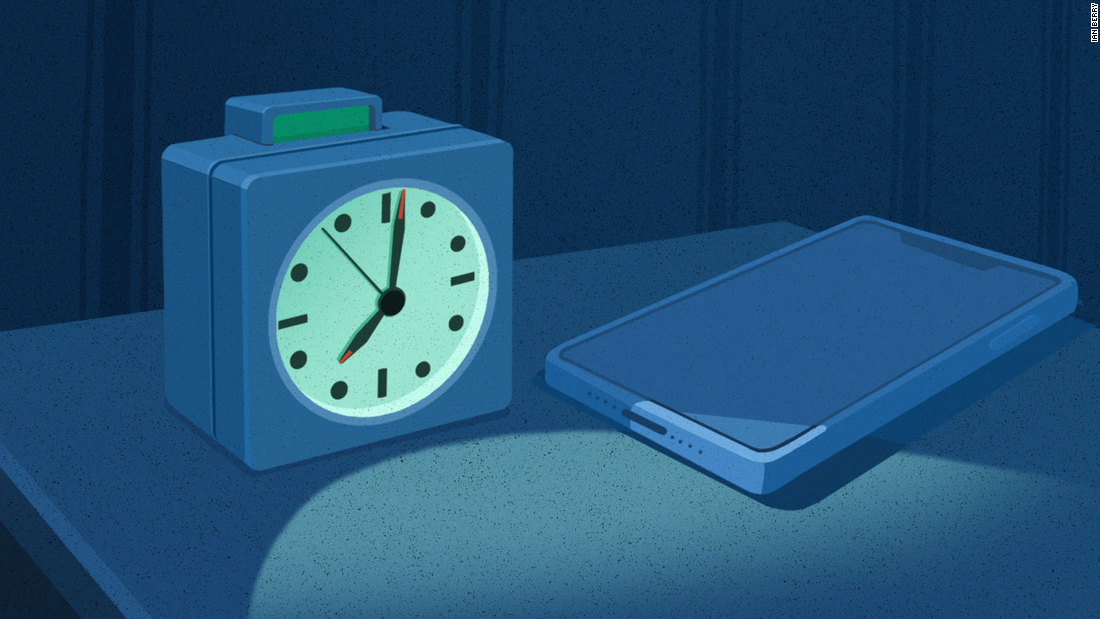
I have reinstated the alarm clock. An overlooked mechanism in today's technologically-synced, your-phone-does-everything world, it tells the time, it wakes you up, it is decentralized from a phone. It is marvelous.
Why? Because before I brought an analogue clock back into my bedroom I was averaging two hours and 56 minutes of screen time per week, and my phone told me this every Monday, moments after my alarm would sound.
And, every morning, while only trying to tap "snooze," I'd be confronted by a flurry of notifications piling up behind one another like a card game of solitaire on the screen. My phone would tell me that my friends were feeling chatty last night with 34-plus Whatsapp messages; there would be Instagram alerts and dozens of emails from multiple accounts. The notifications would fill me with a dread and stress about the day ahead before I'd even had my morning coffee.
I didn't realize it at the time, but my old analogue clock -- a compact, travel model -- was a low-key luxury.
Its design would have paled in comparison to the latest iPhones, but it did its one job very well; its punctuating and shrill screech was effective at waking me up every morning. Pertinently, it wasn't filling my mind with chatter, bad news and deadlines before the day had begun.
Changing habits
I made the switch from alarm clock to phone about 10 years ago after I told someone what I thought was a funny story about how my alarm clock had once gone off in my suitcase while in the trunk of a taxi, forcing us to pull over so I could retrieve it. The story provoked bemusement. "You use an actual alarm clock?" they asked, as though it was a fax machine. "Why don't you use your phone!" Oh, I thought. Why don't I? I probably didn't even know I could at the time. But I succumbed to peer pressure and did away with my old clock. And that's when the luxury of waking up without notifications ended, and the misery of glancing at them in the middle of the night when I checked the time on my phone began.
"The re-introduction of an alarm clock gives me the time, space and separation that my phone didn't."
As our use of cell phones continues to grow (a 2018 report by Deloitte found that American smartphone users check their phones 14 billion times a day, up from 9 billion in the same report from 2016), wellness experts say it is having a negative impact our morning routines.
"When you wake up first thing, the ideal is to wake up and spend a little bit of time within your own mind before you're bombarded with everything else in the world that's going on. Give yourself a chance to adjust to the waking world," said mental health and wellbeing coach Lily Silverton. "Historically we're not used to having our attention taken away as much as it is today."
Before alarms, it was roosters, church bells, knocker-uppers (people who were paid to wake you up by tapping on the door or window with a long stick, which happened up until the 1970s in industrial Britain) and even our very own bladders that got us out of bed. It is widely thought that the clockmaker Levi Hutchins from Concord, New Hampshire, invented one of the first alarm clocks in 1787. His design would only go off once at 4am, his preferred time to wake. Little appears to be known on the details of the actual design, but he wrote, "It was the idea of a clock that could sound an alarm that was difficult, not the execution of the idea. It was simplicity itself to arrange for the bell to sound at the predetermined hour." Hutchins never patented or manufactured this clock.
It was years later, in 1874, when the French inventor Antoine Redier became the first person to patent an adjustable mechanical alarm clock. And in 1876, a small mechanical wind-up clock was patented in the US by Seth E. Thomas, which prompted major US clockmakers to start making small alarm clocks. German clockmakers reportedly soon followed and by the end of the 1800s, the electric alarm clock had been invented.
5 things we still get wrong about sleep, according to an expert
Shopping for clocks
Today, alarm clocks come in any number of designs. From riffs on the Panasonic RC-6025 radio alarm clock, immortalized in the 1993 film Groundhog Day, to more retro designs from classic brands like Roberts. A quick search on Etsy reveals novelty designs in the shape of robots, owls or even rabbits.
Elsewhere, more modern designs include the addition of colour night lights, projectors (to project the time on your ceiling or wall! No, thank you), USB ports speakers, temperature and humidity control, and even teen-proof bed-shakers.
Last year, the late Virgil Abloh's Off-White label teamed up with Braun to release a pair of sleek limited-edition alarm clocks. In orange and blue, the design is based on the brand's classic BC02 alarm clock which, strikingly simple, had been originally conceived by Dieter Rams and Dietrich Lubs in the 1980s. Fashion brand Paul Smith, too, released its version of the clock back in 2020.
All I was after, though, was a straightforward alarm clock, much like my original. And I got one from the local homegoods store nearby for £8.50 (just over 10 dollars). The first night I used it, I felt oddly excited as I physically wound the setting as opposed to swiping on a screen. The next morning, in somewhat of an anti-climax, I woke up before the alarm. But I'd already felt like I had conquered the day, instead of chasing it.
According to Silverton, "Technology exploits our psychological weaknesses." And being connected, she noted, is incredible but terrible at the same time. "It's managing that and creating a routine that works for you."
Which now I think I have. The re-introduction of an alarm clock gives me the time, space and separation that my phone didn't. Even though my phone still sits next to the bed, the difference is it's no longer the first thing I'm reaching for. My first utterance of the day is no longer blaspheming about an email and feeling my blood boil, I find myself gently considering what I might have for breakfast. Which has given me a sense of control and calm. Bizarrely, it has made me feel younger -- I supposed because the experience feels nostalgic, or perhaps because I'm getting better sleep. And what can be more luxurious than that?