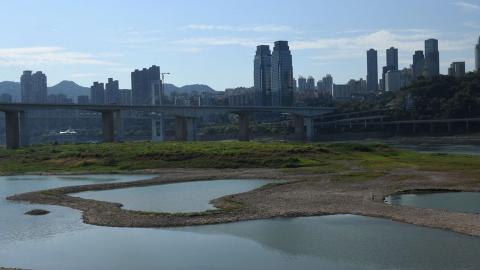
Heatwave starting on Wednesday is expected to flag "excessive heat warnings" in some parts of California, Nevada and Arizona states.
Death Valley, lying between California and Nevada, is known as one of the hottest places on earth, yet, this year it was hit by flash flooding.
(National Park Service / AP)
A "dangerous" heatwave is taking hold of the southwestern United States, with punishing temperatures expected for the next week.
Forecasters said on Tuesday the mercury could reach as high as 44 Celsius in the densely populated Los Angeles suburbs as a heat dome settles in over parts of California, Nevada and Arizona.
"Dangerously hot conditions expected through the week," the National Weather Service (NWS) warned.
"A prolonged period of excessive heat will significantly increase the potential for heat-related illnesses, particularly for those working or participating in outdoor activities," the NWS said.
"Those without access to adequate or reliable cooling or hydration will be at most risk, but much of the population could be susceptible to impacts as well."
Nighttime temperatures are not expected to offer much relief, with lows struggling to get below 26.6 Celsius in many places.
Things were heating up in and around Los Angeles on Tuesday, with inland areas already experiencing stifling temperatures.
But, said David Sweet, a meteorologist at the NWS in Oxnard, California, it is going to get worse.
"We're looking at a heatwave starting on Wednesday and continuing through at least Monday of next week," he told the AFP news agency.
"During that time, we'll be looking at conditions hot enough to warrant an excessive heat warning," he added.
READ MORE:US Death Valley set to claim record for world's hottest temperatureGlobal heating
It is not unusual for southern California to experience heatwaves in September but temperatures above 37.7 Celsius are considered hot even for a place almost perpetually baked by sunshine.
The heat wave comes after swathes of the southwest were lashed with torrential rains over recent weeks.
Some areas, including the notoriously dusty and hot Death Valley, suffered flooding, and one person died after being swept away in Zion National Park in Utah.
Scientists say global heating, which is being driven chiefly by humanity's unending appetite for the power that fossil fuel provides, is making natural weather variations more extreme.
Heatwaves are getting hotter and more intense, while storms are getting wetter and, in many cases, more dangerous.
Source: AFP
Experts say the intensity, scope and duration of the heatwave could make it one of the worst recorded in global history.
The worst-affected area is the Yangtze river basin, with the Tibetan Plateau facing "severe" to "extraordinary" drought conditions.
(AFP)
Half of China's vast territory is now experiencing drought as the country goes through its hottest summer on record, with more high temperatures forecast for today.
A chart from the National Climate Centre showed on Wednesday that swathes of southern China, including the Tibetan Plateau, were experiencing "severe" to "extraordinary" drought conditions.
The world's second-largest economy has been hit by record heat, flash floods and droughts. Scientists say the extreme weather phenomena are becoming more frequent and intense due to climate change.
Southern China has recorded its longest continuous period of high temperatures since records began more than 60 years ago, the agriculture ministry said this week.
The worst-affected area is the Yangtze river basin, stretching from coastal Shanghai to Sichuan province in China's southwest. It is home to over 370 million people and contains several manufacturing hubs including the megacity of Chongqing.
The China Meteorological Administration predicted continued high temperatures of up to 40 degrees Celsius (104 degrees Fahrenheit) in Chongqing and the provinces of Sichuan, Jiangxi and Zhejiang on Thursday.
READ MORE: China sees 'severe threat’ to harvest amid hottest summer on record
[embed]https://www.youtube.com/watch?v=BA0G6XEw4ZE[/embed]
Record low water levels
China's State Council on Wednesday announced a $1.45 billion (10 billion yuan) subsidy to support rice farmers experiencing drought conditions which authorities have warned pose a "severe threat" to this year's autumn harvest.
China produces more than 95 percent of the rice, wheat and maize it consumes, but a reduced harvest could mean increased demand for imports in the world's most populous country -- putting further pressure on global supplies already strained by the conflict in Ukraine.
Officials also called for "a combination of measures to increase water sources to fight drought, first ensure drinking water for the people, ensure water for agricultural irrigation," the State Council added.
Wednesday's CCTV evening news broadcast showed trucks supplying villagers who lacked drinking and agricultural water in rural Sichuan and Chongqing, with remote mountain areas particularly hard hit.
Temperatures as high as 45C (113F) have led multiple Chinese provinces to impose industrial power cuts, as cities struggle to cope with a surge in demand for electricity partly driven by people cranking up the air conditioning.
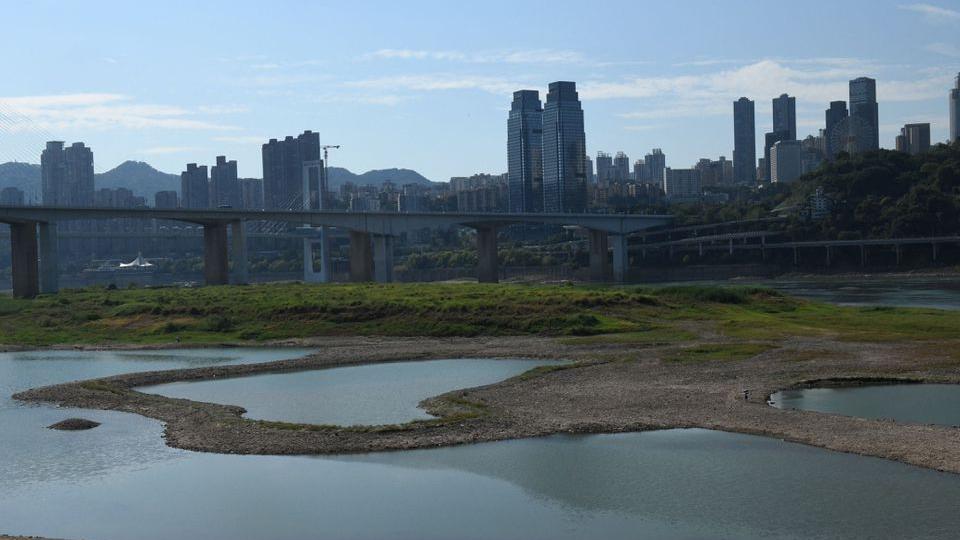
Record low water levels on the Yangtze River have also put pressure on the region's hydropower generators.
The heat broke records in Sichuan, where a temperature of 43.9C (111F) was recorded Wednesday afternoon, the province's Meteorological Service Centre said in a statement.
READ MORE: China's southwest extends power curbs as heatwave continues
Source: AFP
Power rationing that forced factories in China’s southwest to shut down has been extended due to low water at hydroelectric dams.
State weather forecasters issued a heat "red alert" for the 11th consecutive day, as extreme weather continues to play havoc with power supplies and damage crops.
(Reuters)
China's scorched southwestern
regions have extended curbs on power consumption as they
deal with dwindling hydropower output and surging household
electricity demand during a long drought and heatwave.
State weather forecasters issued a heat "red alert" for the
11th consecutive day on Monday, as extreme weather continues to
play havoc with power supplies and damage crops.
They also
raised the national drought alert to "orange" - the
second-highest level.
The drought has already "severely affected" mid-season rice
and summer corn in some southern regions, the ministry of
agriculture said on Sunday.
The National Meteorological Center said as many as 62
weather stations, from Sichuan in the southwest to Fujian on the
southeastern coast, recorded record temperatures. The
situation could improve starting Wednesday as a cold front moves
into China via Xinjiang.
The region of Chongqing, which hit temperatures of 45
degrees Celsius late last week,
announced that opening hours at more than 500 malls and other
commercial venues would be shortened starting Monday to ease
power demand.
Two malls on the list contacted by Reuters news agency confirmed that they had received the government notice and would
abide by the new opening hours. Two hotels on the list said they
were still operating normally but were restricting air
conditioner use.
READ MORE:China issues national drought alert after weeks of extreme heatFurther measures
In neighbouring Sichuan province, a major hydropower
generator, authorities also extended existing curbs on
industrial power consumers until August 25, financial news service
Caixin said on Sunday. Power generation in Sichuan is at just
half the normal level.
It cited firms in the battery industry as saying that
industrial power users in the cities of Yibin and Suining had
been told to remain closed until Thursday.
A Sichuan-based pesticide producer, Lier Chemical Co Ltd
, confirmed in a notice on Monday that output
restrictions at two of its production bases in the province
would continue until August 25th.
Toyota Motor Corp gradually resumed operations at
its Sichuan plant in China on Monday using a power generator
after suspending operations last week, the company's
spokesperson said.
Other regions have also sent 50 emergency power generating
vehicles to Sichuan since last Thursday to help alleviate
shortages.
Several plants in Sichuan and Chongqing, including those of
top battery maker CATL and the electric vehicle
giant BYD, have been only able to partially operate
in recent weeks because of power shortages.
READ MORE:Several dead, missing after flash floods in northwest China
Source: Reuters