‏إظهار الرسائل ذات التسميات decline. إظهار كافة الرسائل

Asian stocks decline amid tensions over Pelosi's visit to Taiwan

Stocks across the board tumbled as jitters about an escalation in regional tension with US House Speaker Nancy Pelosi set to begin a trip to Taiwan, adding to fears about the risk of global recession.

The week began with China, Europe and the United States reporting weakening factory activity, with that in the US decelerating to its lowest level since August 2020.
The week began with China, Europe and the United States reporting weakening factory activity, with that in the US decelerating to its lowest level since August 2020. (Reuters Archive)

Asian shares have been mostly lower amid concerns about regional stability as an expected visit by US House Speaker Nancy Pelosi to Taiwan prompted threats from Beijing.

Benchmarks headed downward across the board in the region in early trading on Tuesday, including Japan, China, South Korea and Australia.

US long-term Treasury yields dropped to a four-month low, pulling the US dollar down, amid a bid for safer assets after China threatened repercussions in the event of the visit by Pelosi to the self-ruled island, which China claims as its territory. Crude oil also sank.

Japan's benchmark Nikkei 225 declined 1.4 percent to 27,594.73. South Korea's Kospi slipped 0.5 percent to 2,439.62. Hong Kong's Hang Seng dropped 2.5 percent to 19,675.87, while the Shanghai Composite dove 2.3 percent to 3,186.27.

Meanwhile, Australian stocks pared declines and the Aussie dollar weakened after the central bank raised the key rate by an as-expected 50 basis points, with markets interpreting changes to the accompanying policy statement as dovish.

Taiwan visit tensions

China sees Taiwan as its own territory and has repeatedly warned of “serious consequences” if the reported trip to the island goes ahead. 

Pelosi has said she is visiting Singapore, Malaysia, South Korea and Japan for talks on a variety of topics, including trade, Covid-19, climate change and security.

While there have been no official announcements, local media in Taiwan reported Pelosi will arrive on Tuesday night, making her the highest-ranking elected US official to visit in more than 25 years.

The week began with China, Europe and the United States reporting weakening factory activity, with that in the US decelerating to its lowest level since August 2020.

That sank crude, with Brent futures edging down to $99.27 a barrel on Tuesday after losing almost $4 overnight. 

US West Texas Intermediate futures also eased to $93.26, extending Monday's almost $5 slide.

The benchmark 10-year US Treasury yield fell as low as 2.53 percent in Tokyo trade, the lowest since April 5, amid wagers the slowdown could spur the US Federal Reserve to ease off the policy-tightening pedal. 

The bonds also benefited from safety-seeking demand before Pelosi's Taiwan visit.

That helped the US dollar slide as low as 130.40 yen for the first time since June 6. The euro jumped as high as $1.0294, a level not seen since July 5.

The Taiwan dollar slipped to its lowest level in more than two years on the weaker side of 30 per US dollar.

READ MORE: US Pelosi's 'provocative' Taiwan visit to undermine ties — China

[embed]https://www.youtube.com/watch?v=25adtd0zrXs[/embed]

Source: AP


Source https://www.globalcourant.com/asian-stocks-decline-amid-tensions-over-pelosis-visit-to-taiwan/?feed_id=5503&_unique_id=62e8df7cf24e2

COVID positivity rate sees slight decline after nearing 3% in Pakistan

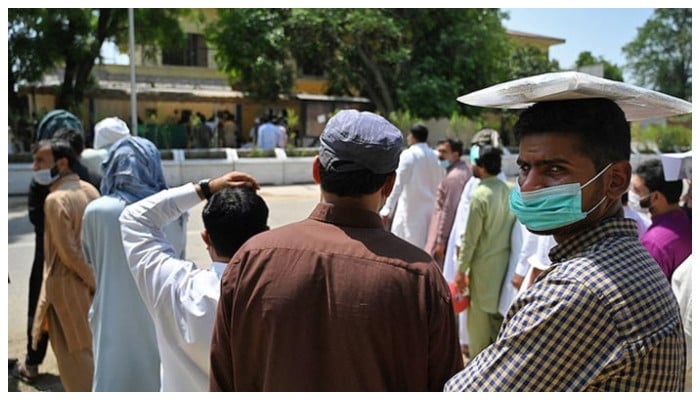
Citizens wearing face masks amid concerns over the spread of coronavirus, wait in a queue in Islamabad, Pakistan, on May 19, 2021. — AFP/File
  • Pakistan reports 532 COVID-19 cases in last 24 hours.
  • Country's positivity ratio stands at 2.74%.
  • COVID-19 claims three more lives overnight.

The COVID-19 positivity ratio in Pakistan has witnessed a slight decline after nearing 3% for several days, the National Institute of Health, Islamabad (NIH) data showed Sunday morning.

Pakistan reported 532 COVID-19 cases during the last 24 hours, which placed the country's coronavirus positivity ratio at 2.74%. The new infections were detected after diagnostic testing on 19,402 samples.

Moreover, the virus claimed the lives of three more people overnight, pushing the country's COVID-19 death toll to 30,467.

Meanwhile, 179 coronavirus patients are being treated in critical care units of different medical facilities across the country.

What is COVID BA.5 variant and why is it reinfecting so many people?

BA5, part of the Omicron family, is the latest coronavirus variant to cause widespread waves of infection globally.

According to the World Health Organisation’s most recent report, it was behind 52% of cases sequenced in late June, up from 37% in one week. In the United States, it is estimated to be causing around 65% of infections.

Rising case numbers

BA5 is not new. First identified in January, it has been tracked by the WHO since April.

It is a sister variant of the Omicron strain that has been dominant worldwide since the end of 2021 and has already caused spikes in case rates – even with reduced testing – in countries including South Africa, where it was first found, as well as the United Kingdom, parts of Europe, and Australia.

Coronavirus cases worldwide have now been rising for four weeks in a row, WHO data showed.

Why is it spreading

Like its closely related sibling, BA4, BA5 is particularly good at evading the immune protection afforded either by vaccination or prior infection.

For this reason, “BA5 has a growth advantage over the other sublineages of Omicron that are circulating,” Maria Van Kerkhove, the WHO’s technical lead on COVID-19, told a news briefing on Tuesday.

For many people, this means that they are getting re-infected, often even a short time after having COVID-19. Van Kerkhove said the WHO is assessing reports of re-infections.

“We have ample evidence that people who’ve been infected with Omicron are getting infected with BA5. No question about it,” said Gregory Poland, a virologist and vaccine researcher with the Mayo Clinic in Rochester, Minnesota.


Source https://www.globalcourant.com/covid-positivity-rate-sees-slight-decline-after-nearing-3-in-pakistan/?feed_id=1174&_unique_id=62dcde9df1119