Australian runner Mina Guli aspires to convince 200 countries by the start of the UN World Conference in March 2023 to take concrete action to address the global water crisis.
“Every one of us has the power to work together to solve it. Individually, you can make an impact, but together, we can change the world,” activist Mina Guli said.
(Elif Öztürk Özgöncü / AA)
An Australian activist, who set out to run 200 marathons to draw attention to global water shortages that are increasing with climate change, has run her 78th marathon race in Istanbul.
“We’re literally in the middle of a massive water problem of a water crisis around the world,” Guli said on Sunday about her “Run Blue” campaign to raise awareness about the water footprint.
Starting her first marathon in her home country on March 22, World Water Day, Mina Guli, 52, set foot in the Turkish metropolis to start the European leg of her campaign after completing marathons in Uzbekistan, Tajikistan, Kenya, Tanzania, Malawi, Zambia, Zimbabwe, Botswana, South Africa and Türkiye’s Lake Tuz (Salt Lake) in the central province of Konya.
“Unfortunately, for most people it is hidden, but I’ve seen it and I want the world to see it, too,” she said.
Guli pointed out that companies are responsible for almost 90 percent of the world’s water use, directly or indirectly, and she aspires to convince 200 countries to take concrete action or “Run Blue” by completing the marathons by the start of the UN World Conference in March 2023.
[embed]https://www.youtube.com/watch?v=9kqd6aFDNEQ[/embed]
'Failure isn't an option'
Guli underlined that with accelerating climate change, the global water crisis requires urgent action.
“We cannot hope anymore. Now we need to make things happen. We’re beyond the time of hope. We are into the time of opportunity for change because frankly, failure isn’t an option. We don’t have a planet B,” she said.
Two months earlier, Guli ran a marathon in the Aral Sea, the fourth largest lake in the world, 90 percent of which has dried up due to water that has not been replenished and increasing temperatures.
WATCH: Scientists say Europe's drought will be worst in 500 years
"I thought to myself for 30 years scientists told us that this lake would dry up and we just ignored them. People told us that Lake Urmia would dry up and we ignored them,” she continued.
“Now people are telling us that the Salt Lake in the US is going to dry up and we're ignoring them, too. We see the rivers in Europe drying up. We see the lakes drying up. Lake Tuz has dried up because of climate change and also because of the diversion of the inbound rivers,” she said.
“So we need to find a way to ensure that these warnings are not ignored anymore.”
2023 UN Water Conference
Emphasising that the issue “has been swept under the rug or it's been forgotten about or deprioritised” for more than 50 years, Guli said the Water Conference “is a really great opportunity for us to use as a catalytic moment to drive change by governments, companies and all of us as individuals.”
“We have an opportunity now over the next few months to show our leaders in government in the halls of power, in the boardrooms that we need them to do more."
READ MORE: Wildfires ravaged US states get flash flood warning
Source: TRTWorld and agencies
The Senate on Sunday passed the Inflation Reduction Act (IRA) along party lines, 51-50, handing Democrats a crucial legislative win as the midterm cycle ramps up.
Vice President Kamala Harris cast the tie-breaking vote with all Democrats in support of the legislation and all Republicans opposed. The proposal was passed via the budget reconciliation process, which allows it to be passed with a simple majority rather than the 60 votes typically needed to overcome a filibuster.
The passage of the sprawling climate, tax and health care legislation now sets up a vote in the Democratic-controlled House, where the bill is expected to pass before President Joe Biden signs it into law.
Included in the bill, supporters say, are measures to support job creation, raise taxes on large corporations and the wealthy, allow Medicare to negotiate down some prescription drug costs, expand the Affordable Care Act health care program and invest in combating climate change by implementing tax credits for clean energy initiatives, among other things.
The legislation's tax provisions, prescription drug-pricing reform, as well as boosted IRS tax enforcement measures, are anticipated to raise an estimated revenue of $739 billion -- $300 billion of which Democrats say would go toward reducing the deficit.
The plan would reduce federal budget deficits by $102 billion over 10 years, according to the nonpartisan Congressional Budget Office.
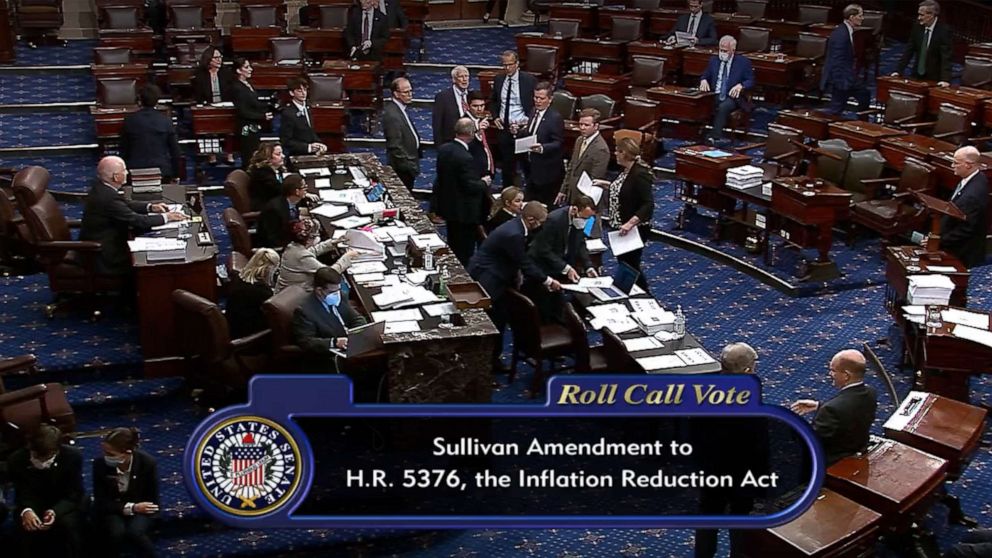
The bill passed the Senate after a punishing, approximately 16-hour "vote-a-rama," in which any senator could introduce an amendment to the bill as part of the budget reconciliation process.
The amendment process fueled painful votes for each party.
Vulnerable Democratic incumbents up for reelection this year had to dance around a vote on the Biden administration's decision to scrap Title 42, a Trump-era order using coronavirus concerns to prevent migrants from entering the country while seeking asylum. Republicans, meanwhile, mostly voted against a Democratic amendment that would have capped out-of-pocket insulin costs at $35 a month for people with private health insurance.
The IRA passage marks the culmination of grueling negotiations between Senate Majority Leader Chuck Schumer, D-N.Y., and Sen. Joe Manchin, D-W.Va., who had been a consistent obstacle to cobbling together a Democrats-only social spending bill via reconciliation.
The pathway for a successful vote was cemented late last week when Sen. Kyrsten Sinema, D-Ariz., another key centrist, signed on after winning some tweaks to the bill.
Senator Patrick Leahy is wheeled to an elevator from the Senate floor during amendment votes, also called the "vote-a-rama", on the Inflation Reduct Act 2022, at the U.S. Capitol building in Washington, Aug. 7, 2022.
Ken Cedeno/Reuters
Among the changes Sinema won were the eliminations of tax provisions targeting wealthy hedge fund managers and private equity executives. The Senate rules official also scrapped a provision intended to reprimand drug companies that raise the prices of some prescription drugs faster than inflation for patients with private insurance.
Still, the bill's passage marks a major step toward President Biden's campaign promises to tackle climate change, reform prescription drug pricing and other issues; and it gives Democrats a new legislative win to run on heading into the November midterms, in an environment where many voters have soured on Biden's handling of the economy and historic inflation.
The IRA also extends a streak of achievements for Biden and congressional Democrats, including passage of a bipartisan anti-gun violence bill and legislation to boost the domestic semiconductor industry.
"This bill is going to change America for decades," Schumer crowed after final passage.
"This vote crystalizes the contrast of the midterms. Senate Democrats have taken a historic step to lower costs like prescription drug prices, tackle inflation and address working families' most pressing concerns. Every Republican voted against the bill because it holds Big Oil, Big Pharma and other corporations that have been jacking up prices accountable, and finally makes them pay their fair share," added Sen. Gary Peters, D-Mich., the chair of Senate Democrats' campaign arm.
Republicans have already forecasted that they'll paint Democrats as uncaring about Americans' financial burdens at a time of rapid price hikes while passing billions of dollars in new spending.
"This idea that this massive tax increase will just somehow be absorbed by corporate America when they will pass those costs along to consumers, and it will make inflation worse," Senate Minority Whip John Cornyn, R-Texas, said last week.