Russia announces a full halt of gas flows to Europe through a key pipeline on day 191 of the conflict, while fighting continues around a nuclear plant where some UN inspectors are on a visit.
Gas prices have sky-rocketed, hurting European industry and households, surging first due to recovering demand after the pandemic and then rising further because of the Ukraine crisis.
(Reuters)
Friday, September 2, 2022US: Russia using energy as a weapon
Moscow is using energy as a tool to pressure Europe, the White House has said about the delayed return of Gazprom's Nord Stream 1 natural gas pipeline, as Europe gets closer to a ban on oil imports from Russia.
"It is unfortunately not surprising that Russia continues to use energy as a weapon against European consumers," a National Security Council spokesperson told the Reuters news agency in an email about the shutdown of the pipeline that sends gas to Europe.
Russia halted gas deliveries to Germany for an indefinite period, after saying on Friday it had found problems in a key piece of equipment, a development that will worsen Europe's energy crisis. Moscow scrapped a Saturday deadline to resume flows on the line, deepening Europe's problems in securing fuel for the upcoming winter.
Gazprom says gas pipeline to Europe shut until turbine repaired
Russia's Gazprom has said natural gas supplies via the Nord Stream 1 pipeline, one of the main supply routes to Europe, will remain shut off after the main gas turbine at Portovaya compressor station near St Petersburg was found to have an "oil leak".
It said the turbine could not operate safely until the leak was repaired, and gave no timeframe for the resumption of gas supplies via the pipeline to Germany.
Nord Stream 1, which runs under the Baltic Sea to supply Germany and others, was running at 20 percent capacity even before flows were halted for three days this week for maintenance. Deliveries were due to resume on Saturday at 0100 GMT.
Russia says it will stop selling oil to countries that set price caps
The Kremlin has said Russia will stop selling oil to countries that impose price caps on Russia's energy resources.
"Companies that impose a price cap will not be among the recipients of Russian oil," Kremlin spokesperson Dmitry Peskov told reporters in a conference call. "We simply will not cooperate with them on non-market principles," Peskov said.
The European Union earlier this year imposed a partial ban on Russian oil purchases. European Commission head Ursula von der Leyen said on Friday it was time for the EU to consider a similar price cap on Russian gas purchases.
Peskov said it was European citizens who were paying the price for such moves, imposed in response to Moscow's military campaign in Ukraine.Russia was studying how a price ceiling on its oil exports might affect its economy, Peskov said.
Energy markets are at fever pitch. This is mainly in Europe, where anti-Russian measures have led to a situation where Europe is buying liquefied natural gas (LNG) from the United States for a lot of money — unjustified money. US companies are getting richer and European taxpayers are getting poorerKremlin spokesperson Dmitry Peskov
G7 to implement Russian oil price cap 'urgently'
G7 industrialised powers have said they will "urgently" move towards the implementation of a price cap on Russian oil imports, in order to stop Moscow from raking in huge profits from soaring energy prices.
Finance ministers from the Group of Seven advanced nations said in a statement they would "urgently work on the finalisation and implementation" of the measure, without specifying the cap level.
The initial price cap would be set "at a level based on a range of technical inputs" they said, adding that its effectiveness would be "closely monitored". G7 leaders agreed in late June to work towards implementing the ceiling on crude sales.
A G7 official in July explained that the maximum price would remain above the cost of the production, so it would not make economic sense for Moscow to deny oil to importing countries.
EU's von der Leyen backs price cap on Russian pipeline gas
Europe needs to impose a price cap on Russian pipeline gas, EU Commission chief Ursula von der Leyen has said, to foil what she said were Russian President Vladimir Putin's attempts to manipulate the bloc's energy market.
She also called for measures to skim off some windfall profits that electricity suppliers have made from the gas crisis, using the money to support vulnerable citizens and companies.
"I firmly believe that it is now time for a price cap on Russian pipeline gas to Europe," von der Leyen told reporters. "A gas price cap can be proposed at European level, and there also is a legal foundation at European level to skim profits temporarily as an emergency measure at a time of crisis," she added.
Both Kiev and Moscow accuse each other of attacking the facility. Dasha Chernyshova has more on the shelling of Zaporizhzhia nuclear power plant pic.twitter.com/LfeKEWVOzN
Ukraine says bombed town housing Russian-held nuclear plant
Ukraine says it has bombed a Russian base in the town of Energodar, where UN inspectors are visiting a Russian-occupied nuclear plant amid safety concerns.
"Targeted strikes by our troops in the localities of Energodar and Kherson have destroyed three artillery systems of the enemy as well as an ammunition depot," the Ukrainian army said.
Arrival of UN inspectors at nuclear plant very positive: Kremlin
The Kremlin says it views as "very positive" the arrival of inspectors from the UN atomic agency at the Russian-controlled Zaporizhzhia nuclear plant in southern Ukraine.
"In general, we are very positive about the fact that, despite all the difficulties and problems...the commission arrived and started to work," Kremlin spokesperson Dmitry Peskov told reporters.
He added, however, that it was "too early" to evaluate the UN team's work. "The main thing is that the mission is there," he said.
A team of inspectors led by International Atomic Energy Agency (IAEA) chief Rafael Grossi on Thursday visited Zaporizhzhia — Europe's largest nuclear facility — that has been held by Russian troops since early March. Several members of the IAEA team remained at the plant after Thursday's visit.
Disconnected reactor of Zaporizhzhia nuclear plant back on Ukraine's grid
The fifth reactor of Ukraine's Russian-occupied Zaporizhzhia nuclear plant was reconnected to Ukraine's grid on Friday, a day after it shut down due to shelling near the site, Ukraine's state nuclear company Energoatom said.
"At present two reactor blocks are working at the station, generating electricity for the needs of Ukraine," Energoatom said on the Telegram messaging app, adding that the fifth reactor had been reconnected at 1.10pm local time (1010 GMT).
The Zaporizhzhia nuclear plant, Europe's largest, was occupied by Russian troops in March, but continues to be operated by Ukrainian engineers despite repeated shelling on its territory, for which Kiev and Moscow blame each other.
[embed]https://www.youtube.com/watch?v=5SV083tEkTI[/embed]
Fourteen Ukrainian service personnel returned in fresh exchange
Fourteen Ukrainian service personnel have been returned to Ukraine in a new prisoner exchange, Ukraine's POW co-ordination centre said on Friday.
The centre did not specify who was released in return. One of the released Ukrainian POWs was an officer, and another a medic, the coordination centre said.
Russia warns US of sending long-range weapons to Ukraine
A senior Russian diplomat has sternly warned Washington against supplying long-range weapons to Ukraine, noting that the US is balancing on the edge of direct involvement in the conflict.
Deputy Foreign Minister Sergei Ryabkov also pointed to the country's military doctrine that envisages the use of nuclear weapons in case of a threat to the existence of the Russian state.
“We have repeatedly warned the US about the consequences that may follow if the US continues to flood Ukraine with weapons," Ryabkov said. “It effectively puts itself in a state close to what can be described as a party to the conflict.”
World food prices fall for fifth month in a row: UN
World food prices have fallen for a fifth consecutive month, partly thanks to the resumption of exports from Ukraine's Black Sea ports, a UN agency has said.
The Food and Agriculture Organisation (FAO) food price index, which tracks the monthly change in international prices of a basket of food commodities, has been falling steadily since hitting an all-time high in March following Russia's offensive against Ukraine.
There was a moderate decline of 1.9 percent in August. Vegetable oils have fallen below their level a year ago, after a 3.3 percent drop. The FAO cereals index fell by 1.4 percent, driven by a 5.1 percent drop in international wheat prices. But global wheat prices were still 10.6 percent above their values in August last year, the FAO said.
Türkiye says six more grain ships left Ukraine under Istanbul deal
Six more ships have left Ukrainian ports under the Istanbul grain export deal, the Turkish National Defence Ministry has said.
A ministry statement, which did not disclose either its point of departure or destination, said shipments from Ukrainian ports are continuing as planned.
Türkiye, the UN, Russia and Ukraine signed an agreement in Istanbul on July 22 to resume grain exports from three Ukrainian Black Sea ports, which paused after the Russia-Ukraine conflict erupted in February.
Since the first vessel sailed under the Türkiye-brokered deal on August 1, more than 65 ships have carried over 1 million tons of agricultural products from Ukraine.
Woman detained for telling Russia whereabouts of husband's army unit: Ukraine
A 31-year-old woman from eastern Ukraine has been detained on accusations of sending the locations of her soldier husband's unit and other army assets to Russian military intelligence, Ukraine's State Security Service (SBU) has said.
The unnamed woman from Dnipropetrovsk region passed on information about the locations of military buildings and equipment along frontline positions in the Donetsk and Zaporizhzhia regions, the SBU wrote on Telegram.
"She would pass the information she received through messenger applications to Russian military intelligence, where it was used for artillery and air strikes," its statement said.
"She took this step despite the fact that she is married to a serviceman of the Armed Forces of Ukraine, and that they have a son together," the agency said.
[embed]https://www.youtube.com/watch?v=ZE0bSuRRBdE[/embed]
Currently 'difficult' for IAEA to impartially assess nuclear plant: UkraineUkraine's state nuclear company Energoatom has said that it would be "difficult" for the United Nations' nuclear watchdog to make an impartial assessment of the situation at the Zaporizhzhia nuclear plant due to Russian interference.
Energoatom also said the mission of the International Atomic Energy Agency (IAEA), which arrived at the power station on Thursday, had not been allowed to enter the plant's crisis centre, where Ukraine says Russia has stationed troops.
"The Russians did not allow the mission to enter (the plant's) crisis centre, where Russian military personnel (are) currently stationed, whom the IAEA representatives were not supposed to see," Energoatom wrote on Telegram.
Norwegian energy group Equinor completes Russia exit
Equinor has completed its exit from Russia, the Norwegian energy group said, delivering on a promise made after Russia's assault on Ukraine in February.
This marks the first full, orderly exit from Russia by an international oil and gas company as pressure to leave mounts on others, such as TotalEnergies and ExxonMobil.
[embed]https://www.youtube.com/watch?v=6ewvAVq8bb8[/embed]
G7 finance chiefs seen advancing Russian oil price cap plan
Group of Seven finance ministers are expected to firm up plans to impose a price cap on Russian oil aimed at slashing revenues for Moscow's war in Ukraine but keeping crude flowing to avoid price spikes, G7 officials said.
The ministers from the club of wealthy industrial democracies are due to meet virtually and are seen as likely to issue a communique that lays out their implementation plans.
"A deal is likely," a European G7 official said, adding that it was unclear how much detail would be revealed , such as the per-barrel level of the price cap, above which complying countries would refuse insurance and finance to Russian crude and oil product cargoes.
For live updates from Thursday (September 1), click here
Source: TRTWorld and agencies
Germany is currently ahead of schedule in its race to fill underground gas storage facilities ahead of winter.
Bloomberg | Bloomberg | Getty Images
Europe's dependence on Russian gas appears to be coming to an end, energy and political analysts say, potentially alleviating the risk of further supply disruptions at a time when many fear Russia could completely cut off deliveries during the winter.
Europe in recent months has endured a sharp drop in gas exports from Russia, traditionally its largest energy supplier.
It has deepened a bitter dispute between Brussels and Moscow and exacerbated the risk of recession and a winter gas shortage.
Russia has cited faulty or delayed equipment as the reason for a reduction in deliveries. European policymakers, however, consider the supply cut to be a political maneuver designed to sow uncertainty across the 27-nation bloc and boost energy prices amid the Kremlin's onslaught against Ukraine.
Russia's energy weapon is going to become moot.
Agathe Demarais
Global forecasting director at The Economist Intelligence Unit
Agathe Demarais, global forecasting director at The Economist Intelligence Unit, a research and advisory firm, told CNBC that the Kremlin appeared to be weaponizing energy supplies and "burning bridges" with Europe while it still could.
Asked whether Russia's energy influence over Europe may be coming to an end, Demarais replied, "Yes. Actually, very much so."
"Europe is heading towards a very difficult winter, probably two years of a very difficult adjustment with a lot of economic pain. But then Europe is essentially going to become more independent with a more diversified mix," Demarais said.
"And what that means is that Russia's energy weapon is going to become moot," she added. "Our view is that Russia knows that and that's why it is already killing off gas supplies or inflicting uncertainty because it knows that if it wants to do damage to Europe it has to do it now. It is a now or never question."
Race to fill gas storage
Germany, until recently, bought more than half of its gas from Russia. Yet, Europe's largest economy is currently ahead of schedule in its race to fill underground gas storage facilities in order to have enough fuel to keep homes warm during the colder months.
Analysts told CNBC that Germany has been able to rapidly fill its gas stocks in recent weeks because of several factors. These include strong supply from Norway, the Netherlands and other countries, falling demand amid soaring energy prices, businesses switching from gas to other types of fuel, and the government providing more than 15 billion euros ($15.06 billion) in credit lines to replenish storage facilities.
The latest estimates from the power industry association BDEW show that German gas consumption from Russia fell to 9.5% in August. That's down from a whopping 60% during the same period last year.
Norway has stepped in to become Germany's biggest supplier of gas, BDEW data shows, providing almost 38% of German consumption last month. The Netherlands, the second-biggest supplier of Germany, was estimated to have delivered roughly 24% of German gas in August.
Ian Bremmer, president of the political risk consultancy Eurasia Group, said via Twitter last week that it "increasingly looks like Germany can get through the winter without severe rationing" even in the worst-case scenario that Russia turns off the taps completely.
That's "very good news," Bremmer said. "Russia's energy influence over Europe is nearly over."
'Winter has yet to come'
While the EU is on track to beat targets for filling gas storage facilities, analysts warn that this alone will not be enough.
Demand reductions are expected to be necessary to ensure that the stored fuel lasts long enough to adequately support households and businesses through the winter.
Jacob Mandel, senior associate for commodities at U.K.-based consultancy Aurora Energy Research, said that should the EU fill its gas storage facilities completely ahead of winter, the best-case scenario would see these reserves last approximately three months.
"The threat of shortages remains," Mandel said. "An unexpected cold snap could quickly drain inventories if imports do not keep pace."
While the EU is on track to beat targets for filling gas storage facilities, analysts warn that this alone will not be enough.
Picture Alliance | Picture Alliance | Getty Images
The latest data compiled by industry group Gas Infrastructure Europe shows that the EU's overall storage levels are at an average of over 80% full, while Germany's underground storage is 84% full ahead of winter.
Andreas Schroeder, head of energy analytics at ICIS, a commodity intelligence service, told CNBC via telephone that Russia's leverage over Europe's energy "is not yet ending, but it is fading — slowly but surely."
However, "we are still in a record high price environment, so clearly, the reduced flows do influence European markets to the extent that we have super high prices," Schroeder said.
"This is still not over even with Germany being slightly ahead of its storage target and the whole European Union also filling its storage [levels]. And having reduced the reliance on Russian flows, it has brought very high prices."
"Winter has yet to come," Schroeder said. "If the winter is mild, we need less consumption cuts but if the winter is severe, we need more. It all hinges on [the] weather now."
Health providers say the gap in funding and rising inflation will force them to either have short staff, prolong waiting times for care or cut back patient care from other areas.
UK inflation is at a 40-year high of 10.1 percent with dire predictions that rates could climb to 18 percent or more next year.
(Reuters Archive)
UK hospital bosses have warned that patient care may have to be cut to offset huge increases in energy bills over the winter months.
Most hospital groups contacted by the medical journal BMJ on Wednesday said they expected bills to at least double, as the price hikes kicked in.
The National Health Service Confederation (NHS), which represents health providers in the publicly funded National Health Service, said there would be a knock-on effect.
"The gap in funding from rising inflation will either have to be made up by fewer staff being employed, longer waiting times for care or other areas of patient care being cut back," the group's senior acute lead, Rory Deighton, told the BMJ.
"A failure to properly compensate the NHS for inflation will only heighten pressure on our health service as we move towards a winter that we know will be particularly challenging this year."
UK inflation is at a 40-year high of 10.1 percent with dire predictions that rates could climb to 18 percent or more next year.
Other affected categories
Last week households were told that their gas and electricity bills would go up by 80 percent from October, with further rises set for next year.
But non-domestic customers are not covered by the energy price cap, making them more vulnerable to the surge in wholesale prices.
Businesses across the board have warned the huge increases could force many to close if the government does nothing to help.
The BMJ said bosses at Great Ormond Street Children's Hospital in London told it that they expected an energy bill of about $756,000 a month in January and February next year.
At the same time last year, it was about $405,322
Sheffield Children's Hospital in northern England has anticipated a rise of nearly 130 percent in its total bill for 2022-23.
But Nottingham University Hospital in central England has budgeted for a 214-percent rise in gas and electricity this year, it added.
NHS England set aside $1.7 billion to cover an expected $560-million increase in energy bills. But the estimate was made in May and prices have risen again, prompting concern it may not be enough.
Health service near 'breaking point'
The NHS, created in 1948 to provide free healthcare and paid out of general taxation, is a cherished British institution.
But the system, which costs $220 billion a year to run and employs some 1.2 million people in England alone, has long faced significant under-funding.
Deighton's boss, chief executive Matthew Taylor, told The Guardian this week that the NHS was "in its worst state in living memory".
One experienced A&E doctor wrote on the UnHerd website this month that the service was "at breaking point", with patients at risk.
Health experts say the crisis is decades in the making but has been exacerbated by squeezed budgets over the last 12 years of the Conservative government, Brexit and the coronavirus pandemic.
Source: AFP
Russian energy giant Gazprom on Wednesday cuts off its gas supplies to Germany via the Nord Stream 1 pipeline for maintenance work, further raising tensions on an already taut electricity market.
The three-day works at a compressor station are "necessary," Gazprom has said, adding that they had to be carried out after "every 1,000 hours of operation."
But Germany's Federal Network Agency chief Klaus Mueller has called it a "technically incomprehensible" decision, warning that it was likely just a pretext by Moscow to wield energy supplies as a threat.
Experience shows that Moscow "makes a political decision after every so-called maintenance," he said, adding that "we'll only know at the beginning of September if Russia does that again."
Europe has been on edge over soaring energy prices as Russia curbed its gas deliveries in the wake of its invasion of Ukraine.
Germany, which is heavily dependent on Russian gas, has accused Moscow of using energy as a "weapon."
'Much better position'
With winter round the corner, European consumers are staring down the barrel of huge power bills. Some countries like France have warned that rationing is a possibility.
Asked if gas supplies would resume after the three-day works are completed on Saturday, Russian government spokesman Dmitry Peskov said "there is a guarantee that, apart from technical problems caused by sanctions, nothing interferes with supplies."
Western capitals "have imposed sanctions against Russia, which do not allow for normal maintenance, repair work," he added, in what appeared to hint at a replay of an earlier round of start-stop rigmarole.
Gazprom had already carried out 10 days of long-scheduled maintenance works in July. While it restored gas flows following the works, it drastically dwindled supplies just days later, claiming a technical issue on a turbine.
The Russian company insists that a key turbine could not be sent to Russia because of sanctions on Moscow. But Germany, where the turbine was located, has said Moscow was itself in fact blocking the turbine's delivery to Russia.
An official at Gascade, which operates the distribution network within Germany, also viewed Gazprom's latest actions skeptically.
"In July, it was regular maintenance planned for a long time by Nord Stream 1, this time it was not planned and we don't know what is behind this operation," the official said on condition of anonymity.
A day ahead of the new shutdown, Chancellor Olaf Scholz said Germany was now "in a much better position" in terms of energy security, having achieved its gas storage targets far sooner than expected.
Europe as a whole was also getting a march on filling its gas storage tanks. On Sunday, storage levels were already at 79.9% of capacity in the EU.
'Gas emergency'
At the same time, fears over throttled supplies have also driven companies to slash their energy usage.
Germany's industry consumed 21.3% less gas in July than the average for the month from 2018 to 2021, said the Federal Network Agency.
Mueller has said such pre-emptive action "could save Germany from a gas emergency this winter."
And Europe's biggest economy was already racing to turn its back on Russian gas.
At the German coastal city of Lubmin, where Nord Stream 1 comes onshore, plans are already well underway for the switch to liquefied natural gas (LNG).
The LNG, transported in by ships, will arrive at Lubmin's industrial port and be converted back into gas and pumped into Gascade's distribution network, which has so far been used to funnel Russian gas around the country.
"We expect to be able to inject gas into the distribution network on Dec. 1," said Stephan Knabe of Deutsche ReGas — the company managing the LNG project.
The company believes that up to 4.5 billion cubic meters of gas can be imported via the Lubmin LNG terminal alone, making up around 8% of Nord Stream 1's capacity.
Europe as a bloc meanwhile was preparing to take emergency action to reform the electricity market in order to bring galloping prices under control. Fear of shortages of natural gas has driven futures contracts for electricity in France and Germany to record levels.
Earlier this month, the Biden administration took a major step in combating the climate crisis with the passage of the Inflation Reduction Act, which includes roughly $370 billion in energy and climate incentives – mostly in the form of tax credits, according to Goldman Sachs.
But with potential ripple effects on global supply chains as the domestic economy shifts toward a more energy-efficient era, strategic ETF investors can stand to benefit from the advances.
"It's very clear that the administration is using the carrot," Tim Johnston, partner at Blue Horizon Capital and co-founder of Li-Cycle, told Leslie Picker in an interview Monday on CNBC's "ETF Edge." "Trying to incentivize people to domesticate or at least work with fair trade countries in order to bolster the supply chain."
Johnston said that incentives are decisive in building infrastructure for a sustainable energy generation, and how we use that energy all the way through.
"This capital that's flowing in through the administration, it's not just coming from the form of loans and grants," he said. "It's also coming through in the form of tax incentives, so all we're expecting to see is a structural benefit that's geared towards some of these companies that are really helping with this overall transition."
And with a recent push toward sustainable ETFs, the move could double as a catalyst to drive further flows in those clean energy companies and industries that stand to benefit.
"It's not as though clean energy is new to the ETF space," Tom Lydon, vice chairman at VettaFi, said in the same interview. "There have been some great ETFs have been around for over a decade."
Two of the biggest, Lydon said, are the iShares Global Clean Energy ETF (ICLN) and the Invesco Solar ETF (TAN). The two funds collectively have $9 billion in assets and are up year to date.
"Most of those ETFs that we have today tend to be cap weighted, so there's more invested in fewer companies," he said, which leaves less allocation to bolster up-and-coming companies in the clean energy space.
Beyond the dominating ETFs in the clean energy sphere, Lydon said that strategic investors need to look at other areas like smaller and overseas companies, and producers of lithium cobalt – not just battery or solar companies.
"We're going to need those minerals as we continue to move this clean energy process forward," Lydon said.
Among the funds driving the transition to new energy is the Blue Horizon New Energy Economy ETF (BNE), which acts as a single index solution to gain global exposure to clean energy themes.
Johnston said that Blue Horizon looks at the transition as being broken out across five broad segments: energy generation, distribution and storage, as well as e-mobility and performance materials – commodities like lithium, nickel, cobalt, copper and rare earths.
"This transition is really broad based, it's not just here in North America," he said. "And what we're trying to do is identifying what we consider the leaders."
That includes staple companies like Tesla that most every ETF investor has, Johnston said, while also incorporating areas like new types of battery technology subgroups and solar power.
"We see them as being an important part of this transition as we go forward," he said.
Ukraine's Zaporizhzhia nuclear plant, occupied by Moscow's troops, came back online Friday, the state operator said after Kyiv claimed it was cut from the national power grid by Russian shelling.
The plant — Europe's largest nuclear facility — was severed Thursday from Ukraine's power network for the first time in its four-decade history due to "actions of the invaders," Energoatom said.
The operator said that as of 2:04 pm the plant "is connected to the grid and produces electricity for the needs of Ukraine" once again.
Ukrainian President Volodymyr Zelensky said his country's nuclear experts had managed to protect the plant "from the worst case scenario which is constantly being provoked by Russian forces."
But he added: "I want to underline that the situation remains very risky and dangerous."
The Zaporizhzhia nuclear plant has been cause for mounting concern since Russian troops seized it in early March.
In recent weeks, Kyiv and Moscow have traded blame for rocket strikes around the facility in the southern Ukrainian city of Energodar.
Separately Friday, the EU presidency vowed to hold an emergency summit on the spiraling energy crisis caused by the war in Ukraine, which this week entered its seventh month.
The bloc has vowed to wean its 27 member states off Russian oil and gas in protest against the invasion, which has led to tough international sanctions against Moscow.
Friday saw Norway, a major natural gas producer, say it was joining the latest package of EU sanctions.
However, anxiety over supply has sent prices soaring, with Germany and France reporting Friday record electricity prices for 2023, more than 10 times higher than for this year.
Czech Prime Minister Petr Fiala said his country, which holds the EU presidency, "will convene an urgent meeting of energy ministers to discuss specific emergency measures."
Anxiety over plant
Zelensky said late Thursday the power cut-off was caused by Russian shelling of the last active power line linking the plant to the network.
"Russiahas put Ukrainians as well as all Europeans one step away from radiation disaster," he said.
Energoatom said the outage was caused by ash pit fires at an adjacent thermal power plant, which damaged a line connecting the only two of the plant's six reactors in operation.
Blaming Russian attacks for damage to the three other power lines linking the complex to the national grid, Energoatom said Friday afternoon one reactor had been reconnected "and capacity is being added."
International Atomic Energy Agency head Rafael Mariano Grossi said Thursday he wants to visit the site within days, warning of potential disaster.
Ukraine energy minister adviser Lana Zerkal said an IAEA inspection "is planned for the next week."
Zelensky said Friday that the team needs to get there as soon as possible "and help maintain the station under Ukrainian control on a permanent basis."
Zerkal told Ukraine's Radio NV late Thursday she was skeptical the mission would go ahead, despite Moscow's formal agreement, as "they are artificially creating all the conditions so that the mission will not reach the site."
U.S. warning
Kyiv suspects Moscow intends to divert power from the Zaporizhzhia plant to the Crimean peninsula, annexed by Russian troops in 2014.
On Thursday, Washington warned against any such move.
"The electricity that it produces rightly belongs to Ukraine," State Department spokesman Vedant Patel told reporters, saying attempts to redirect power to occupied areas were "unacceptable".
Britain's defense ministry said satellite imagery showed an increased presence of Russian troops at the power plant with armored personnel carriers deployed within 60 meters of one reactor.
In another development Friday, French energy firm TotalEnergies said it was divesting its stake in a Russian gas field following a media report that some of its fuel was ending up in Russian fighter jets.
The company said it had signed a deal Friday with its local Russian partner Novatek to sell its 49 percent in the Termokarstovoye gas field "on economic terms enabling TotalEnergies to recover the outstanding amounts invested in the field."
It said the divestment had been agreed in July and Russian authorities gave the approval on August 25.
A day earlier, French daily Le Monde had reported the alleged refining of natural gas condensates from Termokarstovoye into jet fuel for fighter-bombers involved inRussia's assault on Ukraine.
TotalEnergies is the only major Western energy group to continue its operations inRussiabut chief executive Patrick Pouyanne said in March Russian gas fields exploited by the company's joint ventures were vital for supplying energy to Europe.
A charging port on a 2022 Lincoln Corsair Grand Touring plug-in hybrid vehicle during AutoMobility LA ahead of the Los Angeles Auto Show in Los Angeles, California, Nov. 18, 2021.
Bing Guan | Bloomberg | Getty Images
California, the country's most populous state and the center of U.S. car culture, is banning the sale of new gasoline-powered vehicles starting in 2035, marking a historic step in the state's battle against climate change.
The rule, issued by the California Air Resources Board on Thursday, will force automakers to speed up production of cleaner vehicles beginning in 2026 until sales of only zero-emission cars, pickup trucks and SUVs are allowed in the state.
The unanimous vote comes after Gov. Gavin Newsom set a target in 2020 to accelerate the shift away from internal combustion engines. The transportation sector represents the largest source of greenhouse gas emissions in California, which has suffered from record-breaking wildfires, droughts and air pollution worsened by climate change.
The decision is expected to have sweeping impacts beyond California and will likely pave the way for other states to follow suit. At least 15 states, including New Jersey, New York and Pennsylvania, have adopted California's vehicle standards on previous clean-car rules.
Liane Randolph, chair of the California Air Resources Board, said the rule is one of the state's most important efforts yet to clean the air and will lead to a 50% reduction in pollution from cars and light trucks by 2040.
The policy will not ban people from continuing to drive gas cars or from buying and selling them on the used market after 2035. The rule will also allow automakers to sell up to 20% plug-in hybrids, which have gas engines, by 2035.
But the rule does phase out such vehicles over time, requiring 35% of total new vehicle sales to be powered by batteries or hydrogen by 2026 and 68% by 2030. More than 16% of new cars sold in California in 2022 were zero-emissions vehicles, the state said, up from 12.41% in 2021 and 7.78% in 2020.
"California is once again leading the way by establishing commonsense standards that will transition to sales of all zero-polluting cars and light-duty trucks in the state," said Kathy Harris, clean vehicles advocate at the Natural Resources Defense Council.
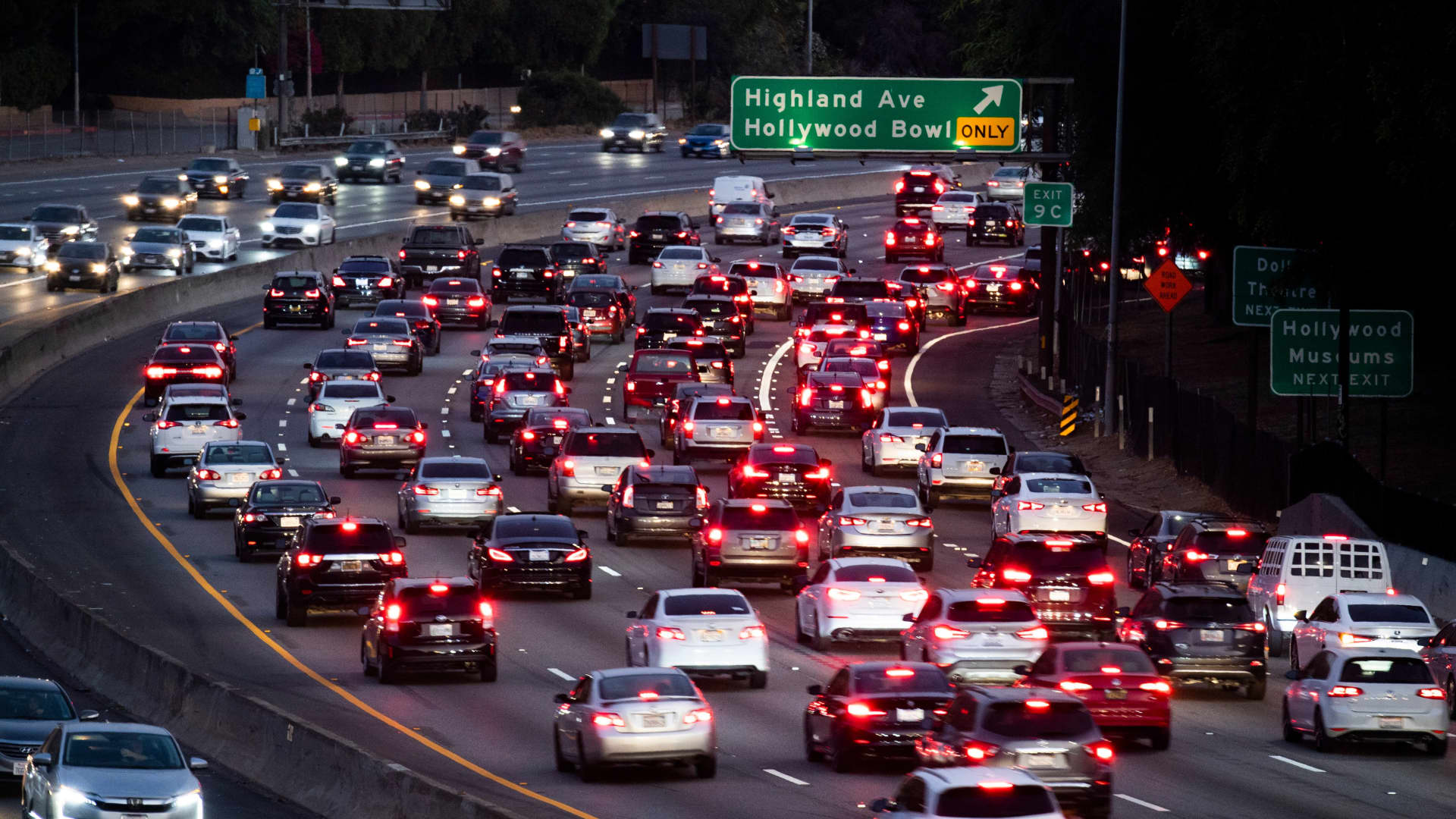
Motor vehicles drive on the 101 freeway in Los Angeles, California.
Robyn Beck | Getty Images
California, home to congested freeways and the smog-filled skies over Los Angeles, has considerable authority over the country's auto industry.
A federal waiver under the Clean Air Act allows the state to adopt stronger fuel economy standards than those of the federal government and it has set the precedent for the rest of the country on how to curb vehicle emissions.
California's ability to control vehicle emissions has spurred innovations like catalytic converters that convert toxic gases and pollutants in exhaust gas into less-toxic pollutants, as well as "check engine" lights. The state established the nation's first tailpipe emissions standards in 1966.
The Trump administration in 2019 revoked California's authority to regulate its own air quality, but the Biden administration restored that authority earlier this year.
State officials said the rule is critical to meeting the state's goal of transitioning to 100% renewable energy by 2045, adding that resulting emissions declines would lead to fewer cardiopulmonary deaths and improved health for those suffering from asthma and other illnesses.
However, meeting the timeline will face challenges, including installing enough charging stations across the state and having adequate access to materials needed to make batteries for electric vehicles.
John Bozzella, president and CEO of the Alliance for Automotive Innovation, which represents major automakers, said California's mandate would be "extremely challenging" for automakers to meet.
"Whether or not these requirements are realistic or achievable is directly linked to external factors like inflation, charging and fuel infrastructure, supply chains, labor, critical mineral availability and pricing, and the ongoing semiconductor shortage," Bozzella said in a statement. "These are complex, intertwined and global issues."
The rule comes after President Joe Biden signed the Inflation Reduction Act earlier this month, which provides funding for electric vehicle tax credits and clean vehicle manufacturing facilities. The Biden administration also issued new nationwide limits on tailpipe emissions last year for new cars and light trucks made through 2026.
Environmental groups praised the decision on Thursday, though some argued that the board needed to set even tougher targets to meet the urgency of the climate crisis. Some groups had previous urged the board to impose a rule to achieve 100% zero-emission vehicle sales by 2030, five years earlier than the actual regulation.
"This rule needed to match the urgency of the climate crisis and instead leaves Californians making sputtering progress in the slow lane," Scott Hochberg, an attorney at the Center for Biological Diversity's Climate Law Institute, said in a statement.
"California needs to act strongly on gas-powered cars instead of ignoring them, and shift to EVs much sooner or watch our climate stability slip away," Hochberg said.
Daniel Barad, California senior policy advocate at Sierra Club, said in a statement that the rule is "a major step towards breathable air in California communities, and will be critical for the state to meet its climate goals and emission reduction targets."
"Other states should move swiftly to join California and adopt this life saving rule, which will improve air quality and help slow the climate crisis," Barad said.
Prime Minister Shehbaz Sharif has invited Qatari investors to invest in Pakistan’s energy, aviation, agriculture and livestock, maritime, tourism and hospitality sectors.
He was talking to a delegation of the Qatar Investment Authority in Doha today (Tuesday).
The Prime Minister underlined Pakistan’s unique geographic and demographic advantages, which combine its strategic location with a huge middle-class market and a large skilled workforce.
Highlighting Pakistan’s liberal and business-friendly investment policies,, he also urged Qatari investors to explore the opportunities presented by the China-Pakistan Economic Corridor to promote regional connectivity and mutual prosperity.
Lauding Qatar’s rapid economic development under the visionary leadership of His Highness the Amir, the Prime Minister reiterated that Pakistan attaches high importance to its relations with Qatar and wanted to upgrade the traditionally warm political ties between the two countries into a comprehensive economic partnership.
He stressed the need to further enhance bilateral economic and investment engagement, particularly in the renewable energy including solar and wind power generation, aviation, maritime, industrial and infrastructure development, and hospitality sectors.
The Prime Minister assured full facilitation to QIA through transparent and expeditious processes.
Biden Energy Secretary Jennifer Granholm suggested in a recent interview that the United States’ green energy push will be the "greatest peace plan" in world history.
"If we want to be energy secure and energy independent, that means we've got to produce our own energy," Granholm said in an interview with VOA News on Friday. "My counterpart in Ireland, the energy minister there, has said that no one has ever weaponized access to the sun. No one has ever weaponized the wind. Perhaps a move to clean energy will be the greatest peace plan the world has ever known."
Granholm’s comment immediately received criticism from conservatives on Twitter and was highlighted in a post from an account operated by the Republican National Committee.
"The war in Ukraine and ensuing energy crisis were entirely brought about by 'clean energy' and climate idiocy," author and Fox News contributor Steve Milloy responded. "Lying. Airhead."
ENERGY SEC. GRANHOLM CLAIMS BAN ON RUSSIAN OIL PROVES ‘WE CAN’T RELY ON THE VOLATILITY OF FOSSIL FUELS’
Energy Secretary Jennifer Granholm speaks during a press briefing at the White House in Washington.
(AP Photo/Evan Vucci)
Granholm’s office did not immediately respond to a request for comment from Fox News Digital.
Granholm has referenced the conversation with her Irish counterpart in the past including an instance in April that prompted Republican Congresswoman Cathy McMorris Rodgers to call her out on Twitter for a "dangerous" line of thinking.
Energy Secretary Jennifer Granholm speaks during a press briefing at the White House, Nov. 23, 2021, in Washington.
(AP Photo/Evan Vucci, File)
SPECIAL COUNSEL RULES BIDEN'S ENERGY SECRETARY VIOLATED HATCH ACT
In the interview, Granholm said that the increasing oil production is what the administration is calling for "right now" but "ultimately we've got to move to clean."
"That's what the bill that the president signed yesterday, for the United States, it is the largest commitment to combating climate change of any country in the world," Granholm said, referring to the recently signed spending bill passed through Congress by Democrats. "It's by 10 the largest bill that we've ever passed in the United States to combat climate change. So it is so important for our energy security. And I know our European allies are trying to do the same."
U.S. Energy Secretary Jennifer Granholm attends the UN Climate Change Conference (COP26), in Glasgow, Scotland, Britain, November 4, 2021.
(Reuters/Phil Noble/File Photo)
Granholm was asked if the upcoming winter months will be "difficult" for Europe given efforts to cut back on Russian energy dependence that many fear will cause an energy crisis as temperatures drop and more Europeans require heating.
CLICK HERE TO GET THE FOX NEWS APP
"I think it will be," Granholm said, adding that NATO allies are united in their opposition to Russia's invasion of Ukraine and will not back down on the effort to "wean" off of Russian fuel.
"There's no doubt it's going to be an expensive winter," Granholm said. "I know that the European leaders are looking for how they can alleviate the pain for real people in these increases in prices. But I know ultimately, they are determined to move away from Russian fuels and toward clean energy."
Andrew Mark Miller is a writer at Fox News. Find him on Twitter @andymarkmiller and email tips to AndrewMark.Miller@Fox.com.
Hungary said Saturday that Russia has started delivering additional gas to the EU member following a July visit to Moscow by its foreign minister.
Hungary's Foreign Ministry said trade negotiations with Moscow "led to an agreement", resulting in Russia's Gazprom starting to deliver "above the already contracted quantities" on Friday.
"It is the duty of the Hungarian government to ensure the country's safe supply of natural gas, and we are living up to it," ministry official Tamas Menczer said on his Facebook page.
In the first phase, an additional volume of 2.6 million cubic meters per day will arrive from the south through the TurkStream pipeline until the end of August, he said, adding negotiations were underway for September deliveries.
Hungarian Foreign Minister Peter Szijjarto made a previously unannounced visit to Moscow in July to discuss the purchase of an additional 700 million cubic meters of natural gas.
"In light of what is known about the current European market conditions, it is clear that the acquisition of such a large amount is impossible without Russian sources," Menczer said in the post on Saturday, mentioning Szijjarto's visit.
An EU plan to cut gas consumption across the bloc by 15 percent to cope with an energy price crisis spurred by Russia's war in Ukraine came into effect this week
Some EU countries, though, had carve-outs from strictly following the rule, which was in any case termed a "voluntary demand reduction".
Hungary, which relies on gas piped in directly from Russia, had demanded the exception.
U.S. Senate Majority Leader Chuck Schumer (D-NY) holds his weekly news conference after the Democratic caucus party luncheon at the U.S. Capitol in Washington, August 2, 2022.
Jonathan Ernst | Reuters
The $430 billion climate change, health-care and tax bill passed by the U.S. Senate on Saturday delivers a major win for Democrats, and will help reduce the carbon emissions that drive climate change while also cutting costs for the elderly.
Democrats hope the bill, which they pushed through the Senate over united Republican opposition, will boost their chances in the Nov. 8 midterm elections, when Republicans are favored to recapture the majority in at least one chamber of Congress.
The package, called the Inflation Reduction Act, is a dramatically scaled-back version of a prior bill backed by Democratic President Joe Biden that was blocked by maverick Senate Democrats Joe Manchin and Kyrsten Sinema as too expensive.
"It's what the American people want," Senate Majority Leader Chuck Schumer told reporters. "We're prioritizing the middle class, working families, those struggling to get to the middle class, instead of what Republicans do: prioritize those at the very top."
The Senate's partisan 51-50 vote, with the tiebreaking vote coming from Vice President Kamala Harris, sends the legislation on to the Democratic-controlled House of Representatives, which is expected to pass it on Friday, after which Biden could sign it into law.
Republicans blasted the bill as a spending "wish list" that they argued would hurt an economy weighed down by inflation, saying it would kill jobs, raise energy costs and undermine growth at a time when the economy is facing a potential recession.
"Senate Democrats are misreading the American people's outrage as a mandate for yet another reckless taxing-and-spending spree," top Senate Republican Mitch McConnell said on Saturday. "Democrats want to ram through hundreds of billions of dollars in tax hikes and hundreds of billions of dollars in reckless spending -- and for what?"
About half of Americans -- some 49% -- support the bill, including 69% of Democrats and 34% of Republicans, according to a Reuters/Ipsos poll conducted Aug. 3 and 4. The most popular element of the bill is giving Medicare the power to negotiate drug prices, which 71% of respondents support, including 68% of Republicans.
Economists, who say the legislation could help the Federal Reserve combat inflation, do not expect a sizeable impact on the economy in the coming months.
Climate focus
With $370 billion in climate-focused spending, it would become the most consequential climate change bill ever passed by Congress.
The bill offers businesses and families billions in incentives to encourage purchases of electric vehicles and energy-efficient appliances, as well as to spur new investments in wind and solar power that would double the amount of new, clean electricity-generating capacity coming online in the United States by 2024, according to modeling by the Repeat Project at Princeton University.
That would help put the U.S. on course to meet its pledge to slash its greenhouse gas emissions in half by 2030 below 2005 levels, made at last year's Glasgow climate summit.
While environmental groups largely embraced the bill, they noted that compromises secured by Manchin, who represents coal-producing West Virginia, would prolong U.S. use of fossil fuels.
Those provisions include rules that would only allow the federal government to authorize new wind and solar energy developments on federal land when it is also auctioning rights to drill for oil and natural gas.
Drug costs
The legislation would lower drug costs for the government, employers and patients, said Juliette Cubanski, deputy director of the Medicare program at the Kaiser Family Foundation.
"Perhaps the biggest effect would be for people with prescription drug coverage through Medicare," she said.
A key change is the provision allowing the federal Medicare health plan for older and disabled Americans to negotiate lower prescription drug prices.
The pharmaceutical industry says price negotiation would stifle innovation. Negotiated prices for 10 of the costliest drugs for Medicare would apply starting in 2026, with that number rising until it caps at 20 a year in 2029.
The nonpartisan Congressional Budget Office estimates Medicare would save $101.8 billion over 10 years by negotiating drug prices.
The provision also introduces a $2,000 annual cap on out-of-pocket costs for the elderly through the Medicare program.
Tax provisions
The bill also imposes a new excise tax on stock buybacks, a late change after Sinema raised objections over another provision that would have imposed new levies on carried interest, currently a tax loophole for hedge fund and private equity financiers. The provision was dropped.
The excise tax is expected to raise an additional $70 billion in tax revenue per year, lawmakers said. That is more than the carried interest provision had been forecast to raise.
A report by the nonpartisan Congressional Budget Office released prior to that last change estimated the measure would reduce the federal deficit by a net $101.5 billion over the next decade.
That was about one-third of the $300 billion in deficit reduction predicted by Senate Democrats, but excluded a projected $204 billion revenue gain from increased Internal Revenue Service enforcement.
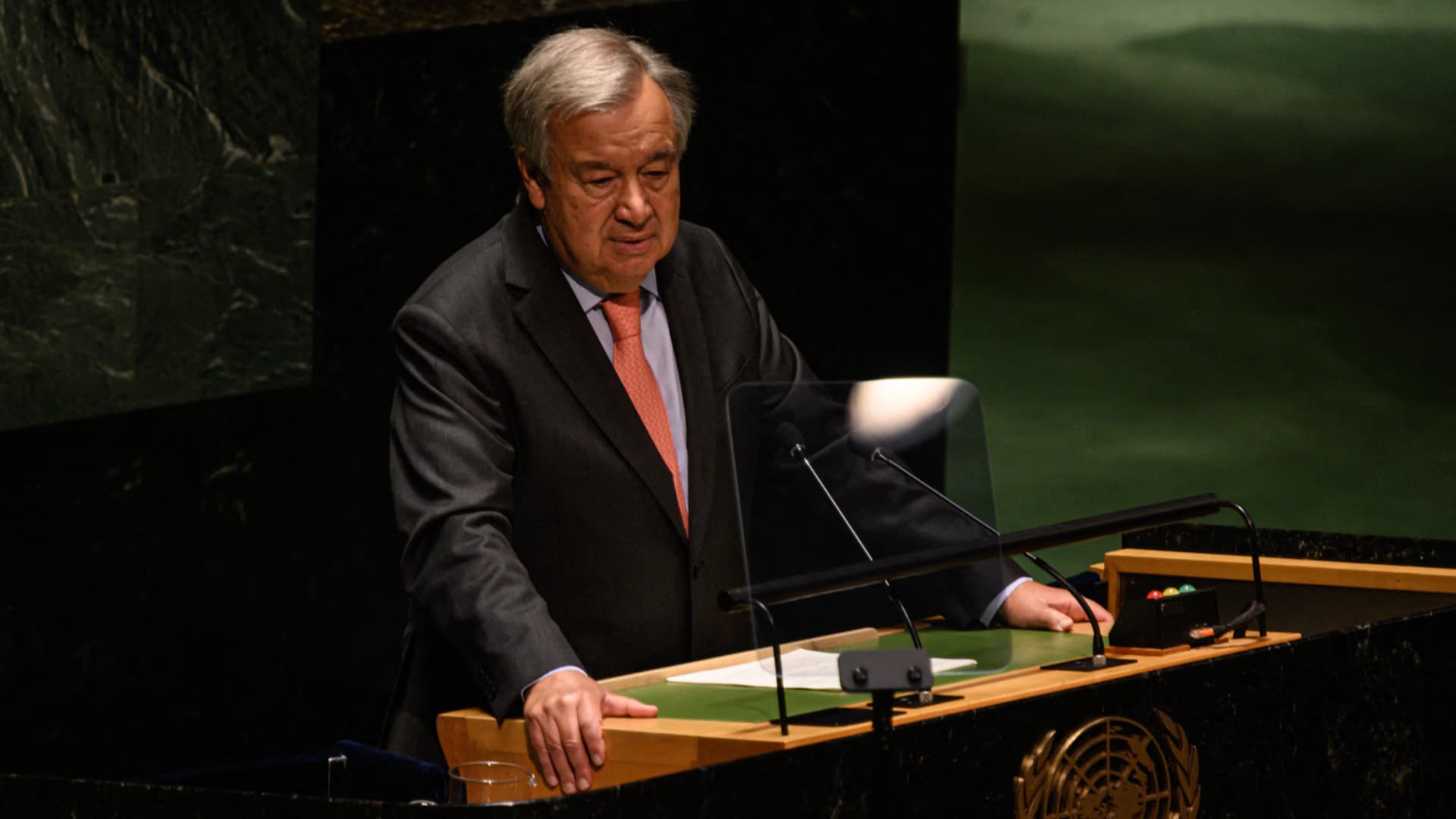
United Nations Secretary General Antonio Guterres speaks during the 2022 Review Conference of the Parties to the Treaty on the Non-Proliferation of Nuclear Weapons at the United Nations in New York City on August 1, 2022.
Ed Jones | AFP | Getty Images
WASHINGTON — United Nations Secretary-General Antonio Guterres urged governments on Wednesday to tax excessive oil and gas profits as the world grapples with an energy crisis triggered in part, by Russia's war in Ukraine.
"It is immoral for oil and gas companies to be making record profits from this energy crisis on the backs of the poorest people and communities," Guterres said in a speech before the international forum.
He added that the funds, which equate to $100 billion in the first quarter of this year should instead be used to support vulnerable communities.
"This grotesque greed is punishing the poorest and most vulnerable people while destroying our only home," Guterres said, calling for governments to also address the mounting climate crisis.
He also urged governments to ramp up and diversify supply chains for raw materials and renewable energy technologies while eliminating bureaucratic red tape around the energy transition.
"Every country is part of this energy crisis," Guterres said.
He also said that the consequences of the Kremlin's war have extended beyond a budding energy crisis and have also exacerbated global food insecurity and crippling debt around the world, but specifically in developing nations.
"Many developing countries drowning in debt, without access to finance and struggling to recover from the COVID-19 pandemic could go over the brink, Guterres warned. "We are already seeing the warning signs of a wave of economic, social and political upheaval that would leave no country untouched," he added.
The U.N. chief announced the establishment of the Global Crisis Response Group aimed at coordinating global solutions to the triple crisis of food, energy and finance.
CNBC Politics
Read more of CNBC's politics coverage:
Guterres' comments come as the first vessel carrying Ukrainian agricultural goods departs from the Black Sea, a significant step in addressing the mounting food crisis provoked by Russia's naval blockade of Ukrainian ports sprinkled along the Sea of Azov and the Black Sea.
Less than 24 hours after the deal was signed though, Russian missiles rained down on Odesa, Ukraine's largest port. World leaders swiftly condemned the Kremlin's missile strike on Odesa, another anxious turn in fruitless efforts to mitigate a mounting global food crisis.
Ukraine's infrastructure minister, Oleksandr Kubrakov, told NBC News on Monday that the vessel is expected to reach Tripoli, Lebanon in two days.
Kubrakov also said that 16 ships are ready to go, but that only three vessels will leave the port each day for the next two weeks. He added that in the next two months, Ukraine hopes to export up to 3 million tons of grain and other agricultural goods by sea per month.
Before Russia's invasion, Ukraine exported 5 million to 7 million tons per month.
MicroStrategy's Michael Saylor is leaving his role as CEO to become Executive Chairman of the company, according to a statement released by the company on Tuesday afternoon. The company's president, Phong Le, will take the reins from Saylor.
Saylor has been in the role of chief executive since launching the company in 1989. MicroStrategy went public in 1998.
MicroStrategy's stock is down over 48% this year. Bitcoin is down over 51% during that same time period.
"I believe that splitting the roles of Chairman and CEO will enable us to better pursue our two corporate strategies of acquiring and holding bitcoin and growing our enterprise analytics software business. As Executive Chairman I will be able to focus more on our bitcoin acquisition strategy and related bitcoin advocacy initiatives, while Phong will be empowered as CEO to manage overall corporate operations," said Mr. Saylor in the release.
The announcement comes as the company announces its second quarter earnings, in which its total revenues dropped by 2.6% compared to a year ago.
MicroStrategy may technically be in the business of enterprise software and cloud-based services, but Saylor has said the publicly traded company doubles as the first and only bitcoin spot exchange-traded fund in the U.S.
"We're kind of like your nonexistent spot ETF," Saylor told CNBC on the sidelines of the Bitcoin 2022 conference in Miami in April.
So far, the Securities and Exchange Commission has only approved ETFs that track contracts speculating on the future price of bitcoin, instead of the cryptocurrency itself. The commission has refused to greenlight any of the formal applications for a pure-play bitcoin-based ETF — a financial instrument that would give investors the chance to invest in bitcoin without having to go through the motions of signing up for an exchange, opening a crypto wallet, or dealing with any of the other logistics involved with buying and holding bitcoin.
"If there was a spot ETF, you'd be paying a 1% fee, and it wouldn't be leveraged. With MicroStrategy, we have a software company that generates cash flow, so we convert our cash flows into bitcoin," said Saylor in April.
MicroStrategy has been adding bitcoin to its corporate balance sheet for the last two years. The company has now spent close to $4 billion acquiring bitcoin at an average price of $30,700.
"We have $5 billion in collateral. We borrowed $200 million. So I'm not telling people to go out and take a highly leveraged loan. What I am doing, I think, is doing my best to lead the way and to normalize the bitcoin-backed financing industry," said Saylor in April.
"As people realize they can borrow against something, then they realize they never have to sell it, and then they start to stretch their time horizon from — 'It's a 36-month speculation,' to — 'It's a 36-year holding.'"