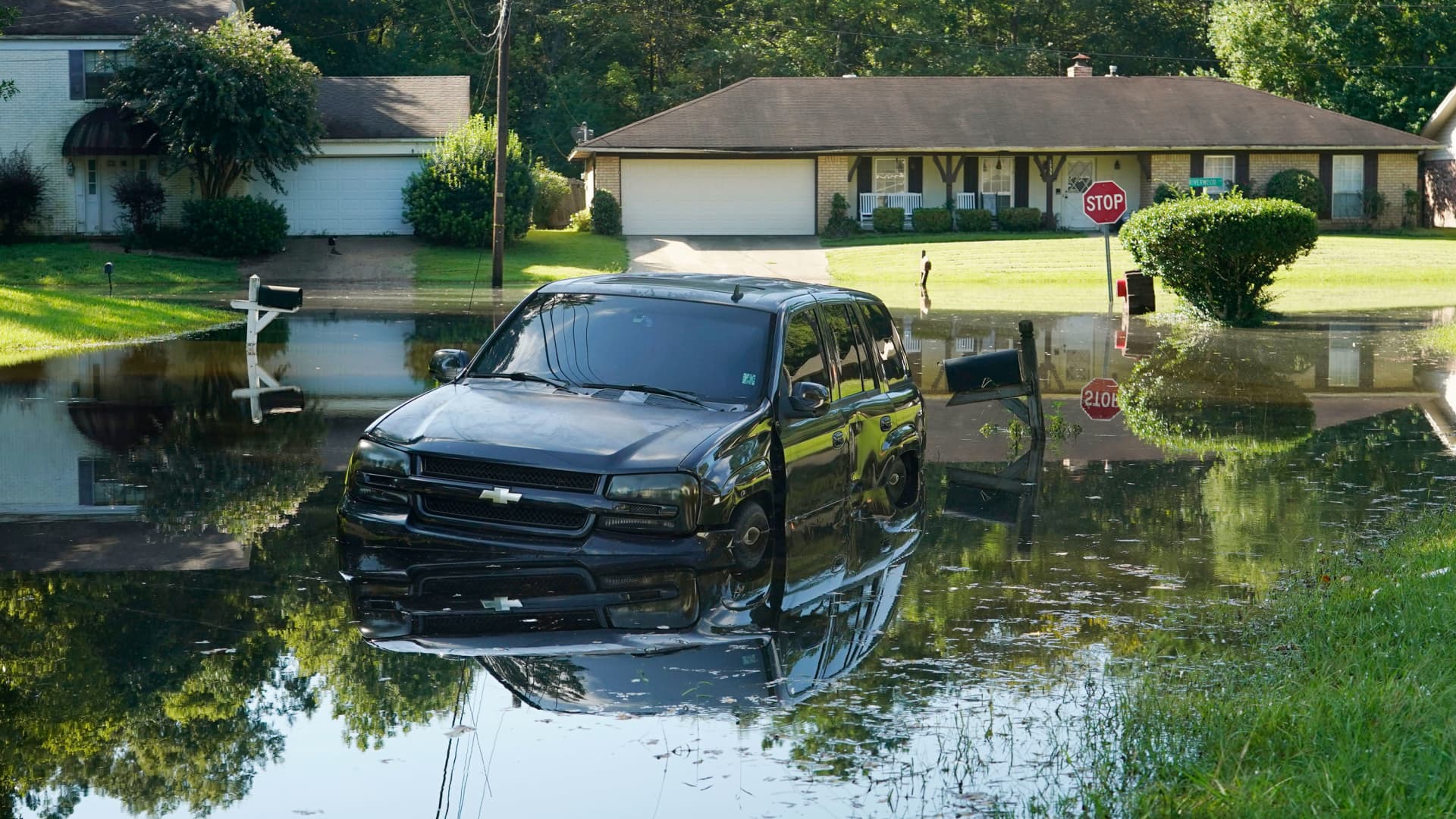
An SUV rests in flood waters in this northeast Jackson, Miss., neighborhood, Monday, Aug. 29, 2022.
Rogelio V. Solis | AP
Residents of Jackson, Mississippi, the state's capital and largest city, do not have access to reliable drinking water for the near future after the city's main water treatment facility failed on Monday.
The state has issued a state of emergency for Jackson and has activated the Mississippi National Guard. It's also distributing drinking and non-drinking water to up to 180,000 people until the system is fixed.
Gov. Tate Reeves said during an emergency briefing Monday night that the city would be without "reliable running water at scale" indefinitely and that there isn't enough water to flush toilets or fight fires.
"Do not drink the water. In too many cases, it is raw water from the reservoir being pushed through the pipes," Reeves warned residents. "Be smart, protect yourself, protect your family."
Officials blamed the problem on longstanding issues at the O.B. Curtis water treatment plant, which has been in crisis for years due to old infrastructure and inadequate resources to update it. The city also said that recent rainfall and flooding of the Pearl River caused complications at the plant.
City officials said the flooding had created issues at the plant, which is located near a reservoir that flows into the Pearl River. City residents have been subject to a boil-water notice since last month after tests found cloudiness in water samples.
The water problem grew worse this week when businesses and homes endured little to no water pressure and officials warned that the water from the taps was untreated. Officials on Monday said the water shortage is likely to last the next couple of days.
Reservoir police observe the water release from the Ross Barnett Reservoir Spillway onto the Pearl River, Sunday, Aug. 28, 2022, in Rankin County, Miss.
Rogelio V. Solis | AP
The governor said the exact cause of failure was unknown, adding that the treatment plant had been inadequately staffed and operated for years. Reeves said the plant's two primary pumps had stopped working, which left the system to depend on unreliable backup pumps.
"It's not operating anywhere near capacity," Reeves said of the plant. "We might find out [Tuesday] it's not operating at all. We'll find out."
The water crisis is affecting the roughly 150,000 people who live in Jackson and the 30,000 who live in surrounding communities that rely on the same water treatment facility. Jackson is about 82% Black, according to U.S. Census data. In addition to the unreliable water system, the city has been grappling with crime and problematic infrastructure.
The Mississippi Emergency Management Agency is distributing water to residents and the state is overseeing efforts to begin emergency repairs and maintenance to get the water system up and running, the governor said.
Unusually heavy monsoon rains have caused devastating floods in both the north and south of the country, affecting more than 30 million people.
An overview by Maxar shows a Pakistani village and fields before (left) and after flooding in Rajanpur, Pakistan.
(Maxar Technologies/Handout / Reuters)
Deaths from widespread flooding in Pakistan topped 1,000 since mid-June as the country’s climate minister called the deadly monsoon season “a serious climate catastrophe.”
Flash flooding from the heavy rains has washed away villages and crops as soldiers and rescue workers evacuated stranded residents to the safety of relief camps and provided food to thousands of displaced Pakistanis.
Pakistan's National Disaster Management Authority reported the death toll since the monsoon season began earlier than normal this year — in mid- June — reached 1,061 people after new fatalities were reported across different provinces on Sunday.
Sherry Rehman, a Pakistani senator and the country's top climate official, said in a video posted on Twitter that Pakistan is experiencing a “serious climate catastrophe, one of the hardest in the decade.”
“We are at the moment at the ground zero of the front line of extreme weather events, in an unrelenting cascade of heatwaves, forest fires, flash floods, multiple glacial lake outbursts, flood events and now the monster monsoon of the decade is wreaking non-stop havoc throughout the country," she said.
The on-camera statement was retweeted by the country’s ambassador to the European Union.
Watch how these incredible Pakistanis are rescuing people during this horrific flood.
"I haven't seen destruction of this scale, I find it very difficult to put into words ... it is overwhelming," said Pakistan's Foreign Minister Bilawal Bhutto-Zardari in an interview with Reuters, adding many crops that provided much of the population's livelihoods had been wiped out.
"Going forward, I would expect not only the IMF, but the international community and international agencies to truly grasp the level of devastation," he said.
Flooding from the Swat River overnight affected northwestern Khyber Pakhtunkhwa province, where tens of thousands of people — especially in the Charsadda and Nowshehra districts — have been evacuated from their homes to relief camps set up in government buildings.
Many have also taken shelter on roadsides, said Kamran Bangash, a spokesperson for the provincial government.
Bangash said some 180,000 people have been evacuated from Charsadda and 150,000 from Nowshehra district villages.
Khaista Rehman, 55, no relation to the climate minister, took shelter with his wife and three children on the side of the Islamabad-Peshawar highway after his home in Charsadda was submerged overnight.
“Thank God we are safe now on this road quite high from the flooded area," he said. "Our crops are gone and our home is destroyed but I am grateful to Allah that we are alive and I will restart life with my sons.”
The unprecedented monsoon season has affected all four of the country's provinces.
Nearly 300,000 homes have been destroyed, numerous roads rendered impassable and electricity outages have been widespread, affecting millions of people.
Rehman told TRT World that by the time the rains recede, "we could well have one-fourth or one-third of Pakistan under water.”
“This is something that is a global crisis and of course, we will need better planning and sustainable development on the ground. ... We’ll need to have climate resilient crops as well as structures,” she said.
Pakistan is facing one of the world’s worst climate crises,& not all of it is of our own making. It’s coming to us from all sides,scorching temperatures,forest fires,water insecurity, glacial melt floods,simultaneous draughts,impacting public health & food insecurity. @trtworldpic.twitter.com/rk6XKaTNwK
— SenatorSherryRehman (@sherryrehman) May 21, 2022
In May, Rehman told BBC Newshour that both the country’s north and south were witnessing extreme weather events because of rising temperatures. “So in north, actually, just now we are ... experiencing what is known as glacial lake outburst floods which we have many of because Pakistan is home to the highest number of glaciers outside the polar region."
The government has deployed soldiers to help civilian authorities in rescue and relief operations across the country. The Pakistani army also said in a statement it airlifted 22 tourists trapped in a valley in the country's north to safety.
Prime Minister Shabaz Sharif visited flooding victims in city of Jafferabad in Balochistan.
He vowed the government would provide housing to all those who lost their homes.
Source: AP
A charging port on a 2022 Lincoln Corsair Grand Touring plug-in hybrid vehicle during AutoMobility LA ahead of the Los Angeles Auto Show in Los Angeles, California, Nov. 18, 2021.
Bing Guan | Bloomberg | Getty Images
California, the country's most populous state and the center of U.S. car culture, is banning the sale of new gasoline-powered vehicles starting in 2035, marking a historic step in the state's battle against climate change.
The rule, issued by the California Air Resources Board on Thursday, will force automakers to speed up production of cleaner vehicles beginning in 2026 until sales of only zero-emission cars, pickup trucks and SUVs are allowed in the state.
The unanimous vote comes after Gov. Gavin Newsom set a target in 2020 to accelerate the shift away from internal combustion engines. The transportation sector represents the largest source of greenhouse gas emissions in California, which has suffered from record-breaking wildfires, droughts and air pollution worsened by climate change.
The decision is expected to have sweeping impacts beyond California and will likely pave the way for other states to follow suit. At least 15 states, including New Jersey, New York and Pennsylvania, have adopted California's vehicle standards on previous clean-car rules.
Liane Randolph, chair of the California Air Resources Board, said the rule is one of the state's most important efforts yet to clean the air and will lead to a 50% reduction in pollution from cars and light trucks by 2040.
The policy will not ban people from continuing to drive gas cars or from buying and selling them on the used market after 2035. The rule will also allow automakers to sell up to 20% plug-in hybrids, which have gas engines, by 2035.
But the rule does phase out such vehicles over time, requiring 35% of total new vehicle sales to be powered by batteries or hydrogen by 2026 and 68% by 2030. More than 16% of new cars sold in California in 2022 were zero-emissions vehicles, the state said, up from 12.41% in 2021 and 7.78% in 2020.
"California is once again leading the way by establishing commonsense standards that will transition to sales of all zero-polluting cars and light-duty trucks in the state," said Kathy Harris, clean vehicles advocate at the Natural Resources Defense Council.
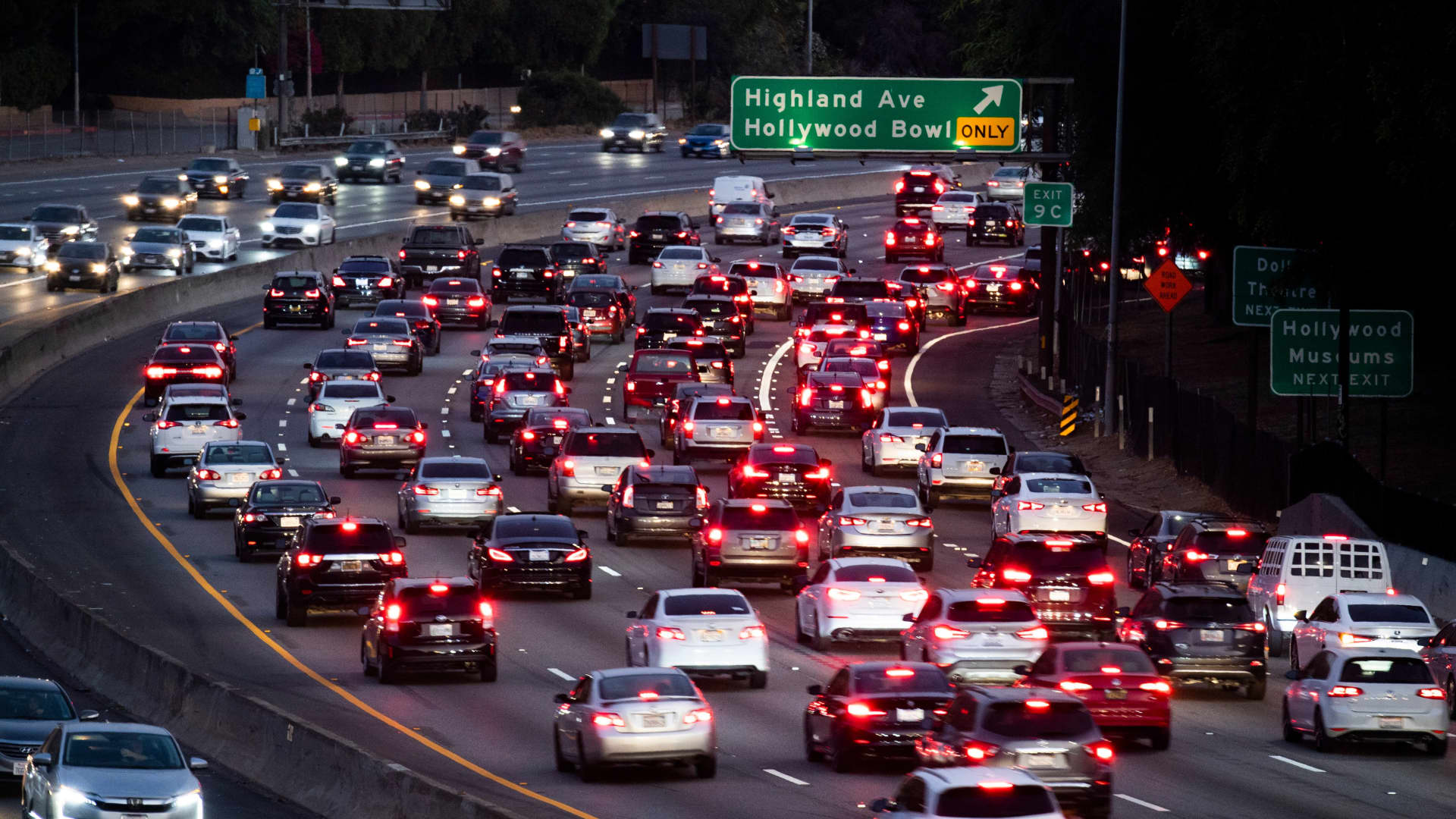
Motor vehicles drive on the 101 freeway in Los Angeles, California.
Robyn Beck | Getty Images
California, home to congested freeways and the smog-filled skies over Los Angeles, has considerable authority over the country's auto industry.
A federal waiver under the Clean Air Act allows the state to adopt stronger fuel economy standards than those of the federal government and it has set the precedent for the rest of the country on how to curb vehicle emissions.
California's ability to control vehicle emissions has spurred innovations like catalytic converters that convert toxic gases and pollutants in exhaust gas into less-toxic pollutants, as well as "check engine" lights. The state established the nation's first tailpipe emissions standards in 1966.
The Trump administration in 2019 revoked California's authority to regulate its own air quality, but the Biden administration restored that authority earlier this year.
State officials said the rule is critical to meeting the state's goal of transitioning to 100% renewable energy by 2045, adding that resulting emissions declines would lead to fewer cardiopulmonary deaths and improved health for those suffering from asthma and other illnesses.
However, meeting the timeline will face challenges, including installing enough charging stations across the state and having adequate access to materials needed to make batteries for electric vehicles.
John Bozzella, president and CEO of the Alliance for Automotive Innovation, which represents major automakers, said California's mandate would be "extremely challenging" for automakers to meet.
"Whether or not these requirements are realistic or achievable is directly linked to external factors like inflation, charging and fuel infrastructure, supply chains, labor, critical mineral availability and pricing, and the ongoing semiconductor shortage," Bozzella said in a statement. "These are complex, intertwined and global issues."
The rule comes after President Joe Biden signed the Inflation Reduction Act earlier this month, which provides funding for electric vehicle tax credits and clean vehicle manufacturing facilities. The Biden administration also issued new nationwide limits on tailpipe emissions last year for new cars and light trucks made through 2026.
Environmental groups praised the decision on Thursday, though some argued that the board needed to set even tougher targets to meet the urgency of the climate crisis. Some groups had previous urged the board to impose a rule to achieve 100% zero-emission vehicle sales by 2030, five years earlier than the actual regulation.
"This rule needed to match the urgency of the climate crisis and instead leaves Californians making sputtering progress in the slow lane," Scott Hochberg, an attorney at the Center for Biological Diversity's Climate Law Institute, said in a statement.
"California needs to act strongly on gas-powered cars instead of ignoring them, and shift to EVs much sooner or watch our climate stability slip away," Hochberg said.
Daniel Barad, California senior policy advocate at Sierra Club, said in a statement that the rule is "a major step towards breathable air in California communities, and will be critical for the state to meet its climate goals and emission reduction targets."
"Other states should move swiftly to join California and adopt this life saving rule, which will improve air quality and help slow the climate crisis," Barad said.
A private jet belonging to Steven Spielberg has burned more than $116,000 worth of jet fuel since June despite the famous Hollywood director's past warnings about global warming, according to a flight tracking database.
Spielberg's plane, a Gulfstream G650, has burned at least $116,159 worth of jet fuel over the course of 16 trips spanning nearly 17,000 miles since June 23, according to flight tracking data from ADS-B Exchange and compiled by the database Celebrity Jets. The figures are likely an underestimate since the database didn't calculate fuel and distance metrics of at least three trips made by Spielberg's jet.
However, Spielberg has previously stated that global warming "terrified" him and ripped people who "go blithely through life" without caring about their impact on the environment.
"I'm terrified of [global warming]," Spielberg remarked during a 2018 interview for his film Ready Player One. "Global warming is a scientific reality. It's not a political trick. It's a true piece of real, measurable, quantifiable science."
JOHN KERRY'S FAMILY PRIVATE JET EMITTED OVER 300 METRIC TONS OF CARBON SINCE BIDEN TOOK OFFICE
During a 2018 interview for his film Ready Player One, Steven Spielberg said, "Everybody has to be held responsible" for their role in climate change.
(Reuters/Stephen Lam)
"People have to come around to believing that this is — we are going to have to have a kind of confrontation with destiny unless we do something about it today," Spielberg said.
He added that "everybody has to be held responsible" for their role in climate change.
"You know when you're not mindful of something that could pose a danger to your children and grandchildren?" Spielberg remarked. "Then you just go blithely through life with aerosol cans and doing all sorts of things that are depleting the ozone."
LEONARDO DICAPRIO TRAVELED ON GAS-GUZZLING PRIVATE JETS, YACHTS WHILE FUNDING CLIMATE NUISANCE LAWSUITS
Among its more than a dozen trips, Spielberg's jet traveled 3,589 miles from Westhampton, New York, to Amsterdam, Netherlands, on June 29, burning $21,183 worth of fuel and emitting 32 tons of carbon dioxide, according Celebrity Jets. The plane then traveled to Rotterdam, Netherlands, before returning to Westhampton on July 1, burning another $24,685 worth of fuel and emitting an additional 38 tons of carbon.
Steven Spielberg, seen on right, has burned at least $116,159 worth of jet fuel over the course of more than a dozen trips spanning nearly 17,000 miles since late June 2022.
(Photo by Donato Sardella/WireImage)
The jet also made lengthy trips from Westhampton to Van Nuys, California, on July 11, from Westhampton to Knock, Ireland, on July 21 and from Teterboro, New Jersey, to Van Nuys on Aug. 4. The most recent trip recorded was a short flight on Thursday evening from Martha's Vineyard, Massachusetts, to Teterboro.
Overall, Spielberg's jet has emitted at least 179 tons of carbon dioxide over the last two months. By comparison, the average American has an annual carbon footprint of 16 tons and the average global footprint is four tons per person.
While the majority of the jet's trips and fuel usage were recorded, the database didn't calculate data for a few flights including two Thursday from Van Nuys to Chicago and from Chicago to Martha's Vineyard.
Spielberg isn't the only Hollywood celebrity who has warned about global warming while taking private jets around the world. Fox News Digital reported last week that actor Leonardo DiCaprio went on multiple fossil fuel-powered trips over the last several years while pushing for extreme measures to combat climate change.
Actor Leonardo DiCaprio has taken several private jets on trips across the world in recent years, including flying from Europe to New York City to accept an environmental activism award in 2016.
(Jordan Strauss/Invision/AP)
CLICK HERE TO GET THE FOX NEWS APP
In 2016, DiCaprio reportedly flew 8,000 miles via private jet from Europe to New York City to accept an award for his environmental activism. He then returned to Europe for a charity event.
That same year, DiCaprio took a private jet to the World Economic Forum (WEF) in Davos, Switzerland. At the summit, the WEF gave DiCaprio its Crystal Award for his "leadership in tackling the climate crisis."
A representative for Spielberg didn't respond to a request for comment.
Thomas Catenacci is a politics writer at Fox News Digital
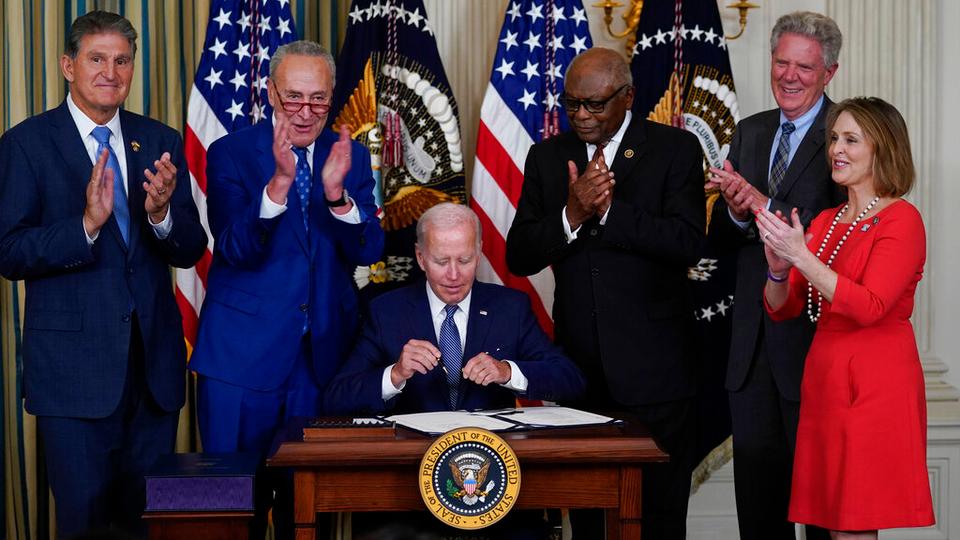
The $430 billion Inflation Reduction Act aims to cut domestic greenhouse gas emissions, lower drug costs and tax corporations.
"Every single Republican in Congress voted against this bill," says Biden.
(AP)
President Joe Biden has signed into law a $430 billion bill that is seen as the biggest climate package in US history, designed to cut domestic greenhouse gas emissions as well as lower prescription drug prices.
Biden was joined by Democratic leaders including Senator Joe Manchin of West Virginia, whose support was crucial to the passage of the Inflation Reduction Act along party lines after he had initially opposed a similar measure.
"Joe, we never had a doubt," Biden said of Manchin on Tuesday at the White House.
Biden used the event to criticise Republicans as he sought to use a string of Democratic-led legislative victories to help boost Democrats in congressional midterm elections in November.
"In this historic moment, Democrats sided with the American people and every single Republican sided with the special interests," said Biden.
"Every single Republican in Congress voted against this bill," he added.
It will also allow Medicare to negotiate lower drug prices for the elderly and ensure that corporations and the wealthy pay the taxes they owe.
Democrats say it will help combat inflation by reducing the federal deficit.
Senate Republican leader Mitch McConnell said the new law will have the opposite impact.
"Democrats robbed Americans last year by spending our economy into record inflation. This year, their solution is to do it a second time. The partisan bill President Biden signed into law today means higher taxes, higher energy bills, and aggressive IRS audits," he said, referring to the Internal Revenue Service.
Democratic-led House of Representatives approves $430 billion bill that is seen as biggest climate package in US history, delivering a major legislative victory for President Biden ahead of November 8 midterm elections.
The House voted 220-207 along party lines to pass the measure titled "Inflation Reduction Act" and send it on to Biden to sign into law.
(Reuters)
US lawmakers have adopted President Joe Biden's sprawling climate, tax and health care plan –– a major win for the veteran Democrat that includes the biggest ever American investment in the battle against global warming.
The House of Representatives on Friday approved the measure by a 220-207 vote along party lines following its adoption in the Senate on Sunday by a razor-thin margin, with Vice President Kamala Harris casting the tie-breaking vote.
The legislation to fight the climate crisis and lower prescription drug prices aim to cut domestic greenhouse gas emissions.
It will also allow Medicare to negotiate lower drug prices for the elderly and ensure that corporations and the wealthy pay the taxes they owe.
Democrats say it will help combat inflation by reducing the federal deficit.
Democrats hope the legislation will help them at the polls in November, when voters decide the balance of power in Congress ahead of the 2024 presidential election.
Republicans are favoured to win a majority in the House and could also take control of the Senate.
Biden quickly hailed the adoption of his plan, which includes a $370 billion investment aimed at bringing about a 40 percent drop in greenhouse gas emissions by 2030.
"Today, the American people won. Special interests lost," the president tweeted in the minutes after the vote.
Republicans say 'it will kill jobs'
The bill's main revenue source is a 15 percent corporate minimum tax aimed at stopping large, profitable companies from gaming the Internal Revenue Service code to slash their tax bills to zero, which has led to mixed reactions from business groups to the legislation.
Republicans oppose the legislation, warning it will kill jobs by raising corporate tax bills, further fuel inflation with government spending and inhibit the development of new drugs.
"Democrats more than any other majority in history are addicted to spending other people's money, regardless of what we as a country can afford," House Republican leader Kevin McCarthy said in a floor speech.
But the bill does not leave the US fossil fuels industry out in the cold.
Some provisions allow the federal government to authorise new wind and solar energy developments on federal land only when it is also auctioning rights to drill for oil and natural gas.
The fossil fuel protections disappointed progressives but posed no barrier to Democratic support.
About half of Americans support the climate and drug pricing legislation, including 69 percent of Democrats and 34 percent of Republicans, according to a Reuters news agency/Ipsos poll conducted on August 3 and 4.
The Senate on Sunday passed the Inflation Reduction Act (IRA) along party lines, 51-50, handing Democrats a crucial legislative win as the midterm cycle ramps up.
Vice President Kamala Harris cast the tie-breaking vote with all Democrats in support of the legislation and all Republicans opposed. The proposal was passed via the budget reconciliation process, which allows it to be passed with a simple majority rather than the 60 votes typically needed to overcome a filibuster.
The passage of the sprawling climate, tax and health care legislation now sets up a vote in the Democratic-controlled House, where the bill is expected to pass before President Joe Biden signs it into law.
Included in the bill, supporters say, are measures to support job creation, raise taxes on large corporations and the wealthy, allow Medicare to negotiate down some prescription drug costs, expand the Affordable Care Act health care program and invest in combating climate change by implementing tax credits for clean energy initiatives, among other things.
The legislation's tax provisions, prescription drug-pricing reform, as well as boosted IRS tax enforcement measures, are anticipated to raise an estimated revenue of $739 billion -- $300 billion of which Democrats say would go toward reducing the deficit.
The plan would reduce federal budget deficits by $102 billion over 10 years, according to the nonpartisan Congressional Budget Office.
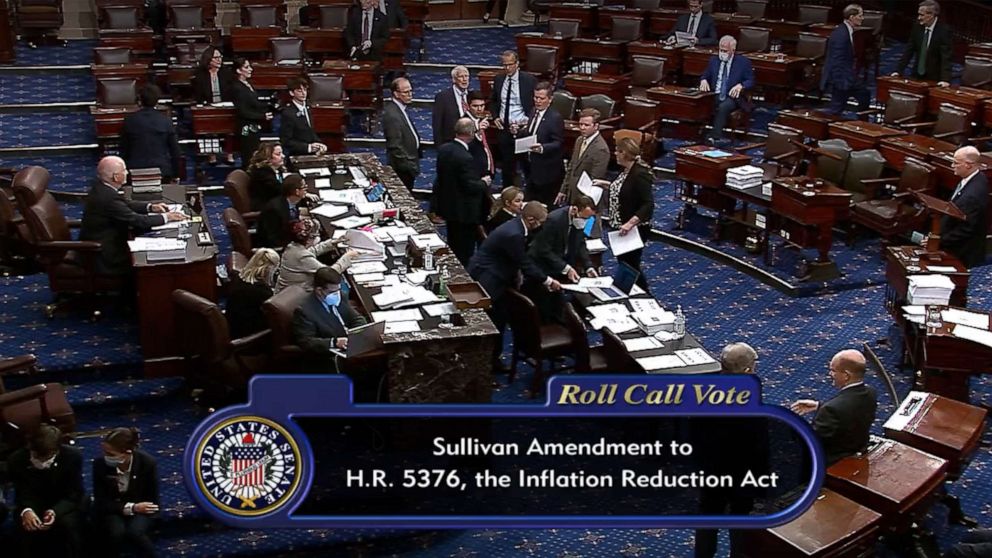
The bill passed the Senate after a punishing, approximately 16-hour "vote-a-rama," in which any senator could introduce an amendment to the bill as part of the budget reconciliation process.
The amendment process fueled painful votes for each party.
Vulnerable Democratic incumbents up for reelection this year had to dance around a vote on the Biden administration's decision to scrap Title 42, a Trump-era order using coronavirus concerns to prevent migrants from entering the country while seeking asylum. Republicans, meanwhile, mostly voted against a Democratic amendment that would have capped out-of-pocket insulin costs at $35 a month for people with private health insurance.
The IRA passage marks the culmination of grueling negotiations between Senate Majority Leader Chuck Schumer, D-N.Y., and Sen. Joe Manchin, D-W.Va., who had been a consistent obstacle to cobbling together a Democrats-only social spending bill via reconciliation.
The pathway for a successful vote was cemented late last week when Sen. Kyrsten Sinema, D-Ariz., another key centrist, signed on after winning some tweaks to the bill.
Senator Patrick Leahy is wheeled to an elevator from the Senate floor during amendment votes, also called the "vote-a-rama", on the Inflation Reduct Act 2022, at the U.S. Capitol building in Washington, Aug. 7, 2022.
Ken Cedeno/Reuters
Among the changes Sinema won were the eliminations of tax provisions targeting wealthy hedge fund managers and private equity executives. The Senate rules official also scrapped a provision intended to reprimand drug companies that raise the prices of some prescription drugs faster than inflation for patients with private insurance.
Still, the bill's passage marks a major step toward President Biden's campaign promises to tackle climate change, reform prescription drug pricing and other issues; and it gives Democrats a new legislative win to run on heading into the November midterms, in an environment where many voters have soured on Biden's handling of the economy and historic inflation.
The IRA also extends a streak of achievements for Biden and congressional Democrats, including passage of a bipartisan anti-gun violence bill and legislation to boost the domestic semiconductor industry.
"This bill is going to change America for decades," Schumer crowed after final passage.
"This vote crystalizes the contrast of the midterms. Senate Democrats have taken a historic step to lower costs like prescription drug prices, tackle inflation and address working families' most pressing concerns. Every Republican voted against the bill because it holds Big Oil, Big Pharma and other corporations that have been jacking up prices accountable, and finally makes them pay their fair share," added Sen. Gary Peters, D-Mich., the chair of Senate Democrats' campaign arm.
Republicans have already forecasted that they'll paint Democrats as uncaring about Americans' financial burdens at a time of rapid price hikes while passing billions of dollars in new spending.
"This idea that this massive tax increase will just somehow be absorbed by corporate America when they will pass those costs along to consumers, and it will make inflation worse," Senate Minority Whip John Cornyn, R-Texas, said last week.
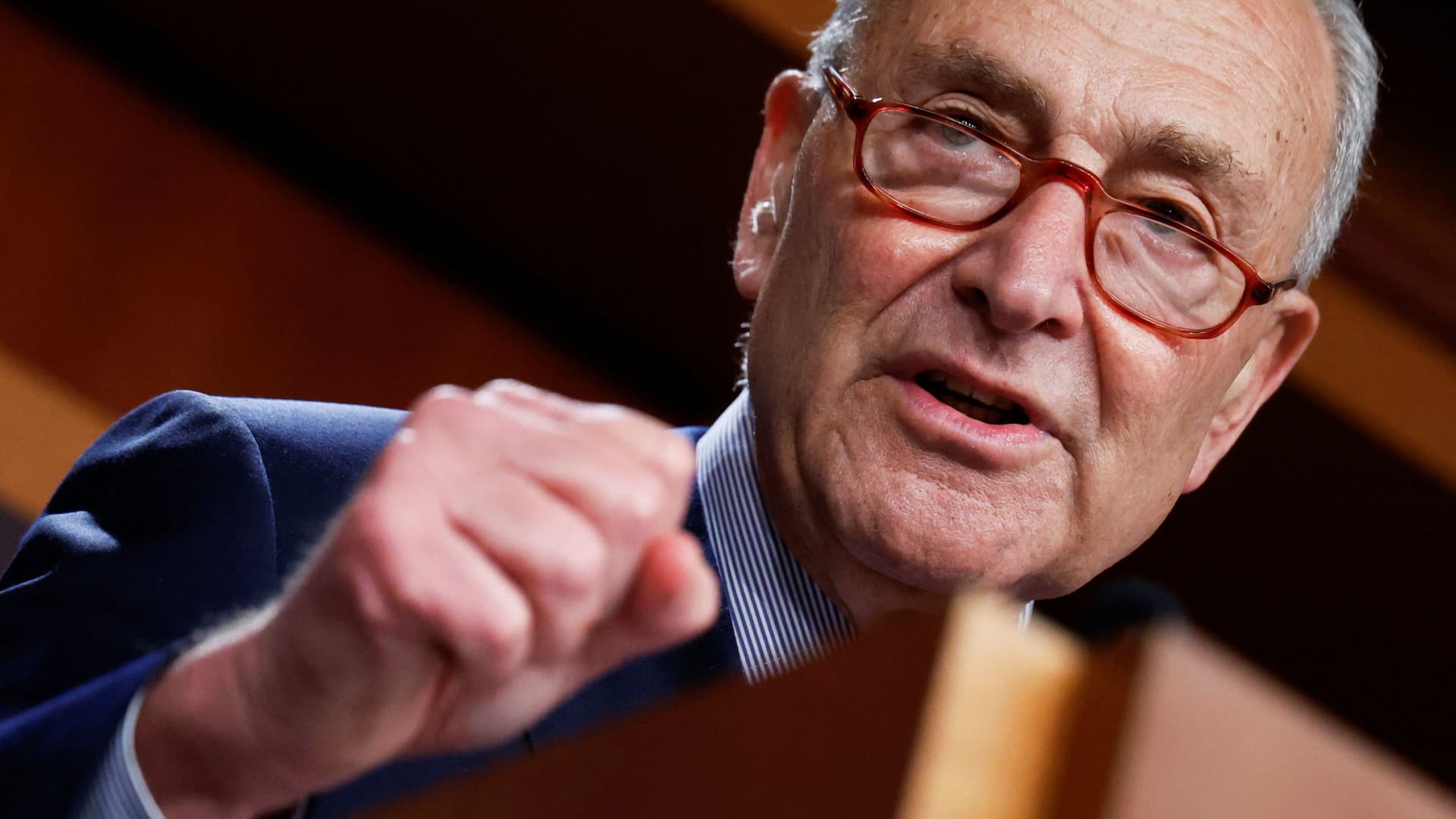
U.S. Senate Majority Leader Chuck Schumer (D-NY) holds his weekly news conference after the Democratic caucus party luncheon at the U.S. Capitol in Washington, August 2, 2022.
Jonathan Ernst | Reuters
The $430 billion climate change, health-care and tax bill passed by the U.S. Senate on Saturday delivers a major win for Democrats, and will help reduce the carbon emissions that drive climate change while also cutting costs for the elderly.
Democrats hope the bill, which they pushed through the Senate over united Republican opposition, will boost their chances in the Nov. 8 midterm elections, when Republicans are favored to recapture the majority in at least one chamber of Congress.
The package, called the Inflation Reduction Act, is a dramatically scaled-back version of a prior bill backed by Democratic President Joe Biden that was blocked by maverick Senate Democrats Joe Manchin and Kyrsten Sinema as too expensive.
"It's what the American people want," Senate Majority Leader Chuck Schumer told reporters. "We're prioritizing the middle class, working families, those struggling to get to the middle class, instead of what Republicans do: prioritize those at the very top."
The Senate's partisan 51-50 vote, with the tiebreaking vote coming from Vice President Kamala Harris, sends the legislation on to the Democratic-controlled House of Representatives, which is expected to pass it on Friday, after which Biden could sign it into law.
Republicans blasted the bill as a spending "wish list" that they argued would hurt an economy weighed down by inflation, saying it would kill jobs, raise energy costs and undermine growth at a time when the economy is facing a potential recession.
"Senate Democrats are misreading the American people's outrage as a mandate for yet another reckless taxing-and-spending spree," top Senate Republican Mitch McConnell said on Saturday. "Democrats want to ram through hundreds of billions of dollars in tax hikes and hundreds of billions of dollars in reckless spending -- and for what?"
About half of Americans -- some 49% -- support the bill, including 69% of Democrats and 34% of Republicans, according to a Reuters/Ipsos poll conducted Aug. 3 and 4. The most popular element of the bill is giving Medicare the power to negotiate drug prices, which 71% of respondents support, including 68% of Republicans.
Economists, who say the legislation could help the Federal Reserve combat inflation, do not expect a sizeable impact on the economy in the coming months.
Climate focus
With $370 billion in climate-focused spending, it would become the most consequential climate change bill ever passed by Congress.
The bill offers businesses and families billions in incentives to encourage purchases of electric vehicles and energy-efficient appliances, as well as to spur new investments in wind and solar power that would double the amount of new, clean electricity-generating capacity coming online in the United States by 2024, according to modeling by the Repeat Project at Princeton University.
That would help put the U.S. on course to meet its pledge to slash its greenhouse gas emissions in half by 2030 below 2005 levels, made at last year's Glasgow climate summit.
While environmental groups largely embraced the bill, they noted that compromises secured by Manchin, who represents coal-producing West Virginia, would prolong U.S. use of fossil fuels.
Those provisions include rules that would only allow the federal government to authorize new wind and solar energy developments on federal land when it is also auctioning rights to drill for oil and natural gas.
Drug costs
The legislation would lower drug costs for the government, employers and patients, said Juliette Cubanski, deputy director of the Medicare program at the Kaiser Family Foundation.
"Perhaps the biggest effect would be for people with prescription drug coverage through Medicare," she said.
A key change is the provision allowing the federal Medicare health plan for older and disabled Americans to negotiate lower prescription drug prices.
The pharmaceutical industry says price negotiation would stifle innovation. Negotiated prices for 10 of the costliest drugs for Medicare would apply starting in 2026, with that number rising until it caps at 20 a year in 2029.
The nonpartisan Congressional Budget Office estimates Medicare would save $101.8 billion over 10 years by negotiating drug prices.
The provision also introduces a $2,000 annual cap on out-of-pocket costs for the elderly through the Medicare program.
Tax provisions
The bill also imposes a new excise tax on stock buybacks, a late change after Sinema raised objections over another provision that would have imposed new levies on carried interest, currently a tax loophole for hedge fund and private equity financiers. The provision was dropped.
The excise tax is expected to raise an additional $70 billion in tax revenue per year, lawmakers said. That is more than the carried interest provision had been forecast to raise.
A report by the nonpartisan Congressional Budget Office released prior to that last change estimated the measure would reduce the federal deficit by a net $101.5 billion over the next decade.
That was about one-third of the $300 billion in deficit reduction predicted by Senate Democrats, but excluded a projected $204 billion revenue gain from increased Internal Revenue Service enforcement.
Extreme weather events like the deadly wildfires and flood-causing rains simultaneously gripping the world are signs of a looming climate emergency, according to a young environmentalist.
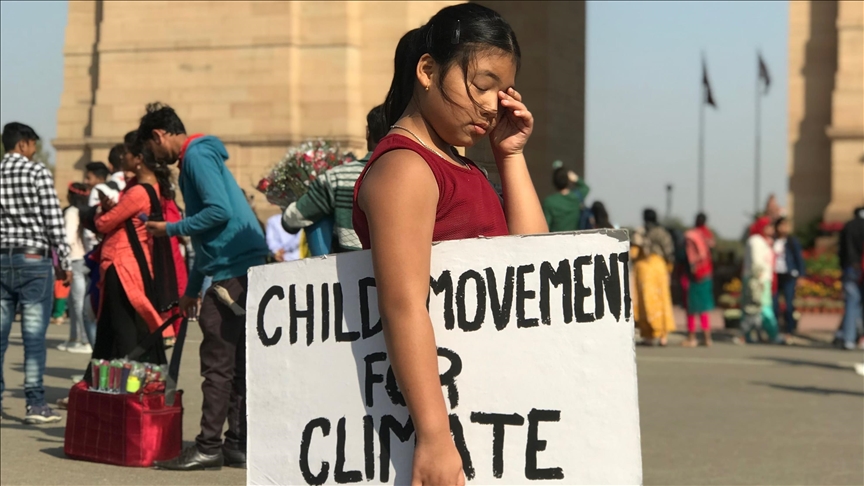
Speaking to Anadolu Agency, Indian climate activist Licypriya Kangujam warned of the increasing frequency and intensity of climate change-linked weather events and called on world leaders to take concrete steps on the matter.
"We want clean air to breathe, clean water to drink, and a clean planet to live (on), so these all are basic rights for all of us," she said.
Defining the reduction of carbon emissions as "the biggest challenge" at the moment, Kangujam said another urgent issue was biodiversity loss related to climate change and that both must be tackled together as "many biodiversity hotspots become climate hotspots."
Pointing to the wildfires, droughts, floods, food shortages, cyclones, heat waves, and air pollution that are currently impacting different parts of the world, she underlined the need for "equal attention and climate justice."
"This is true climate emergency ... These are all the impacts of climate change and our world leaders need to act now as soon as possible" for vows on paper to become action to "save our planet and our future," said the 10-year-old activist who was also a leader of The Child Movement, a climate and child rights group.
While the world must shift to renewable energy to achieve a low-carbon future, she stressed, global events continue to make achieving this goal harder.
"Considering natural gas and nuclear as clean energy is unacceptable at any cost. We want to have clear transition to clean energy," Licypriya underlined, referring to the European Parliament's decision last month backing EU rules labeling investments in gas and nuclear power plants as climate-friendly.
On the move, she said Europe had taken the war in Ukraine as "an excuse" to increase their reliance on fossil fuels, rather than expand the capacity of renewable energy sources.
Simply more 'greenwashing'
The ongoing energy crisis is proof that Europe is fully dependent on fossil fuels and will not quit them easily in the next few decades despite ambitious plans under the Paris climate agreement, Licypriya stated.
Signed on Dec. 12, 2015, the accord sets out a global framework to avoid dangerous levels of climate change by limiting global warming to well below 2C and pursuing efforts to limit it to 1.5C. To achieve this, the Paris deal focuses on lowering greenhouse gas emissions through a system of pledge and review.
The EU wants to encourage private investment in natural gas and nuclear, making it "very difficult" to make the transition from fossil fuels, particularly coal, to clean energy, warned Licypriya, arguing that this amounted to simply another case of "greenwashing."
In response to a question on the main focus of an upcoming global climate strike on Sept. 23, the Indian activist pointed to the climate crisis of the global south.
"We will draw the attention to our world leaders and also to the global media to stop neglecting the voice of the global south when we suffer the most. We want a concrete climate solution now," she added.
On how climate activism has developed in recent times, especially with the COVID-19 pandemic, Licypriya highlighted that online climate activism had gained huge momentum during the lockdowns all over the world.
"In street demonstrations, we need physical presence which is difficult for everyone. Now, the participation in climate activism is in huge increase all over the world after the pandemic."
The logo of the Government of Singapore Investment Corp. (GIC)
Munshi Ahmed | Bloomberg | Getty Images
Singapore's sovereign wealth fund GIC reported stable returns for the year but warned of "profound uncertainties" as investors face worries about inflation, pandemic risks and geopolitical challenges.
The fund's portfolio recorded an annualized dollar nominal rate of return of 7% over a 20-year period ending March 31, 2022, GIC said in its annual report published on Wednesday.
It also achieved an annualized rolling 20-year real rate of return of 4.2 % for the period ending March 31, after stripping away inflation. GIC doesn't publish annual results.
Still GIC, which is among the world's largest investors, painted a rather bleak picture of the global environment.
"Years of concerns over deflation have turned into worries of elevated inflation, forcing economic policymakers to reverse stimulus policies," said Chief Executive Lim Chow Kiat in the report.
"At the same time, the clock for the climate crisis is ticking, pandemic risk lingers on, and geopolitical conflicts and domestic political schisms are growing. There are no easy choices for policymakers and business leaders, and in turn, for investors."
Rising inflation
Given these uncertainties, we have doubled down on our core investment principles — diversify our portfolio, take the long view, and emphasize preparing rather than predicting.
As a result, the CEO said he expects portfolio diversification to be "more challenging as few assets are spared from the effects of worsening inflation and slower economic growth."
GIC said its diversified portfolio and cautious investment stance helped cushion its performance from the market correction that occurred in early 2022.
"Given these uncertainties, we have doubled down on our core investment principles — diversify our portfolio, take the long view, and emphasize preparing rather than predicting," Lim said in the report.
Amid the global shift to a low-carbon economy, the fund announced it has set up a dedicated office focusing on sustainability, to ramp up focus on that front.
The new office will deepen research into critical issues and integrate sustainability further into all its investment and corporate processes, GIC said as part of the release of its annual report.
Destructive fires in recent years that burned too hot for forests to quickly regrow have far outpaced the US government's capacity to replant trees.
Blazes have charred 5.6 million acres so far in the US this year.
(AP Archive)
The Biden administration has said the government will plant more than one billion trees across millions of acres of burned and dead woodlands in the US West, as officials struggle to counter the increasing toll on the nation's forests from wildfires, insects and other manifestations of the climate crisis.
"Our forests, rural communities, agriculture and economy are connected across a shared landscape and their existence is at stake," Agriculture Secretary Tom Vilsack said in a statement on Monday announcing the reforestation plan.
"Only through bold, climate-smart actions ... can we ensure their future."
Destructive fires in recent years that burned too hot for forests to regrow naturally have far outpaced the government's capacity to plant new trees. That has created a backlog of 4.1 million acres in need of replanting, officials said.
The US Agriculture Department said it will have to quadruple the number of tree seedlings produced by nurseries to get through the backlog and meet future needs.
That comes after Congress last year passed bipartisan legislation directing the Forest Service to plant 1.2 billion trees over the next decade and after President Joe Biden in April ordered the agency to make the nation's forests more resilient as the globe gets hotter.
Officials had to pursue a more piecemeal approach with incremental measures such as Monday's announcement since most of the administration's agenda on the climate crisis remains stalled due to disagreements within Congress.
To erase the backlog of decimated forest acreage, the Forest Service plans over the next couple of years to scale up work from about 60,000 acres replanted last year to about 400,000 acres annually, officials said.
Blazes have charred 5.6 million acres so far in the US this year, putting 2022 on track to match or exceed the record-setting 2015 fire season, when 10.1 million acres burned.
Many forests regenerate naturally after fires, but if the blazes get too intense they can leave behind barren landscapes that linger for decades before trees come back.
The Forest Service this year is spending more than $100 million on reforestation work and is expected to further increase in coming years, to as much as $260 million annually.
To prevent replanted areas from becoming similarly overgrown, practices are changing so reforested stands are less dense with trees and therefore less fire-prone, said Joe Fargione, science director for North America at the Nature Conservancy.
But challenges to the Forest Service's goal remain, from finding enough seeds to hiring enough workers to plant them, Fargione said.
Many seedlings will die before reaching maturity due to drought and insects, both of which can be exacerbated by the climate crisis.
Living trees are a major “sink” for carbon dioxide that’s driving the climate crisis when it enters the atmosphere, Fargione said. That means replacing those that die is important to keep climate change from getting even worse.
A destructive wildfire near Yosemite National Park burned out of control through tinder-dry forest on Sunday and had grown into one of California's biggest blazes of the year, forcing thousands of residents to flee remote mountain communities.
Some 2,000 firefighters battled the Oak Fire, along with aircraft and bulldozers, facing tough conditions that include steep terrain, sweltering temperatures and low humidity, according to the California Department of Forestry and Fire Protection, or Cal Fire.
"It's hot out there again today," Cal Fire spokesperson Natasha Fouts said Sunday. "And the fuel moisture levels are critically low."
Crews on the ground protected homes as air tankers dropped retardant on 50-foot (15-meter) flames racing along ridgetops east of the tiny community of Jerseydale.
Light winds blew embers ahead into tree branches "and because it's so dry, it's easy for the spot fires to get established and that's what fuels the growth," Fouts said.
The fire erupted Friday southwest of the park near the town of Midpines in Mariposa County. Officials described "explosive fire behavior" on Saturday as flames made runs through bone-dry vegetation caused by the worst drought in decades.
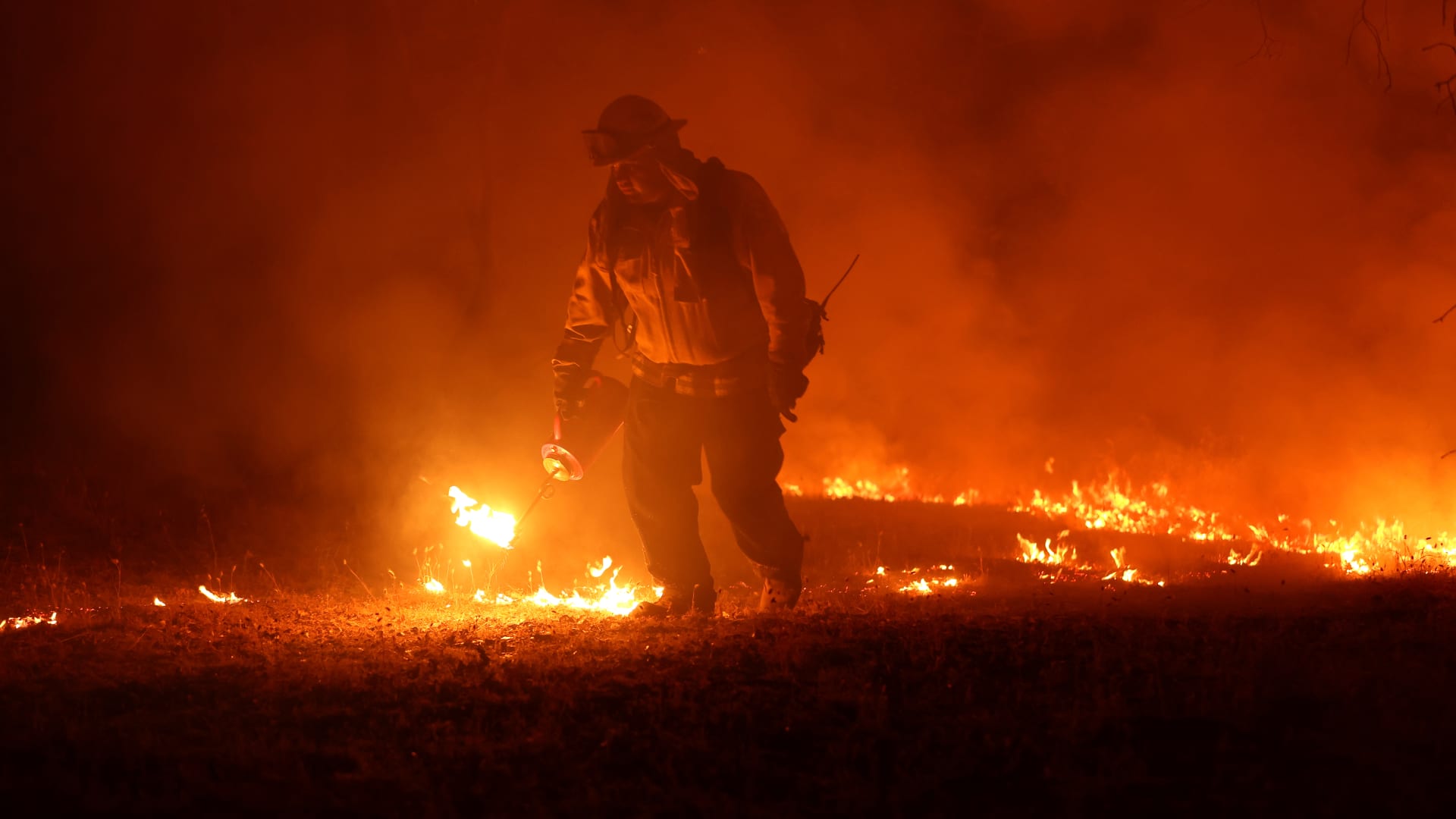
A California firefighter lights a backfire while battling the Oak Fire on July 23, 2022 near Mariposa, California.
By Sunday the blaze had consumed more than 22 square miles (56 square km) of forest land, with no containment, Cal Fire said. The cause was under investigation.
Evacuations were in place for over 6,000 people living across a several-mile span of the sparsely populated area in the Sierra Nevada foothills, though a handful of residents defied the orders and stayed behind, said Adrienne Freeman with the U.S. Forest Service.
"We urge people to evacuate when told," she said. "This fire is moving very fast."
Lynda Reynolds-Brown and her husband Aubrey awaited news about the fate of their home from an evacuation center at an elementary school. They fled as ash rained down and the fire descended a hill towards their property.
"It just seemed like it was above our house and coming our way really quickly," Reynolds-Brown told KCRA-TV.
Gov. Gavin Newsom proclaimed a state of emergency for Mariposa County due to the fire's effects.
Flames destroyed at least 10 residential and commercial structures and damaged five others, Cal Fire said. Assessment teams were moving through mountain towns to check for additional damage, Fouts said.
Numerous roads were closed, including a stretch of State Route 140 that's one of the main routes into Yosemite.
California has experienced increasingly larger and deadlier wildfires in recent years as climate change has made the West much warmer and drier over the past 30 years. Scientists have said weather will continue to be more extreme and wildfires more frequent, destructive and unpredictable.
Pacific Gas & Electric said on its website that more than 3,100 homes and businesses in the area had lost power as of Sunday and there was no indication when it would be restored. "PG&E is unable to access the affected equipment," the utility said as flames roared Friday.
The Oak Fire was sparked as firefighters made progress against an earlier blaze, the Washburn Fire, that burned to the edge of a grove of giant sequoias in the southernmost part of Yosemite National Park. The 7.5-square-mile (19-square-km) fire was nearly 80% contained after burning for two weeks and moving into the Sierra National Forest.